Feature
What Is Animal Welfare Worth? Economists Have a New Way to Calculate It
Research•7 min read
Feature
New technology can detect pain in farm animals, but critics say it may do more to bolster the system than improve it.
Feature • Science • Technology

Words by Emily Payne
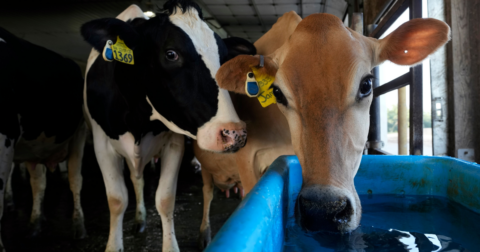
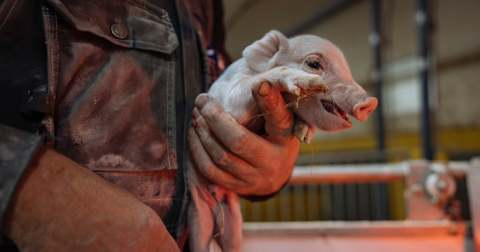
A cow favors one leg. A chicken breathes with their beak slightly open. A goat spends a little more time lying down, a little less time eating. A pig pins their ears back, or squeals at a higher pitch. All of these subtle changes can signal pain in farm animals before more obvious signs of suffering appear.
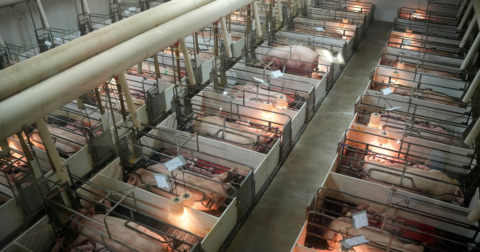
But on modern factory farms housing hundreds to tens of thousands of animals, those signals are easily missed.
Researchers and technologists are exploring an emerging technology known as automated pain detection to help farmers identify health problems in animals earlier and relieve their pain faster.
While the technology remains largely experimental for livestock, interest is accelerating. A growing body of research is assessing whether artificial intelligence can recognize pain in farm animals using facial expressions, gait, vocalizations and other behavioral cues. And recently a handful of startups have begun developing commercial applications.
Automated pain detection systems combine cameras, microphones and other sensors — measuring signals like facial expressions, posture, gait, vocalizations or body temperature — with machine learning to identify behaviors and physiological changes associated with pain or distress.
Supporters see the technology as a way to improve the lives of billions of farm animals worldwide. But critics worry that this type of optimization could make highly intensive, cramped environments even more economically viable, risking further expansion of factory farms while avoiding animal welfare problems inherent to the industrial farming system — in addition to concerns about worker surveillance.
Whether automated pain detection ultimately improves animal welfare, researchers say, may depend less on the technology itself than on the industrial food system in which it is deployed.
One of the biggest challenges in improving farm animal welfare is that animals cannot simply tell humans when something is wrong. Farmers and veterinarians generally identify pain through observed behavioral changes, such as an animal walking differently, becoming lethargic or losing their appetite.
But before those signs are obvious, the animal may already have been suffering for some time. Automated pain detection aims to help farmers intervene earlier.
“Moving the needle from reactive to proactive” by using predictive AI, “that’s the ultimate goal,” says Suresh Raja, professor at Dalhousie University, who also founded a tech company that is working to democratize automated pain detection for farm animals.
Pain indicators vary by species, Raja explains. Cattle’s facial muscle movements are often highly informative, but chickens’ smaller faces offer fewer visual signals, so researchers look instead to subtler cues such as how chickens blink their eyes, direct their gazes or vocalize. Because automated pain detection systems analyze all of these factors continuously, they can identify nuances and patterns that would be impossible for humans to see, according to Raja.
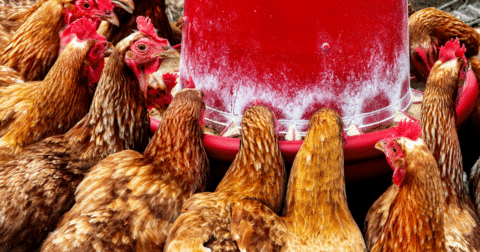
In the United States and Canada, a typical commercial broiler shed holds roughly 20,000 to 40,000 chickens, with some large farms holding 60,000 per shed. “When you walk into a broiler facility … For a human they all look the same,” says Raja. “But when we use AI computer vision, they can find out those smaller subtle differences which we cannot see with the naked eye … the AI can do that within a fraction of a second.”
Deep learning models have proven effective in studies, predicting acute pain in goats with above 60 to 80% accuracy using only facial cues, and predicting cattle pain at accuracy rates comparable to trained veterinarians (about 97%). And as more training data is gathered, the systems are expected to become more accurate.
Raja says there is “a lot of convergence happening” within the industry to help scale these technologies, including potential data-sharing agreements to bring animal health data together across the various commercial entities on a typical farm — for example, cattle neck collar providers or milk testers. In the past few years, a handful of startups have emerged that use video analytics and acoustic sensors to identify animals in distress.
But pain and quality of life are both hard to measure and hard to define, which make them especially difficult for technology to solve. Critics of automated pain detection argue that reducing pain to a collection of measurable signals risks overlooking important aspects of animal welfare — and diverting attention from the conditions that cause suffering in the first place.
“Taking care of animals requires more than limiting negative experiences,” Jeff Sebo, a professor of environmental studies at New York University, tells Sentient in an email. “It also requires giving animals the opportunity to pursue positive experiences, express their agency, maintain social relationships and more.”
In an AI and Ethics paper published this year, researchers argued that many causes of farm animal pain are already well understood, and resources should go toward preventing those problems rather than only detecting them after they occur.
“There is no need for an advanced machine learning algorithm to realize (and respond to) the pain of animals,” the researchers write. “Disease, poor housing, painful routine practices, bad handling and parturition cause pain.”
Furthermore, the researchers argue that artificial intelligence-based pain detection systems could reduce animal welfare to only what algorithms can measure, which risks overlooking less easily detected conditions in industrial animal agriculture.
“Inherent in the technology as a risk is that it could lead to an oversimplified perspective on the animal and on animals’ pain,” co-author Leonie Bossert tells Sentient. Bossert is a postdoctoral researcher in animal and AI ethics at the University of Vienna. “Providing an animal with a good life of course also means much more than just not trying [to have] these animals in pain.”
This points to broader ethical questions about industrial animal agriculture itself, which automated pain detection is unable to address, even though it may benefit animal welfare in the short term.
Further, Sebo writes, the technology could simply serve as public relations for a harmful industry: “It could make it easier for producers to humanewash a fundamentally harmful system, marketing factory farming as animal-friendly while continuing to confine, exploit and slaughter vast numbers of animals unnecessarily.”
The industry’s embrace of “precision agriculture,” which is a broad field aimed at optimizing farm management, including automated pain detection, generally promotes highly integrated, corporate-controlled ecosystems.
The International Panel of Experts on Sustainable Food Systems, an independent panel of scientists, food policy experts and farmers, released a report this year warning that these types of innovations could lock agriculture “into high-cost, high-energy, and high-input pathways.”
Researchers argue that for automated pain detection to meaningfully improve animal welfare in the agriculture industry, there must be an open conversation about who, or what, is actually benefiting.
“If we want to use this technology in a responsible way, then really the interest of the animals has to be in the focus … even if the farmers or the industry won’t benefit from it,” says Bossert. For her, automated pain detection would ideally serve as an early warning system, followed by a trained veterinarian’s evaluation.
Raja agrees that automated pain detection should serve as a decision-support tool, not a decision-maker, and warns against an overreliance on the technology. Farmers, veterinarians, policymakers and animal welfare experts all need a role in shaping how the technology is deployed, he says.
However, these technologies will likely be most accessible to and useful for factory farms, which must monitor hundreds to tens of thousands of animals at once — an industry known to be riddled with animal welfare and cruelty issues. Bossert expects automated pain detection to become another component of precision livestock farming, making farms “more profitable and more efficient.”
“We think the risk must be taken seriously that the development of automated pain detection may align more closely with the interests of the animal farming industry than with the welfare of affected animals,” Bossert and her co-author write in their recent paper.
For Sebo, “better than current factory farming” is a low bar. Instead, he wonders whether automated pain detection could be used to support system-wide change away from these harmful systems to reduce animal suffering.
“The question for me is not only whether automated pain detection can make a bad system somewhat less bad, but also whether it can support a transition to a fundamentally different kind of system.”
Emily Payne is a journalist covering the intersection of food, agriculture, health and climate. Currently based in Denver, Colorado.

Feature
Culture•7 min read
Perspective
If you’re looking to reduce your water impact, eating less meat is a great place to start.
Culture•8 min read

Solutions
A 60-year mystery has been solved as researchers discover a coral ecosystem on the Benin-Togo continental shelf that is still teeming with marine life.
Research•5 min read