News
Trump’s Beef Import Plan Could Bring Down Prices — and Drive Up Emissions
Climate•4 min read
News
Warming waters alter where fish and shellfish live, push them beyond what they can tolerate and increase risk of disease.

Words by Gaea Cabico
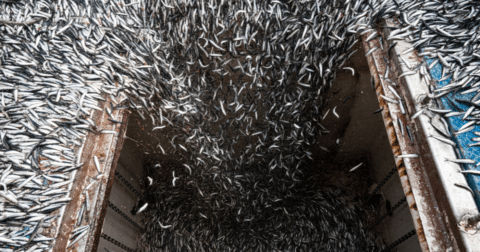
Last month, Peru closed its anchovy fisheries after catching less than a quarter of its quota due to the El Niño-linked unusually warm waters that drove the small, silver fish to seek cooler and deeper waters beyond the fleet’s reach. Much of the world’s fishmeal and fish oil comes from anchovies caught off the coast of Peru. These products are used as ingredients in feed for farmed fish and other animals, as well as in some dietary supplements. Removing large quantities of these tiny fish can reduce the ocean’s ability to store carbon and deprive larger fish and marine mammals of food, contributing to population declines.
Every few years the phenomenon El Niño alters conditions of oceans around the world, and the World Meteorological Organization warns it could be intense this season given how much it has warmed the tropical Pacific already. Meanwhile, marine heatwaves that have been persistent since 2025 have made the waters along the U.S. West Coast unusually warm. Fishers have reportedly caught Pacific thread herring and striped marlin north of their usual ranges, as far north as California, according to researchers, and Washington, respectively.
But marine heatwaves and El Niño do much more than raise water temperatures. Sea creatures can be forced to live in environments where they struggle to survive, pushing them past their physiological limits or making them more vulnerable to disease and, in extreme cases, causing mass mortality. For example, a severe marine heatwave in the Red Sea coincided with a mass fish die-off of nearly 1,000 fish, while a heatwave in Alaska killed an estimated 4 million common murres — black and white seabirds — through starvation. More broadly, marine heatwaves were linked to population declines of up to 43% among fish living near the warmest edges of their usual ranges.
Marine heatwaves can be devastating for animals because a sudden spike in temperature means the animals “cannot adjust to the high temperature or cannot leave the environment,” William Cheung, a professor who studies oceans and fisheries at the University of British Columbia, tells Sentient. They may experience mass mortality, Cheung says, like what happened during the “Blob,” a massive marine heatwave in the northeast Pacific. It lasted from 2013 to 2016 and stretched from Alaska to Mexico.
The Blob’s effects rippled through the marine food web: Pacific cod populations in Alaska plummeted, salmon runs suffered as warm water degraded food quality for young fish entering the ocean and declines in krill affected animals higher up the food chain. Kelp forests withered. Millions of seabirds died. Toxic algae blooms also forced closures of Dungeness crab and clam fisheries in California and Washington.
Similar disruptions unfolded on the other side of the U.S. in 2012, where waters off the Gulf of Maine rose to temperatures high enough, notes Bigelow Laboratory for Ocean Sciences senior research scientist Nick Record, to match conditions researchers had not expected to see until 2100.
The warmer waters prompted lobster to molt and move into shallower waters earlier in the season, resulting in an unusually large catch that overwhelmed processors and sent prices plummeting. Maine is the country’s largest lobster-producing state. Meanwhile, the distribution of plankton had changed. As a crucial part of the North Atlantic right whales’ diet, like much of ocean animals, the massive mammals were forced outside protected areas, bringing them into contact with fishing gear and shipping traffic, says Record.
The Gulf of Maine has since cooled, but Record cautions against reading that as a return to normal. “We’re still warming. This cold condition would have been like an average condition 20 years ago, but it’s cold now.”
Warmer water doesn’t just move fish around; it can also make them more vulnerable to disease. Maya Groner, a quantitative marine disease ecologist at Bigelow, says that when water temperatures rise beyond what an animal can comfortably tolerate, its “performance and fitness can decline really, really dramatically” and its immune defenses can become less effective. Warmer water also makes animals burn more energy, meaning they need more food to stay healthy. “If they’re not getting that, then they can be sort of more in a weaker condition and more susceptible to infection,” she tells Sentient.
Among the diseases Groner is watching most closely is Vibrio vulnificus, a bacterium that can contaminate shellfish, and if eaten raw, a person can get an infection that can progress rapidly to sepsis and death in severe cases. Historically, Vibrio has been associated with warmer waters, but it has been found in cooler regions, including the Northeast United States.
Warmer conditions are associated with many other diseases, such as pacific oyster mortality syndrome, sea star wasting and Ichthyophonus, a parasite that has been linked to the decline in Chinook salmon in Alaska’s Yukon River.
Farmed fish are particularly vulnerable to disease outbreaks because they are kept in close proximity and have little room to escape harmful conditions. In Northern Norway, an intense marine heatwave in August 2024 contributed to unprecedented salmon lice outbreaks at fish farms, resulting in major die-offs. The outbreak was compounded by the large growth in the aquaculture industry in the region, with limited capacity to remove the parasite.
According to Groner, aquaculture operators are able to monitor and intervene to halt disease spread. Operators can adjust harvest timing, cull infected stock, vaccinate and selectively breed for heat tolerance and disease resistance, Groner says.
El Niño-driven warming can extend deeper into the ocean and weaken the wind-driven upwelling that normally cools West Coast waters and brings nutrients to the surface, explains Michael Milstein, public affairs officer of the NOAA West Coast Region.“The warmer temperatures associated with El Niño hug the coastline, which can bring species that prefer warmer waters closer to the coast, making them more accessible to fishing,” Milstein tells Sentient in an email.
A new market squid fishery emerged in Oregon after the species shifted north during the Blob and the El Niño that followed, while California’s squid landings fell sharply.
Other marine species benefit as well. “Anchovy and rockfishes seem to benefit, which may be contingent upon areas of favorable habitat persisting through the event, but this is currently something difficult to predict,” researchers at California Cooperative Oceanic Fisheries Investigations, write in an email to Sentient.
The arrival of warm-water migratory species such as tuna and dorado may change fishing patterns in California, the researchers also say. Because these species are popular with recreational anglers, fishers may target them instead of cooler-water resident targets such as rockfish, potentially easing pressure on those cooler-water dwellers.
To keep pace with a more unstable ocean, fisheries management will need to be more dynamic, Record says. That means adapting fisheries decisions based on changing ocean conditions rather than relying solely on historical patterns. “It requires more monitoring. It requires this thought process of playing out scenarios like: ‘What if they show up here this year?’”
For managers, the speed of change is increasingly important as fish move into new waters. “Many fishes are spatially managed and if new fish show up in locations where they were previously not caught, then management decisions will have to be made more rapidly than normal,” the California Cooperative Oceanic Fisheries Investigations says. Seasonal forecasts can give managers a head start. El Nino and marine heatwaves can be predicted up to six months in advance.
But forecasts come with uncertainty, Groner says, and scientists should be upfront about the limits of their knowledge. Groner believes scientists need to communicate not only what they expect to happen but also what they don’t know.
Gaea Cabico is Sentient's editorial fellow, and an award-winning journalist from the Philippines who reports on climate change, environmental issues and energy through a social justice lens. She holds a master's degree in science journalism from New York University.
News
Climate•8 min read
Feature
Iceland said “No” to joining the European Union this weekend, choosing to shield its marine resources from rampant overfishing.
Climate•3 min read
News
Animal agriculture drives 71% of biodiversity damage from food production on farmland.
Climate•5 min read