Investigation
Lame, Suffocated and Dead: The Drug Supersizing America’s Cattle
Food•19 min read
News
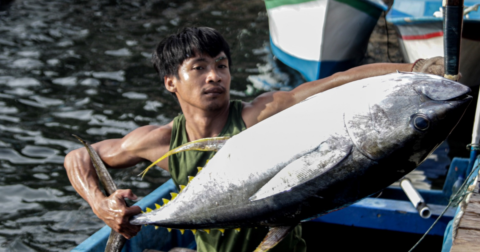
Small-scale fisheries mostly feed local communities, providing essential nutrients to around 2.3 billion people.

Words by Gaea Cabico
Industrial fishing harms small-scale fisheries, a vital source of food and nutrition for billions of people, particularly in coastal communities that depend on local catches. Perversely, the risk of conflict with industrial fleets is often greatest where small-scale fisheries contribute most to people’s diets. The governments of these nations also tend to have the least capacity to manage those conflicts.
That’s the central finding of a new index of 126 coastal countries, published in the journal Nature Food, which identifies hotspots where small-scale fishers are most vulnerable to conflict with industrial fishing vessels. Africa is the most vulnerable region, followed by Oceania, Asia and Central America. Guinea, Sierra Leone and Mozambique rank highest among individual countries. No country in Europe or North America was classified as highly vulnerable — to some degree this is due to stronger regulations, but also many of these countries rely more on imported seafood and less on local catches. The United States, for instance, imports around 82% of its seafood from other countries, and the EU imports a majority of its seafood as well.
The study also identifies countries where exposure to industrial fishing was unexpectedly low, which could offer clues on how to reduce conflict.
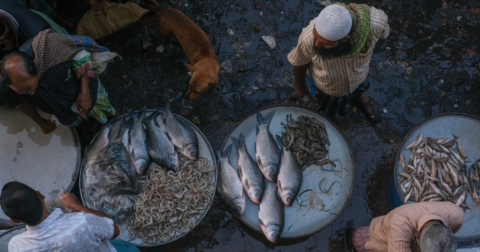
Much of the fish caught by small-scale fisheries stays close to home to feed local communities. Globally, small-scale fisheries supply at least 40% of the world’s wild-caught fish and are an important source of essential nutrients for 2.3 billion people.
The findings are particularly concerning because a country’s reliance on small-scale fisheries for nutrition is the strongest predictor of its vulnerability, says Melissa Cronin, an assistant professor at University of Massachusetts Dartmouth and the study’s lead author. “This conflict is occurring in the places where people are literally eating and surviving off of the small-scale fishery the most,” Cronin tells Sentient.
Industrial fleets can block small-scale fishers from fishing grounds and compete for the same fish, meaning there’s less food for coastal communities because small-scale catch mostly stays local. By contrast, much of the catch from the industrial fleet is exported and some is turned into fishmeal to feed farmed fish and livestock. Industrial fishing can also drive up fish prices at local markets, making fish too expensive for locals.
The researchers’ index offers a picture of where tensions could grow as climate change shifts fish populations, demand for seafood increases and governments expand “blue economy” plans — aquaculture, tourism, energy and mining — in coastal waters. Cronin hopes that countries will use the index to assess the potential risks before expanding industrial fishing or granting foreign fleets access to their waters.
The paper advances research on fisheries conflict beyond individual case studies by offering a global comparative framework, Rashid Sumaila, a professor at University of British Columbia who was not involved in the study, tells Sentient in an email. But it falls short of quantifying the economic losses small-scale fishers suffer from competition. Cronin says the paper is meant to be an “agenda-setting” study that lays the groundwork for further research into how these conflicts unfold on the ground.
To assess vulnerability across coastal countries, the researchers looked at three things: how much industrial fishing overlaps with small-scale fishing geographically, how heavily countries rely on small-scale fisheries for food and livelihood, and how well their governments can manage the impacts of interactions between the two. To track industrial fishing, they examined vessel activity within 25 kilometers of shore between 2017 and 2021.
The index measures the risk of conflict, not actual clashes, which are difficult to track.
About 90% of the industrial fishing ships in the study that could be identified were trawlers, Cronin says. The data, however, do not distinguish between midwater trawlers, which can compete more directly with small-scale fishers, and bottom trawlers, which drag heavily weighted nets along the seafloor and can cause serious damage to habitats.
The researchers also identified 15 outlier countries with unexpectedly low exposure to industrial fishing, including Libya, Yemen, Greece, Comoros and the Solomon Islands. They say these “bright spots” could inform proactive policy, though low exposure today does not guarantee it will last as these countries could become more vulnerable if industrial fishing expands in nearshore waters.
Cronin says political instability may be a factor in places like Yemen, where industrial fleets may be staying away because it is not safe to fish. Other possible explanations include proactive policies that reduce conflict, fewer subsidies or no foreign fishing agreements.
To reduce the vulnerability of small-scale fishers to industrial fleets, the authors recommend that governments limit subsidies — such as credits, loans and fuel assistance — for large-scale fleets. “Many of these large-scale fleets are enabled to fish by fuel subsidies” and other government assistance, Cronin says. They “can just get really discounted fuel, and so you’re able to fish much more.” Industrial fishers receive about 3.5 times more subsidies per capita than small-scale fishers, even though small-scale fishers account for roughly 90% of fisheries jobs worldwide.
“This is really highly problematic in situations where both sectors are fishing in the same waters and competing for similar fish stocks, and especially when the small scale or coastal fleet is really important for nutrition and food security,” Elena Finkbeiner, director of coastal community fisheries at nonprofit organization Conservation International and one of the study’s authors, tells Sentient.
A World Trade Organization agreement that took effect in 2025 bans subsidies for illegal, unreported and unregulated fishing and for fishing overfished stocks. Finkbeiner calls it a step in the right direction, but says its impacts remain to be seen.
The authors also recommend that governments negotiate fairer access agreements with distant-water fleets, which are large fishing vessels that operate in other countries’ waters or on the high seas. The authors note that past fishing agreements have often failed to deliver lasting benefits for host countries.
Another recommendation is that countries implement the Voluntary Guidelines for Securing Sustainable Small-Scale Fisheries, a United Nations framework that takes a human rights-based approach to supporting small-scale fishers and fish workers. One element of the guidelines is the creation of preferential access areas: zones where industrial fishing is restricted or banned to protect small-scale fishers.
At least 44 countries have established preferential access areas. The study found that these countries tend to be more vulnerable to conflict, raising the question: Are they working? The researchers suggest that these policies may be reactive, adopted in response to past or ongoing conflict with large-scale fleets. Cronin also says that without effective enforcement, the preferential access areas may not be enough on their own “to resolve or reduce conflict risk.”
Finkbeiner says the index needs to be updated continuously and treated as a prompt for deeper inquiry, not taken at face value. Cronin says the next step for the research is to find case studies that show what these conflicts actually look like and to “understand what solutions countries and fishing communities have figured out,” she says.
Cronin also points to ongoing global discussions on how to cut subsidies for large industrial fishing fleets. “There’s been a lot of conversation, like at the World Trade Organization, about addressing and reducing those subsidies,” she says, so that the industrial fishing industry is “actually paying the true cost of fishing, or at least something closer to it.”
Gaea Cabico is Sentient's editorial fellow, and an award-winning journalist from the Philippines who reports on climate change, environmental issues and energy through a social justice lens. She holds a master's degree in science journalism from New York University.
Feature
Food•11 min read
Investigation
Neither StarKist nor its parent company responded to union leaders' requests to negotiate amid the allegations raised in an investigation by Global Labor Justice.
Food•8 min read
News
Biologists are uncovering short-term and long-term genetic changes in fish biology.
Fisheries & Aquaculture•8 min read