Explainer
Why Beef Is Bad for Climate Change, Explained
Climate•5 min read
News
A new report argues that focusing solely on climate emissions can result in breeding programs that increase animal suffering.

Words by Emily Payne
Breeding farm animals for higher productivity has long been presented as a climate win: chickens that grow faster, cows that gain weight quicker and hens that lay more eggs. But a new report from a U.K. government advisory committee warns that breeding animals for maximum yields and lower emissions may also intensify animal suffering.
The recently released U.K. Animal Welfare Committee report argues that when sustainability efforts focus narrowly on cutting emissions, they risk incentivizing breeding programs that leave animals prone to pain, disease and physical dysfunction. And because a handful of multinational firms dominate global livestock genetics, those breeding decisions shape the lives of billions of farm animals worldwide.
“Whenever we optimize for one value, we risk undermining another. The history of farmed animal breeding makes this clear,” Jeff Sebo, professor and co-director of the Wild Animal Welfare Program at New York University, tells Sentient in an email about the report. “Selecting for fast growth and high yields has repeatedly produced animals who struggle to move, reproduce or live naturally.”
The U.K. report authors note that most definitions of “sustainability” do not explicitly include any animal welfare considerations, and this risks perpetuating breeding programs that cause harm. The livestock industry has been breeding animals with the aim of enhancing productivity since the 18th century, long before corporate sustainability goals.
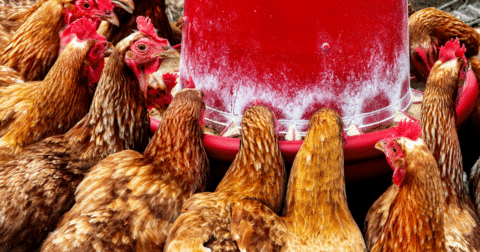
Broiler chickens, for example, have been genetically selected to grow rapidly and produce larger muscles, with growth rates climbing by more than 400% between 1957 and 2005. These traits are associated with painful leg problems, cardiovascular disorders, limited mobility and higher mortality rates in chickens.
Other livestock industry sectors have seen similar trends: Some modern hens’ laying cycles can exceed 500 eggs, compared to an average of about 85 eggs per cycle in the early 1900s. This forces the hens to draw from their own bone calcium to produce shells, leading many to develop osteoporosis and become susceptible to bone fractures.
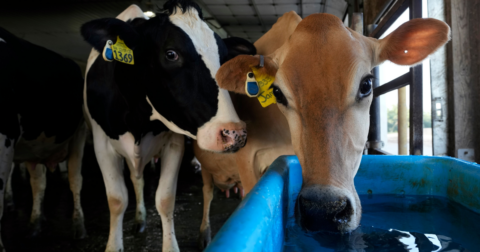
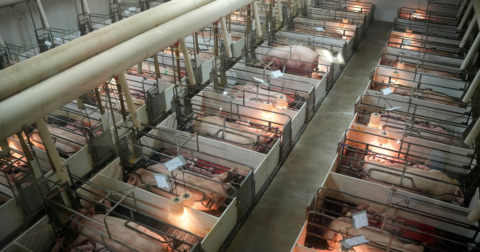
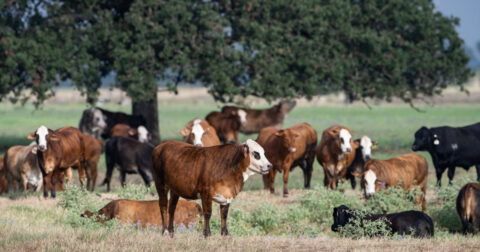
Meanwhile, breeding sows for large litters compromises the welfare of both the sows and piglets. Many cattle — whose average weight has increased by about 45% from 1975 to 2024 in the U.S. — experience a growing list of health concerns tied to this weight gain, including difficulty walking, heat stress, liver abscesses, congestive heart failure and deaths during the final stages of feedyard production.
Despite their impact on animal welfare, increases in production efficiency are typically considered beneficial for climate change. More efficient livestock farms — achieved through advanced genetics and breeding, among other factors — reduce the resources and time required to produce each pound of meat, milk or eggs, which lowers what’s called the emission intensity, or the amount of greenhouse gases emitted per animal unit.
“These [corporate sustainability] frameworks tend to measure emissions per unit of output, which can make swapping one animal product for another look like progress even if much more animal suffering and death is required to produce that product,” writes Sebo.
Switching from fast-growing to slower-growing chicken breeds could prevent 15 to 100 hours of suffering per bird, Sentient previously reported. But the switch would increase emissions by about 1 kilogram of carbon dioxide equivalent per kilogram of chicken — going against some companies’ emissions reduction goals.
The global animal agriculture industry is valued at up to $3.3 trillion, and just a handful of multinational breeding firms and shared genetic lines produce about 100 billion farm animals each year — meaning that breeding decisions typically have global consequences.
However, there is no international group tasked with assessing animal welfare, like the Intergovernmental Panel on Climate Change, and the topic remains peripheral at major negotiations like the U.N. Climate Conference.
“There is a lot greater public and policymaker pressure for companies to develop climate commitments” than animal welfare commitments, says Dan Blaustein-Rejto, director of food and agriculture at the pro-technology environmental non-profit the Breakthrough Institute. But he argues that the climate and animal welfare goals are not always in conflict.
“Some of the clearest climate wins or improvements come from healthier animals … there’s a lot of overlap between the climate community and the welfare community that is often missed,” says Blaustein-Rejto, pointing to interventions to reduce mastitis and other diseases as examples.
“If you improve the health of animals, that normally improves their capacity to transform feed into protein, either meat or milk, which reduces the emission intensity,” says Pol Llonch Obiols, professor and researcher at Autonomous University of Barcelona in the Department of Animal and Food Science.
Both greenhouse gas emissions and animal welfare also vary significantly between farm animal species. For example, in general, beef cattle experience far better welfare than chickens, but also produce more greenhouse gas emissions.
In addition, “animal welfare” can mean different things to different researchers or stakeholders. Food companies tend to define animal welfare in terms of healthy and productive animals, while animal advocates aim to minimize animal suffering, and abolitionists believe animal agriculture should be ended entirely rather than reformed.
For advocates like Peter Stevenson, chief policy adviser at the advocacy group Compassion in World Farming, the only way to reduce greenhouse gas emissions while protecting animal health is for consumers to eat less meat.
Research supports this claim: A 2024 global policy report by the Food System Economics Commission found that in order to address the global climate, nature and health crises, high- and middle-income regions must reduce their per capita intake of animal-sourced food by 68% and 62%, respectively, from 2020 to 2050.
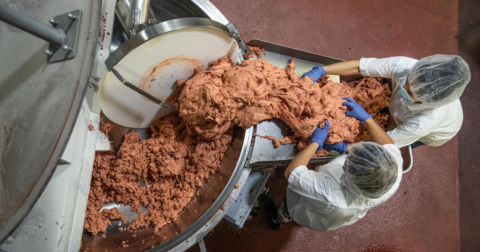
“Overall, there needs to be a big reduction. It’s the only way of lowering greenhouse gas emissions from the sector without imposing huge harm on the animals,” says Stevenson. And many epidemiologic studies have linked red and processed meat consumption with increased risk of Type 2 diabetes, cardiovascular disease and cancer, he adds, “so there are many arguments to say we actually need to rethink our diets.”
Emily Payne is a journalist covering the intersection of food, agriculture, health and climate. Currently based in Denver, Colorado.
Feature
Climate•4 min read
News
Warming waters alter where fish and shellfish live, push them beyond what they can tolerate and increase risk of disease.
Climate•6 min read

News
Planetary emissions are already in a dangerous phase, scientists warn.
Climate•4 min read