Feature
What the History of Blue Baby Syndrome Tells Us About Today’s Fight for Clean Water
Factory Farms•14 min read
Feature
Manure management planning could prevent fertilizer pollution. But an antiquated system isn’t doing enough to track manure, a former state employee says.
This story is a collaboration between Inside Climate News and Sentient Media.
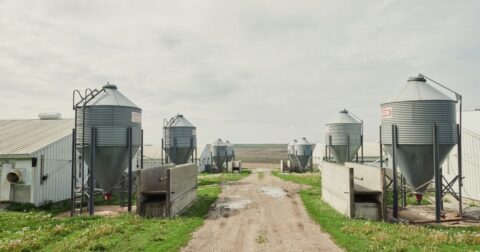
More than a thousand hogs grow fat in the enclosed shed-like structures on Gene Tinker’s farm in northeast Iowa, while a few hundred cattle pace in open feedlots.
His farm is one of nearly 8,000 concentrated animal feeding operations (CAFOs) in Iowa. But the 64-year-old is not an average Iowa pork producer.
Less than a decade ago, Tinker was the state’s top administrator managing questions and disputes over livestock operation permitting.
Tinker was the animal feeding operations coordinator at the Iowa Department of Natural Resources (DNR) for 14 years. Before losing his job during department budget cuts in 2017, he advised staff who granted permits to livestock facilities and reviewed plans for handling the manure produced by those facilities.
For years, Tinker says, he had unsuccessfully advocated for the department to update its rules on applying livestock manure as fertilizer. Now, the former coordinator of the state’s livestock regulating body says the DNR’s approach to enforcing regulations and collecting data about livestock waste is inadequate, emphasizing the need for better management to address environmental risks and protect water quality.
While the DNR requires farmers to submit documents outlining their plans for spreading livestock manure, the agency doesn’t collect records of where and how much manure is actually spread.
Those records exist, produced by the certified hauling companies that contract with CAFOs to apply manure. But Iowa law classifies them as “confidential,” limiting public oversight and accountability.
That’s a mistake, because application records could easily be digitized and made publicly accessible, Tinker argues, bolstering the state’s toolkit in its struggle with water pollution issues.
Manure is rich in nitrogen and phosphorus that fuel plant growth, but what’s not absorbed by plants can end up in waterways, triggering toxic algal blooms and high levels of nitrate in drinking water. Ingested nitrate can cause a deadly condition in infants and several studies have linked exposure to the chemical to elevated cancer risk.
Nitrate pollution of drinking water has risen in tandem with the cancer rate in Iowa—one of only two states where the rate of new cancer cases is on the rise.
Yet despite a nearly 50% increase in nitrate levels in Iowa’s waterways and mounting evidence linking agricultural practices to pollution, Iowa has not substantively updated its fertilizer and manure rules since 2002, except for a 2009 amendment regulating when manure could be applied to snow-covered ground.
“The DNR isn’t changing because nobody’s making them change,” says Tinker.
Tammie Krausman, communications director for the Iowa DNR, wrote in a statement to Inside Climate News that the “DNR is focused on implementing the requirements in Iowa law established to help protect surface and groundwater resources.”
“Many of the requirements for animal feeding operations exceed federal requirements, such as those established for manure management plans, construction of manure storage structures and manure application requirements,” Krausman added.
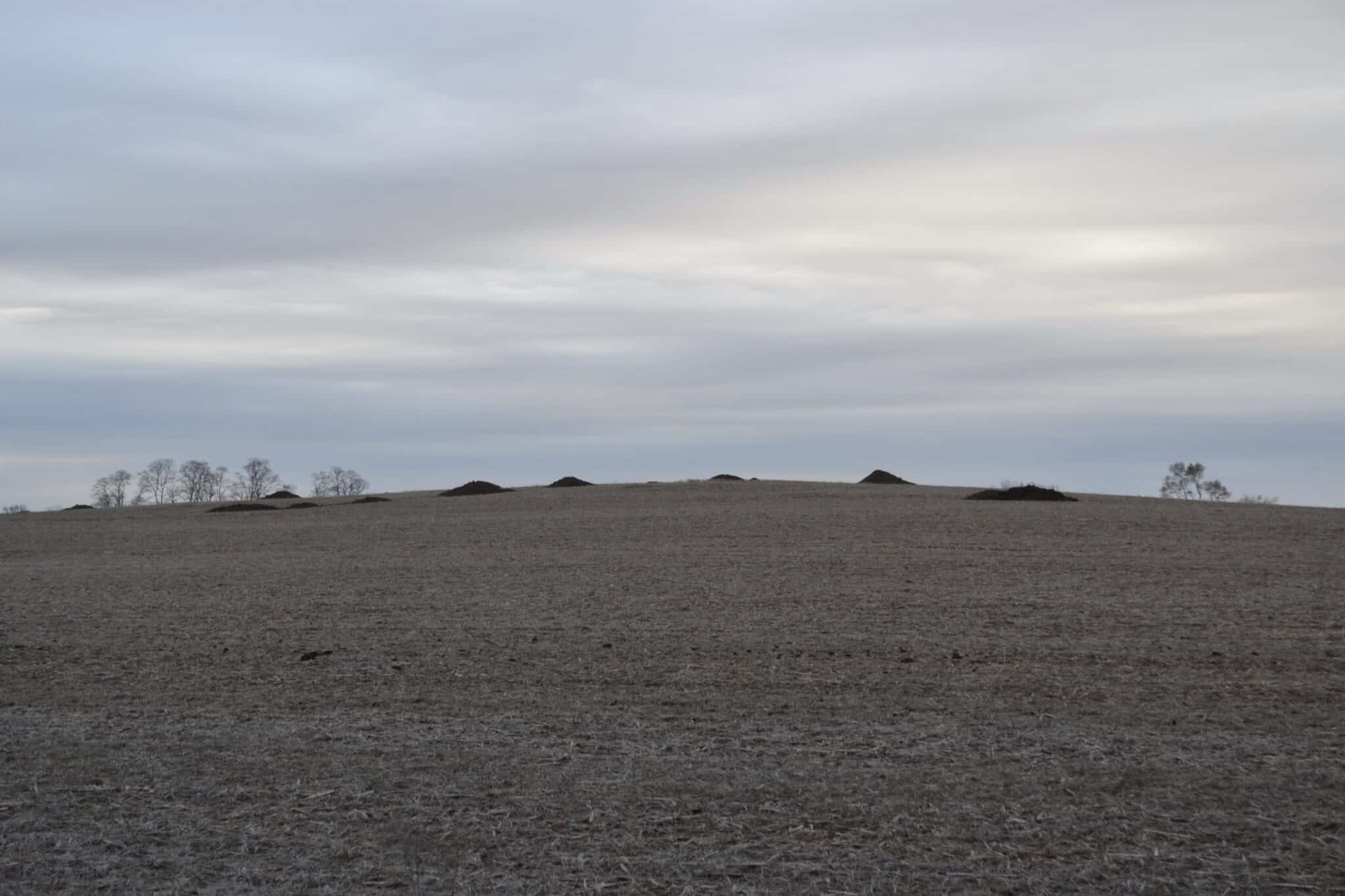
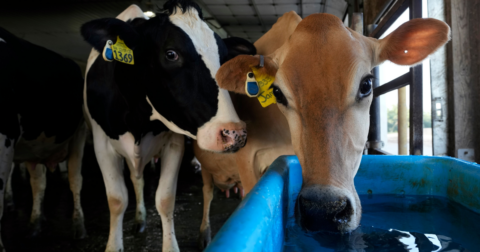
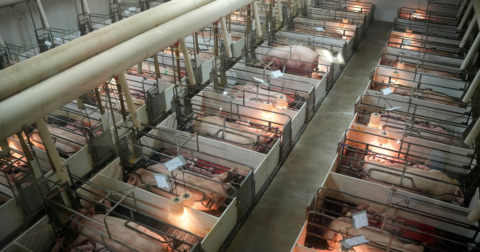
Ninety-nine percent of farm animals in the U.S. are raised in CAFOs, which are typically characterized by shed-like structures that house hundreds to thousands of animals. Iowa alone is home to approximately 23 million hogs, nearly all of which are raised in confinement, and which produce an estimated 110 billion pounds of manure each year.
Iowa’s Animal Agriculture Compliance Act, first codified in 2002, requires facilities with over 500 animal units—roughly 500 cattle, 1,250 hogs or 100,000 broiler chickens—to submit a lengthy document every four years detailing their plans for disposing of the waste produced by the livestock.
Manure management plans require Iowa livestock producers to specify the exact fields for manure spreading and demonstrate that the nutrients in the manure won’t exceed the needs of crops and pollute waterways.
Yet tracking the disposal of the 110 billion pounds of manure produced each year across millions of acres of Iowa’s cropland is no small task. Tinker insists that the state could do more to improve the process.
Iowa’s six regional DNR field offices are responsible for collecting and filing the plans submitted by CAFOs in their region.
All manure management plans undergo an administrative review to ensure that all supporting information is present and the appropriate fee has been paid, says Jeremy Klatt, an environmental specialist in Iowa DNR’s field office in Mason City.
That review is a box-ticking exercise, says Klatt. “It’s not looking at if the numbers make sense, it’s just looking at the completeness of the plan,” he says.
The initial review offers no assurance that manure is handled in an environmentally responsible way, argued Tinker, the former DNR coordinator.
During separate technical reviews, DNR staff check manure application rates and review application records to ensure that a plan is based on environmentally sound calculations and will not overload a field with more nitrogen or phosphorus than crops can absorb. But these technical reviews occur only during random on-site inspections or when a new facility seeks a construction permit.
Klatt, who regularly visits facilities to conduct technical reviews of manure management plans, says DNR records indicate that, as of November, the agency has done 617 such inspections since the start of the year. That’s about 7% of all active plans in the state.
The manure management planning system only captures what farmers intend to do with their manure, not necessarily what they end up doing, says Cindy Garza, an environmental engineer at DNR’s Mason City field office.
The DNR does not collect actual manure application records, Garza explained. Those are held on-site at livestock facilities and are evaluated only during a technical review. The state considers them confidential information, a designation that Tinker sees as an Achilles’ heel for DNR oversight.
“What’s so proprietary about how much manure you put on a field? Especially if you’re telling the government ahead of time how much you’re allegedly putting on the field,” says Tinker. “All you’re doing is providing the records so people can verify you actually did what you said you were going to do.”
Dividing cropland for manure application while avoiding nutrient over-application is a delicate balancing act. Without application records, the DNR has limited ability to oversee that distribution, says Tinker.
It is common for the same field to be earmarked for manure application by several CAFOs across multiple plans.
In hundreds of manure management plans reviewed by Inside Climate News, over 45,000 acres of cropland were listed as application sites in more than one plan, potentially increasing the risk of manure overapplication and nutrient runoff.
This isn’t strictly against the rules, says Klatt.
As long as a field doesn’t receive more than its maximum allowable amount of manure in a year, an application field can be in two different plans, he says. “If Facility A is planning to spread it one year and Facility B is doing it in the second year, that’s no problem.”
Without viewing application records, there’s no way to know which fields were actually treated, or with how much manure.
“There’s no verification that manure application actually occurred the way it claimed it was. There’s no verification that there haven’t been multiple production sites putting manure on the same fields. There’s no verification of any of that,” says Tinker.
Not only is the DNR not collecting enough information from livestock producers, it’s also not doing enough with the data it already has, Tinker says.
In 2023, the department began operating a public database to track facility submissions, upload files and ensure plans are turned in on time. But there is still no system for aggregating data from multiple plans to get a better understanding of the big picture, according to current and former DNR staff.
An inadequate database limits the department’s ability to ask and answer questions about manure management in the state, Tinker says. “They should be able to tell you exactly how many tons of nitrogen and phosphorus are applied every year in this state,” he says. As of right now, they can’t.
Tinker also doubts the accuracy of the calculations underpinning manure management plans.
While still at the DNR, he lobbied unsuccessfully to update the values that are used to estimate a field’s nitrogen needs to reflect the latest crop science.
In manure management plans, estimated phosphorus demand is based on soil testing and a recently updated soil loss equation, but the rates used to predict nitrogen demand are woefully outdated, Tinker says.
They are based upon desired yields, in bushels, of a given crop, rather than on the field’s actual capacity to use and retain nitrate.
“Those factors were developed in the 1950s, and I don’t know if anybody knows exactly where they came from,” says Tinker.
In recent decades, scientists across the Midwest—including faculty at Iowa State University—developed a new tool for determining optimal nitrogen application rates, one that accounts for recent research and fluctuating corn prices.
When Tinker attempted to incorporate the calculator into the DNR’s manure management rules, he says he faced resistance from agricultural trade associations concerned that reducing nitrogen fertilizer use would reduce yields.
The old nitrogen rates have remained the same; meanwhile, excess water-soluble nitrate, produced by soil bacteria from nitrogen, is of growing concern in Iowa. The state faces some of the highest nitrate pollution in the nation.
Exposure to nitrate pollution via drinking water is linked to long-term health problems, such as a higher risk of lethal cancer, and acute life-threatening issues for children, including methemoglobinemia, which is also known as blue baby syndrome. Iowa has the second-highest cancer rate in the nation and one of only two states where cases are on the rise. Many residents suspect agricultural pollution of waterways is partially to blame.
Beyond the health risks, Iowa’s water pollution is costly. When nitrate levels spiked in the Raccoon and Des Moines rivers this summer, Des Moines Water Works spent about $10,000 a day operating its nitrate removal facility. Even then, the city had to enact a lawn-watering ban because its systems could not handle the rising pollution.
“Progress continues to be made on reducing the number and impact of illegal manure discharges to waters of the state,” wrote Krausman, communications director for the Iowa DNR. From 2024 to 2025, the DNR reported 13 incidents of manure discharged directly into state waterways.
However, the majority of nutrient pollution in the state is indirect, leaching off fields treated with excess fertilizer. Since publishing its nutrient reduction strategy in 2014, Iowa has seen increased adoption of voluntary conservation practices to reduce nutrient loss, but only slight improvement in the nutrient levels in its waterways.
The state’s efforts to control manure from the nearly 124 million animals aren’t keeping pace with the rate of nutrient pollution. Tinker believes Iowa has intentionally turned a blind eye to the process.
“They could modernize. It could all be shared so everybody could look at it. But they don’t want that,” says Tinker. “It’s, ‘Trust me. Just trust me.’ Well, it should be, ‘Trust, but verify.’”

Anika Jane Beamer covers the environment and climate change in Iowa, with a particular focus on water, soil and CAFOs. A lifelong Midwesterner, she writes about changing ecosystems from one of the most transformed landscapes on the continent. She holds a master’s degree in science writing from the Massachusetts Institute of Technology as well as a bachelor’s degree in biology and Spanish from Grinnell College. She is a former Outrider Fellow at Inside Climate News and was named a Taylor-Blakeslee Graduate Fellow by the Council for the Advancement of Science Writing.

Nina B. Elkadi is a former Editor-at-Large for Sentient. Her investigative reporting explores corporate influence within the agricultural industry, the environmental impacts of factory farming and how negligence impacts consumers and workers. Her work also appears in National Geographic, Inside Climate News, Civil Eats, High Country News, Ambrook Research, JSTOR Daily, Barn Raiser and more. She splits her time between Washington D.C. and her hometown of Iowa City.

Explainer
Climate•10 min read

Feature
A survey taken this past spring shows a majority of Iowans say they have experienced negative environmental impacts from industrial animal operations. But plenty are also ambivalent, or ignorant, about…
Elections•11 min read
Here’s what the data reveal about the country’s factory farm hotbed.
Inside Iowa•8 min read