Explainer
Where Iowa’s Gubernatorial Candidates Stand on Water Quality
Climate•10 min read
News
If passed by the governor, the bill would protect farms from lawsuits surrounding their greenhouse gas emissions.
News • Factory Farms • Policy • Politics

Words by Seth Millstein
Update: On April 30th, Iowa Gov. Kim Reynolds signed the bill in question, House File 2527, into law.
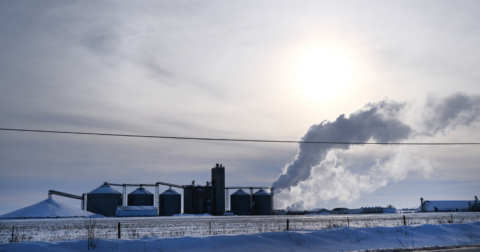
The Iowa Senate approved a bill to shield factory farms in the state from lawsuits regarding their greenhouse gas emissions. The legislation would significantly narrow the situations in which agricultural facilities in Iowa, a state with notoriously lax farm pollution regulation, can be held legally liable for damages caused by their emissions.
If the governor approves the proposed bill, anyone who sues a farm for damages relating to its greenhouse gas emissions will have to meet an additional burden of proof: In addition to demonstrating that the damage itself occurred or will occur, plaintiffs will also have to prove that the farm in question violated an existing permit, regulation or law while emitting the gases in question, which plaintiffs will have to specify.
The bill was passed 33-13 on a mostly party-line vote in the state Senate March 24, with 12 Democratic lawmakers, as well as Republican Doug Campbell, opposing it. Democratic Sens. Catelin Drey, Izaah Knox and Mike Zimmer voted for the bill. The bill had already been cleared by the Iowa House in February and is now awaiting a signature from Gov. Kim Reynolds.
Iowa is not the only state to clamp down on lawsuits against factory farms. In 2023, then-governor of South Dakota Kristi Noem passed a law that limits who is allowed to file lawsuits and nuisance complaints against farms, and places a cap on how much money can be awarded in said lawsuits. Florida passed a similar law two years earlier, and a number of other states have similar statutes on the books.
Iowa has more factory farms than any other state, and they collectively produce around 110 billion pounds of manure annually. Manure and fertilizer both contain several potent greenhouse gases that can contaminate the air and water when improperly managed. That’s not just hypothetical: Agriculture is the leading cause of water degradation worldwide, and a 2025 study from Columbia University and NASA researchers found that large-farms produce more fine-particulate air pollution than any other emissions source in much of the U.S., China and Europe.
The consequences of this pollution are wide-ranging. Iowa has a massive problem with elevated nitrate levels in drinking water all across the state, and high nitrate exposure has been linked to the state’s unusually high cancer rates. In 2025, a record number of beaches in Iowa were unswimmable due to harmful E. coli, bacteria that can grow in the guts of cows and other ruminant animals. U.S. farms don’t have to report hazardous air pollution that comes from animal waste — even lethal gases like hydrogen sulfide and ammonia.
Iowa farms are subject to a patchwork of state and federal regulations aimed at mitigating this damage. But state regulatory agencies across the United States, including in Iowa, have a long, documented history of allowing farms to slip under the radar and violate these regulations without consequence. Often state environmental agencies such as Iowa’s are also underfunded and understaffed.
In 2017, for example, the Iowa Department of Natural Resources reported that Iowa was home to just under 10,000 medium-to-large livestock farms — but subsequent satellite imagery identified an additional 5,000 farms that the agency was unaware of and wasn’t tracking or regulating. In 2023, USDA data shows that only 4% of Iowa’s factory farms even have water pollution discharge permits, which means that the vast majority of the state’s factory farms operate without any document placing limits on how much and in what manner they are allowed to pollute the water with waste.
The Department of Natural Resources is tasked with inspecting farms to ensure that they comply with their nutrient management plans, which detail how they dispose of the manure they produce. But a specialist at the department told Sentient that as of November 2025, the agency was only able to inspect 7% of the farms with active plans. That same year, a Sentient analysis found that 38 food or agricultural facilities in Iowa were cited for water pollution violations — but only one was fined.
While debating the new bill, Democratic State Sen. Art Staed called it a “legislative intent to shield corporate polluters,” and warned that it would be “extraordinarily difficult for individual communities or even the state to hold polluters accountable” for emissions if it passed.
In the House, Republican Rep. Derek Wulf, who introduced the bill, said that it was aimed at protecting farmers who’d been put “in the crosshairs” by “Green New Deal policies.” Sentient has reached out to Rep. Wulf for clarification on which policies he was referring to and has not received a response.
This piece has been updated.
Seth Millstein is a writer and musician living in the Bay Area. He has helped launch several early-stage journalism startups, including Bustle and Timeline, and his work has been published in Bustle, Huffington Post, The Daily Dot and elsewhere.

Feature
Elections•11 min read
Here’s what the data reveal about the country’s factory farm hotbed.
Inside Iowa•8 min read
Find out how much manure is in your backyard.
Inside Iowa•9 min read