News
Sustainable Seafood Labels Aren’t Always What They Seem
Food•6 min read
News
The political back-and-forth resurfaces industrial animal agriculture’s contribution to the public health threat of antimicrobial resistance.

Words by Sophie Kevany
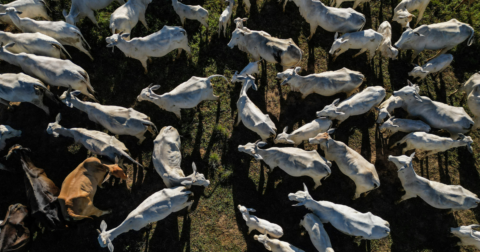
The European Union says it will block imports of Brazilian animal-sourced foods, including beef, starting September 3, if the country cannot show that it does not use antibiotics to enhance livestock production.
In order to avoid the pending ban, Brazil must demonstrate that it complies with EU rules forbidding the use of antibiotics to increase livestock growth and productivity. The ban does not affect current imports, and comes on the heels of the controversial trade deal commonly known as EU-Mercosur that provisionally came into effect May 1.
Nico Muzi, chief program officer of sustainable food at Madre Brava, a non-governmental organization, wrote Sentient in an email that he expects Brazil will work quickly to resolve the ban, and also noted the threatened ban would have minimal impact due to the relatively small trade levels, with the EU being Brazil’s ninth export destination for beef and eighth for poultry, by volume.
The trade deal was meant to open European Union markets to the agricultural products of Argentina, Brazil, Paraguay and Uruguay, and in turn to open those countries to European industrial goods. The trade deal took years to conclude, with opponents arguing the deal, now in effect, will force EU farmers to compete with cheaper animal-sourced food imports from countries with lower production standards. A report from Eurogroup for Animals, an EU animal welfare organization, argues that products from the four Mercosur countries are sourced from animals raised with welfare standards lower than those required in the European Union.
Opponents also argue that the trade policy will encourage South American deforestation, a practice already heavily tied to Brazil’s beef production.
The timeline for when Brazil “can potentially be added” to the list of countries allowed to export products to the EU will depend, an EU spokesperson says in an emailed statement, on two factors. The first is how quickly Brazil can demonstrate it meets EU rules on antimicrobial use in livestock production. Antimicrobials are a larger category of substances that include antibiotics.
The second factor, the spokesperson says, is how quickly Brazil can clear the existing livestock supply chain of antimicrobials given the EU stipulates that both “exported animals” and “the animals that the exported products originate from” must never have received antimicrobials to promote growth or yield, nor certain antimicrobials reserved for human infections.
This suggests, however, that animals with shorter lifespans, broiler chickens and egg laying hens for example, might be approved for EU import sooner than animals with longer lifespans, like beef cattle.
“We have closely engaged with the Brazilian authorities on this issue,” the statement adds, “and will continue contact to work towards their compliance with these requirements. Once compliance is demonstrated, the EU will be able to authorise the exports” from Brazil.
The EU spokesperson’s statement went on to say that the ban on Brazilian imports to the EU would “not affect other Mercosur members” because these countries “have submitted the necessary guarantees of compliance with the Union requirements on the use of antimicrobials.”
The spokesperson also added that EU antimicrobial rules, which have applied to EU producers since 2022, are “an essential part of the EU’s ‘One Health’ agenda to fight antimicrobial resistance,” commonly known as AMR, which it described as “the biggest public health threats of our time.”
Elvire Fabry, trade and economic security program director at the Paris-based Jacques Delors Institute, a European policy think tank, further noted that Brazil had itself recently banned the use of five “performance-enhancing” antimicrobials, but the ban, she wrote in an email, “only applied to meat sold within Brazil. The country continued to allow meat destined for foreign countries to be produced using these drugs.”
In a separate but related incident, a joint investigation led by the Irish Farmers’ Association and the Irish Farmers Journal late last year found that representatives of these groups who visited four Brazilian states, “were able to walk in off the street to agri-stores and buy prescription-only injectable antibiotics … without any prescription, questions, or recording of buyer details.”
The investigation also found “no evidence, in practice, of effective controls on medicine usage in farm animals,” no cattle traceability and no “credible means to certify beef from this country as meeting EU import requirements.” The Irish Farmers’ Association reportedly submitted the findings to “EU institutions.”
The EU did not respond to questions about whether the removal of Brazil from the list of countries allowed to export animal products to the EU was linked to the Irish findings.
Sentient reached out to the Brazilian embassy in Brussels for comment on the upcoming ban, as well as the Irish findings. The embassy responded by email with a link to a May 12 statement from the ministries of foreign affairs, livestock agriculture and trade that said Brazil’s government “will promptly undertake all necessary measures” to reverse the EU ban and “restore Brazil’s status on the list of authorized countries, and ensure the continued flow of exports of these products to the European market, to which Brazil has exported for the past 40 years.”
Muzi also wrote Sentient that any meat imported into the EU “must comply with our food safety standards.”
“We have some of the strictest regulations regarding the use of antimicrobials to promote growth or increase animal production. We should demand enforcement of those rules for any animal product entering the Union. That’s fair for our farmers, good for our health and beneficial for animal health,” Muzi shares.
Clarification: The following phrasing has been edited to more accurately summarize the interview: and also noted the threatened ban would have minimal impact due to the relatively small trade levels, with the EU being Brazil’s ninth export destination for beef and eighth for poultry, by volume. Additionally, the piece has been edited to clarify the role of EU spokesperson.
Sophie Kevany is a freelance journalist writing for The Guardian, Sentient Media and other publications. She previously worked for Dow Jones and Agence France Presse (AFP) and has a Master’s in Journalism from Dublin City University. She has lived and worked in Ireland, the US, South Africa, France, Peru and Spain.
News
Farms•7 min read
Investigation
A chemical additive helped stop fishmeal from catching fire on ships, but it carried a downstream carcinogenic risk to modern food systems.
Food•6 min read
Explainer
Three of the largest dairy co-ops market the vast majority of milk sales; some have expanded into milk processing and other parts of the dairy industry.Farmers say these organizations —…
Food•1 min read