News
Inside Big Beef’s ‘90s Campaign to Rewrite Its Climate Story
Big Meat•6 min read
News
Calling it “biogenic methane” is a red flag for climate scientists.

Words by Seth Millstein
Last week, the European Commission released its much-anticipated Livestock Strategy. The result of years of dialogue and planning among EU policymakers, the strategy is a set of policy recommendations aimed at fostering “a resilient, competitive and sustainable livestock sector” across the European Union. But climate advocates warn the strategy could be a disaster for efforts to fight global warming, and could lock in already-unsustainable levels of methane emissions from meat and dairy farms.
Although the strategy makes mention of climate goals, it’s aimed primarily at protecting the livelihoods of those in the livestock industry, and “help[ing] livestock farmers address economic, environmental and market challenges.”
One specific line in the strategy — framing methane emissions from livestock as “biogenic methane” emissions — has raised alarm bells among advocates and researchers about the future of how methane emissions are regulated. These critics fear future climate strategies might focus on stabilizing agricultural emissions at current levels, as opposed to reducing them.
One third of all greenhouse gas emissions comes from food production, with meat, especially beef, driving most emissions from the food sector.
Climate advocates warn that the Livestock Strategy fails to address the significant role that livestock production plays in rising global temperatures. As written, the measures endorsed by the strategy are “designed to maintain the status quo and make small tweaks to the existing system,” Caitlin Smith, Campaign Manager at the Changing Markets Foundation, tells Sentient.
“And the existing system is not working,” Smith says. “We have huge issues with water pollution, air pollution, huge huge droughts happening that are affecting farmers across the region.”
Livestock is a major source of greenhouse gases, accounting for up to around 20 percent of all GHGs worldwide. In the European Union, over 65 percent of agricultural greenhouse gas emissions are the result of livestock production, according to a report from the European Environment Agency.
This is largely due to the cattle industry’s methane emissions. One of the “big three” greenhouse gases, methane accounts for around 17 percent of global greenhouse emissions. Although it dissipates from the atmosphere significantly faster than carbon dioxide, it also warms the atmosphere much quicker before doing so.
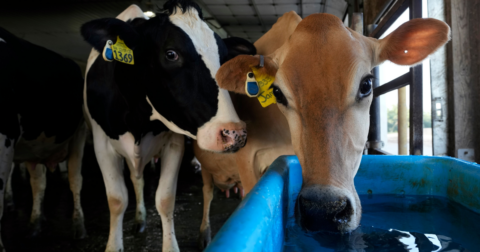
Agriculture is also by far the biggest source of methane emissions worldwide, and around 60 percent of agricultural methane emissions come from livestock. This is mostly due to beef and dairy production: cows emit methane as part of their natural digestive process, and their manure continues emitting methane after it’s been excreted.
Methane only lingers in the atmosphere for around 12 years; carbon dioxide, by contrast, can last for hundreds of years. But methane is also much more potent as a warming agent than carbon dioxide, and as a result, its global warming potential over a 100-year period is 28 times higher than that of CO2.
Because of how potent it is, reducing methane emissions has become a key goal for climate change advocates. Smith calls it “the best climate emergency brake that we’ve got right now” to reduce global warming. But one line in the Livestock Strategy suggests that the European Union might not be placing this burden on the agriculture industry.
Here’s the segment of the Livestock Strategy that has climate advocates sweating, with the key portion bolded:
Certain existing methodologies for estimating livestock emissions do not fully reflect the actual variation in emissions across diverse production systems, breeds and feeding regimes…discussions are on-going to explore the need to take account of the biogenic nature of methane emissions as part of a short-term carbon cycle. More refined approaches are needed to better reflect real management practices and ensure a more accurate and fair assessment of livestock’s climate performance.
To understand the reaction, it’s important to look at what “biogenic methane” is, and what it isn’t.
Biogenic methane simply refers to methane that comes from a biological source, like a cow, as opposed to fossil fuels or other processes.
There is a small difference between how biogenic methane and fossil methane impact the climate, but the difference is relatively insignificant. All methane, regardless of source, degrades to CO2 at the end of its life, a process that plays out after it’s carried out the bulk of its atmospheric warming.
If the methane originally came from a cow, that CO2 technically isn’t new. Plants absorbed the CO2 from the air, a cow ate the plants, the cow’s stomach converted it to methane and it was emitted via a burp. In this sense, the CO2 that remains after the methane has dissipated is simply an existing emission making its way through the carbon cycle.
If the methane in question came from fossil fuels, the CO2 that remains after it breaks down isan additional emission: The methane that was produced had been underground, and thus wasn’t in the air prior to its extraction.
This means that fossil methane does warm the atmosphere more than biogenic methane. But the difference is minuscule: The global warming potential, or GWP, of fossil methane is 29.8, while the GWP for biogenic methane is 27, according to the IPCC. The difference is small because most of methane’s atmospheric warming occurs before it has degraded into CO2.
Smith says that the livestock industry has seized on and overemphasized this small difference in order to “downplay the impact of methane from agriculture in order to delay any action” aimed at reducing agricultural methane emissions.
“It has been often used by the industry to open the door to change the metrics about how we measure methane, and to move from reductions to stabilization of methane,” Smith says.
Take New Zealand, a country with almost twice as many cows as people. Every five years, the country reassesses and updates its emissions reductions goals, and its most recent update established very different standards for biogenic methane and fossil methane. While New Zealand will aim for net zero emissions of fossil methane and every other greenhouse gas by 2050, it will only pursue a 14 to 24% reduction in biogenic methane emissions.
In effect, this two-tiered approach places most of the burden for emissions reductions on every industry other than agriculture. Smith fears that Ireland, which has a large dairy industry and is preparing its own climate targets for 2040, will adopt a similar approach as Ireland — and she’s not alone.
“We know that this conversation, and these arguments, have been put forward in Ireland, so the fact that now you’re seeing it in an EU-wide document is just cause for concern,” Claire Stockwell, Director of European Strategy at International Agriculture and Trade Policy, tells Sentient.
Stockwell says that focusing on biogenic methane is “part of the playbook from industrial agriculture,” and including that sentence in the Livestock Strategy could open the door to another controversial concept in methane reduction conversations: additional warming.
Biogenic methane is closely linked to arguments about “no additional warming,” also known as “temperature neutrality.”
When CO2 is released into the atmosphere, it remains there for hundreds or even thousands of years. Because of this, emitting CO2 on a regular basis steadily increases concentrations of CO2 in the atmosphere, even if the amount that’s emitted on a yearly basis stays constant.
Methane doesn’t work like that. It oxidizes to water and carbon dioxide in the atmosphere after around twelve years, so if the amount being emitted every year remains constant, the amount of methane concentrated in the atmosphere will, after an initial 12 year period, remain constant as well.
This means that if livestock and fossil fuel producers simply maintain their current levels of methane emissions without increasing them, there will be “no additional warming” of the atmosphere — at least, not as the result of methane emissions. This has served as a basis for arguing that agricultural producers don’t actually need to reduce their methane emissions in order to fight global warming. They simply need to avoid increasing them.
“The idea is that we only have to stabilize [methane emissions] to have no additional warming, or temperature neutrality,” Smith explains. “Both sound very positive and nice, but are actually hugely detrimental to meeting [the emissions goals of] the Paris Agreement.”
The problem is that methane emissions are already much too high as it is. The amount of methane in the atmosphere is now more than 2.5 times higher than it was before industrialization. Methane accounts for 30% of global warming today, despite comprising only 17% of emissions. At current emissions rates, the world is already on track to blow past the Paris Agreement’s limits, which some scientists say were insufficient in the first place. Emissions need to fall, not remain the same, in order to forestall climate catastrophe.
“The IPCC has also been clear on this,” Stockwell says. “If you look at their scenarios for what you need to do to keep [in alignment with the Paris Agreement], it has significant reductions for methane. It’s basically assuming eventually you will phase out the fossil methane, but you still need deep and sustained cuts in biogenic methane to have any attempt to keep safe levels on our planet.”
Ireland is in the process of crafting its own climate targets for 2040. It hasn’t finished doing so, but several of the preliminary reports and analyses prepared by the country’s Climate Change Advisory Council suggest that it’s considering adopting a temperature neutrality approach to reducing its emissions, and/or creating different standards for biogenic methane.
But a 2025 study in Environmental Research Letters concluded that, while the concept of temperature neutrality “presents an attractive means of positioning [Ireland]’s global mitigation contribution,” it’s an ineffective criteria for reducing emissions. The authors noted that the argument for temperature neutrality rests in part on “the widespread misperception that agricultural sector methane emissions, being largely biogenic, are part of the natural cycle and therefore less problematic than fossil fuel-derived methane emissions.”
“The [temperature neutrality] approach is not a robust basis for fair and effective national climate policy, and risks a potentially costly underestimation of both long-term methane mitigation and carbon dioxide removal in the context of national planning for an equitable, sustainable, food secure future,” the authors wrote.
At the end of the day, the focus on biogenic methane and pursuit of temperature neutrality both have the same effect: Downplaying the consequences of emissions from livestock farms, and giving the meat and dairy industries license to continue emitting dangerous amounts of methane as a matter of course.
The EU’s Livestock Strategy isn’t a binding document. It doesn’t create any new laws, or obligate any of the EU’s constituent countries to abide by any new rules. But the document’s reference to biogenic methane is a serious red flag, Smith and Stockwell say.
“It’s distracting you from the fact that methane is methane, whether it’s coming from a cow or whether it’s coming from a pipeline,” Stockwell says. “It’s still going to have an impact on the planet. It’s still going to heat up the planet. We’re still suffering those consequences, so that’s why we’re concerned that this overt focus on the biogenic aspect of methane is serving as a distraction from dealing with the problem of methane itself.”
Clarification: The following line was deleted as it was repetitive: The Livestock Strategy is the culmination of a years-long process by EU policymakers to map out a guide for the future of European agriculture. This line was also edited for clarity: There is a small difference between how biogenic methane and fossil methane impact the climate, but the difference is relatively insignificant.
Seth Millstein is a writer and musician living in the Bay Area. He has helped launch several early-stage journalism startups, including Bustle and Timeline, and his work has been published in Bustle, Huffington Post, The Daily Dot and elsewhere.
News
Climate•4 min read

Solutions
A new report from the World Resources Institute on its Coolfood pledge initiative observes progress and challenges in curbing cafeteria emissions.
Climate•6 min read
Explainer
It all comes down to burps and land.
Climate•5 min read