News
Trump’s ‘New Era of Animal Welfare’ Excludes Almost All Farm Animals
Policy•5 min read
News
The department quietly reversed course on Biden-era rulings meant to enforce equal treatment and transparency on how meat companies pay farmers.
News • Meat Lobby • Policy

Words by John McCracken
The U.S. Department of Agriculture has quietly announced plans to reverse three recently passed protections for contract chicken farmers.
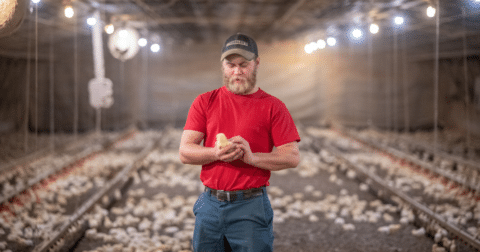
Nearly every chicken raised for meat in the country is done so within the contract system, which exposes farmers to huge financial risk. Contract poultry farmers take on massive amounts of debt to build and upgrade barns in order to raise birds they don’t own. The chickens themselves are owned by billion-dollar meat companies like Tyson Foods or Brazilian-owned Pilgrim’s Pride. Contract growers are often paid using the tournament system, a financial system that advocates call exploitative and one that the Biden administration hoped to reform.
U.S. broiler farmers raised over 9 billion chickens for meat in 2024.
In early July, the USDA filed to rescind three reforms passed under the Biden administration. Two of the rulings have been in effect since 2024, with the third meant to take effect July 1.
One of the targeted rules that was already in effect forbade meatpacking companies and poultry dealers from discriminating against livestock and poultry producers on the basis of protected categories like race, religion or ethnicity, as well as forbidding retaliation from meatpacking companies for protected activities like working with other dealers. The second reformed the poultry tournament system and increased transparency requirements of poultry dealers, such as certain financial and debt disclosures. The third rule would make additional changes to the tournament system and further prevent meatpackers from engaging in deceptive practices.
These rules are updates to the Packers and Stockyards Act, a 1921 law meant to protect livestock farmers from predatory behaviors.
“For years, meat corporations have abused hardworking farmers and ranchers,” says Emily Miller, staff attorney for environmental watchdog organization Food & Water Watch in a public statement. “Now, the Trump administration is proposing to undo long-overdue progress made to level the playing field.”
The USDA did not comment on the removal of these rulings and referred Sentient to the Office of Management and Budget, which did not respond to a request for comment.
Two rules, implemented in 2024, are currently in effect, while the other ruling meant to change poultry payment systems was paused at the beginning of July. A public comment process on the removal of all of these rules is slated for July and October of this year.
The USDA’s move comes after years of back and forth between contract chicken farmers, agricultural reform advocates, major poultry processing companies and industry groups.
Under the contract system, farmers take out loans to build, purchase or upgrade buildings to raise massive flocks, often over a million birds per year. The companies own the birds, genetics, feed and nutritional additives the birds take in order to grow to plump sizes to be harvested for as much meat as possible. Companies will ask growers for expensive changes and upgrades in equipment and buildings, keeping farmers stuck in debt and reliant on a single company’s contract.
When it comes time to slaughter, most contract farmers are paid using the tournament system. In this system companies will rank flocks of birds grown against others based on the size of the birds grown and how much feed and other expenses were used to raise the flock. A grower will receive more money the higher ranking they receive and receive smaller payments when they rank lower.
Contract chicken farmers experience swings in payment from one flock to another, while also carrying the burden of debt for raising birds for a company. When a company shutters meatpacking plants, contract farmers are often left holding the bag, millions of dollars in debt and with no other company to sell their birds to.
The poultry industry is highly consolidated. Four companies — Tyson Foods, Pilgrim’s Pride, Perdue and Wayne-Sanderson Farms — control about 60% of the industry. Sentient reached out to these companies regarding the rules update but none replied.
The broiler chicken industry is a $45 billion per year business. Industry groups have lobbied and collectively spent millions to influence legislation, with the Packers and Stockyards Act being a main target for revision in the past.
The National Chicken Council, an industry group representing major poultry companies and processors, applauded the Trump administration’s move, calling the paused rules rushed and unnecessary.
“These rules were rushed, one-size-fits-all mandates that would have added compliance costs and legal uncertainty without benefiting farmers or consumers,” Chicken Council president Harrison Kircher says in a public statement. “We trust this Administration to regulate competitive markets, support American agriculture, and protect consumers — not through duplicative federal mandates, but through common-sense oversight that reflects how the modern broiler industry actually works.”
While the chicken industry applauds the proposed reversal of rules meant to protect and inform chicken farmers of financial burden, others call the decision a step in the wrong direction.
The USDA’s decision “is a setback for contract poultry growers who have spent years advocating for greater fairness, transparency, and accountability throughout the food system,” Holly Spainhower, a senior policy specialist at the animal advocacy organization Mercy For Animals, tells Sentient in an email.
Mercy for Animals operates a program that helps contract poultry growers and other industrial animal farmers transition away from industrial animal agriculture, called the Transfarmation Project.
“Contract growers deserve fair contracts, transparent payment systems, and meaningful protections from unfair business practices,” Spainhower writes. “Mercy For Animals urges USDA to move forward with these long-overdue reforms rather than dismantle them.”
John McCracken is an investigative reporter whose work examining the nation's consolidated meat industry, industrial agriculture and climate change has received awards and recognition from the Chicago Book Club, North American Agricultural Journalists, Wisconsin Newspaper Association, Iowa Newspaper Association and more. He has been invited to speak about his reporting at the Society for Environmental Journalists, NICAR and more.

Explainer
Climate•10 min read

Feature
A survey taken this past spring shows a majority of Iowans say they have experienced negative environmental impacts from industrial animal operations. But plenty are also ambivalent, or ignorant, about…
Elections•11 min read
News
Mama Bear allegedly uses misleading branding on Atlantic salmon cubes sourced by Australis Foods, an aquaculture operation accused of harming Chile’s sensitive marine environment.
Legal Action•6 min read