News
Marine Heatwaves and El Niño Are Disrupting Fisheries
Climate•6 min read
News
Extreme heat has changed what it takes to produce a glass of milk.
News • Climate • Food Systems

Words by Melina Walling
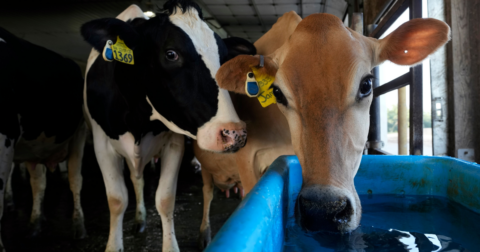
Dairy farmer Megan McAllister knows what it looks like when her cows start getting toasty.
They clump together in groups. Their four-chambered stomachs working on digestion create what she calls their own little “onboard furnace.” And she can measure a drop in how much milk they produce.
“If the girls aren’t comfortable, they aren’t going to be as productive,” McAllister tells Sentient.
Each year, she says her family tries to invest in technology to keep her cows more comfortable, especially cooling. Since they added more fans to their 290-cow operation in New Vienna, Iowa, they’ve noticed less of a dip in milk production on the hottest days of the summer. Now they lose two to six pounds per cow, down from 10 to 12 pounds.
But a new study finds that the heat does more than limit the quantity of milk a cow produces. It also changes the quality, steadily deteriorating nutritional components like fat and protein as temperatures rise, according to a paper out last month in the journal Environmental Research Letters.
This matters to the dairy industry because farmers get paid not by the overall weight or volume, but are instead priced using a formula that takes those nutritional components into account. As climate change increases the intensity and duration of heat events, industrial dairies with more capital tend to be better equipped to handle the added strain on their margins, coauthor and Cornell University associate professor of applied economics Ariel Ortiz-Bobea tells Sentient.
As a result, Ortiz-Bobea sees heat events adding to the trend of consolidation toward bigger farms in the dairy industry, with small farms unable to invest enough to adapt. Another concern is that industry efforts to breed cows to maximize protein and fat content will be inconsistent with a quest for other protective traits like heat resilience.
“I don’t worry about their ability of coming up with technological solutions to address issues,” Ortiz-Bobea says of the dairy industry broadly. “If yields go down, you just have more animals.” Large-scale operations are increasingly the dairy industry norm in the United States. Between 2002 and 2022, “farms with 1,000 cows or more increased by 60%,” according to USDA research.
Examining data from over 6.5 million cows, Ortiz-Bobea and his team saw the decrease in dairy quality with exposure to higher levels of temperature and humidity. They observed the effect across the country, across different farm sizes and across the entire time period studied, from 2007-2016.
What was particularly striking, he says, is that unlike yields, they could see a gradual decline in quality even during temperate seasons, at temperatures that wouldn’t be considered extreme. “You think, oh, as long as you’re below 70 Fahrenheit, then you’re fine, right?” he says. “Even if it’s more subtle and more subdued, relatively speaking, it’s happening.”
Finding that temperature and humidity also affect milk quality is a useful contribution in an area that has received less attention than others in dairy science, Claire Palandri, an assistant professor at the Hebrew University of Jerusalem who was not involved in the research, tells Sentient.
But more work would be needed to understand exactly what technologies were being used on different farms, and how different interventions might be able to make a difference, says Palandri, who as a postdoctoral scholar at the University of Chicago studied how farmers could only partially offset climate change impacts on milk production.
From a climate change perspective, it would have been useful to use models to see how different warming scenarios might affect dairies, says Gerald Nelson, University of Illinois, Urbana-Champaign professor emeritus of agricultural economics.
“I suspect they wouldn’t be positive for the dairy industry,” Nelson tells Sentient in an email.
Dairy farms have often been located in places where it’s been historically cooler, but as climate change worsens extreme heat, farmers in more places, especially the humid East and Southeast, will have to weigh how much they’re willing to invest, Mike Badzmierowski, agricultural policy manager at the World Resources Institute, tells Sentient.
“With climate change, we can only expect right now that we’re going to see higher temperatures, and combined with the high humidity, that’s going to lead to more stress,” Badzmierowski says.
He adds that business-as-usual food production also produces a significant amount of the greenhouse gases contributing to climate change, with dairy — including energy used to grow feed, cows belching methane and the whole supply chain it takes to get dairy products to the dinner table — accounting for roughly 3% to 4% of global human-caused emissions. The aviation sector is responsible for a similar amount, according to the National Oceanic and Atmospheric Administration’s research arm.
“Unfortunately, agriculture is both a contributor to climate change and one of the sectors most exposed to its consequences. The goal should be to build food systems that sharply reduce methane and other pollution,” Badzmierowski writes in an email.
McAllister thinks it’s a priority for dairies of all sizes to invest in cooling technology but points out that it can be easier for some than others. “I think as a dairy is larger, as they milk more cows, they can probably spread that cost out easier,” she says.
That’s an effect researchers have already seen in studies on milk quantity.
“It’s hard to be a competitive small farm, and dealing with extreme weather is one of those reasons,” says Marin Skidmore, an assistant professor in the Department of Agricultural and Consumer Economics at the University of Illinois who was not involved with Ortiz-Bobea’s research.
Skidmore tells Sentient her team has found that smaller farms are more vulnerable to heat-related losses. Based on other research, they think that’s because of the money it takes to run infrastructure like fans, misters and other cooling technology.
The federal government has in the past offered grant funding to support dairy initiatives, which could include cooling strategies, but the Trump administration has rolled back many farm programs tied to clean energy infrastructure. One example is the Rural Energy for America Program, which included energy efficiency improvements that could apply to dairies but is not currently accepting grant applications, according to its webpage. Some state governments have announced piecemeal funding for climate resilience or energy efficiency in recent years, but dairy farmers across the U.S. don’t universally have access to funds that could help with cooling.
There’s a balance between how much a cooling strategy costs and the gain it provides, Neslihan Akdeniz, an assistant professor at the University of Wisconsin-Madison who designs energy-efficient ventilation systems for dairy buildings, tells Sentient. “More cooling is not always worth it. For example, we do not place an AC unit inside a dairy barn. It would be the best cooling strategy, but the cost cannot be offset,” Akdeniz writes in an email.
Skidmore thinks Ortiz-Bobea’s research sheds light on the economic toll of extreme heat on farmers. “Since farmers are paid on components, anything that is going to impact the protein or fat content in the milk is a direct cut on their income,” Skidmore said.
That also affects conditions for workers. In summers with worsening heat due to climate change, many bosses care more about protecting milk output than about providing comfortable living accommodations or protections like healthcare, one worker in New York tells Sentient, speaking in Spanish. He works on one of the largest dairy farms in the area, where about 70 workers milk about 3,000 cows, and requested anonymity due to fear of retribution.
“If it gets hotter for the cows, that’s when the cows get stressed from the heat,” he says. “Less milk means less money.”
Workers are exposed to the elements throughout the year as they do physically demanding work in extreme heat and cold, he says. He explained that the fans used for cooling kick up dust and can cause eye and respiratory infections.
“When I get home I put in eye drops, and in the morning I use them too, because the dust irritates my eyes,” he says.
Although heat impacts can take a toll in certain weeks of the year, overall, milk quality has been getting better and better over time “in pretty much every measure that you can think of,” Leonard Polzin, a dairy markets and policy outreach specialist at the University of Wisconsin-Madison, tells Sentient. That has largely to do with genetics, since breeders in the industry have been selecting each generation of animals to produce more milk with boosted protein and fat content.
But that may eventually get more challenging if breeders don’t also consider heat resilience in their quest for the perfect milking cow, according to Ortiz-Bobea.
Most dairy cows in the United States are Holsteins, a breed that originated in a region of the Netherlands where the climate was once much cooler than most places where they live on farms today, says Nina von Keyserlingk, a professor of applied biology in the animal welfare program at the University of British Columbia.
She tells Sentient that managing heat stress for productivity isn’t necessarily the best welfare indicator, because if cows are hot and eating less, the decline in milk production lags a couple days behind. How they’re actually feeling can be harder to measure than concrete data on their output.
“Welfare is more than just good health. It’s also the emotional experience of that animal,” she says. “If you go outside in the middle of a heat wave, you’re not the happiest person in the world, and you may be totally healthy.”
The breeders optimizing dairy genetics often have other priorities in mind, however. “It’s like a machine, right? Like they’re being bred to just to transform feed into milk,” Ortiz-Bobea says. In the pursuit of genetic progress, he says, traits like heat resilience that might not be the highest priority “are going to be harder to address down the road.”
Clarification: Marin Skidmore’s research compared the effects of heat stress on herd sizes. The team hypothesized about the impacts of various costs based on research conducted by others.
Melina Walling is a features and investigative reporter for Sentient. She reports on agriculture, climate change, science and environment and is passionate about understanding the nuances and intersections of food, labor, culture and planetary health. Her work has been published in The Associated Press, USA Today, Grist, The Arizona Republic and The Cincinnati Enquirer and other outlets. Walling is based in Chicago.

News
Climate•4 min read
News
Are four years of pro-environment policies about to come to an end?
Climate•8 min read
Feature
Iceland said “No” to joining the European Union this weekend, choosing to shield its marine resources from rampant overfishing.
Climate•3 min read