News
Inside Big Beef’s ‘90s Campaign to Rewrite Its Climate Story
Big Meat•6 min read
News
Are four years of pro-environment policies about to come to an end?

Words by Seth Millstein
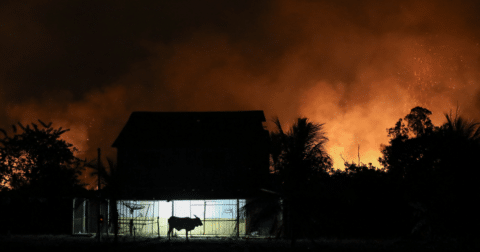
Brazilians will soon head to the polls to elect their next president, and the two leading candidates’ environmental policies couldn’t be more different. Incumbent President Luiz Inácio Lula da Silva, usually referred to as Lula, has dramatically reduced deforestation in the Brazilian Amazon over the last four years, but his main opponent in the race wants to do the exact opposite. Brazil has made serious gains in fighting deforestation under Lula. Is all of that about to come to an end?
The Amazon rainforest, the majority of which is in Brazil, is an incredibly important resource in the fight against global warming, as its roughly 390 billion trees capture around 2.4 gigatons of carbon dioxide from the air every year, preventing it from warming the atmosphere. Deforestation is threatening the rainforest’s ability to remove carbon, and the country’s next president will play a major role in determining the future of Brazil’s forests.
Up to two rounds of voting will determine Brazil’s next president. The first, on October 4, will include a wide array of candidates. If none of them win a majority, the top two vote-getters will advance to a runoff vote to be held on October 25. Polling strongly suggests that Lula and Senator Flávio Bolsonaro will advance to the runoff, and that when they do, the vote will be extremely close.
Flávio Bolsonaro is the son of Jair Bolsonaro, Lula’s predecessor. A pro-development politician who largely opposes environmental regulations, Jair Bolsonaro spurred an enormous increase in deforestation during his presidency, and his son is expected to pursue a similar path if he wins.
People deforest land for a number of reasons, including logging, gold mining and palm oil production. But beef production is by far the leading driver of deforestation worldwide and in the Brazilian Amazon specifically, with developers clearing trees to make way for cattle pastures.
Deforestation has a number of serious environmental consequences. Trees can help keep global temperatures in check by capturing carbon dioxide from the atmosphere, but when they’re removed, that benefit disappears. Burning the trees down, a common method of deforestation, releases the carbon dioxide the trees had trapped back into the atmosphere. Research also points to another loss: once the forest has been cleared, it loses the ability to store carbon for the future too (unless it is rewilded), something researchers describe as a “carbon opportunity cost.” The damage is happening to other uncultivated landscapes too, like the Cerrado, also located primarily in Brazil.
Clearing forests is also disastrous for the animals who live, breed and hunt in them. In 2020, forest fires in the Pantanal region of the Brazilian Amazon killed an estimated 17 million vertebrates — and that was just one region in one year. A 2021 report from the Science Panel for the Amazon found that more than 10,000 species of plants and animals in the Amazon are at risk of extinction due to deforestation. This type of “mutilation of the tree of life…is a serious threat to the stability of civilization,” because it disrupts the food webs and ecosystems that humans rely on for food and a livable environment, researchers wrote in 2021.
Many Brazilians make their living working in agriculture, logging or gold mining — industries that often require deforestation to expand. These folks don’t want restrictions on deforestation to affect their livelihoods, and neither do the companies that profit from clearing and repurposing forested land.
Because of this, politicians like presidential candidate Flávio Bolsonaro’s father and Lula’s predecessor, Jair Bolsonaro, support making it easier to deforest the Amazon. Jair Bolsonaro made several moves to increase and expand deforestation in the Brazilian Amazon during his single four-year term as president. He sharply reduced enforcement of environmental regulations aimed at protecting the Amazon, reduced deforestation monitoring, cut the budget of the country’s main environmental agency and appointed pro-development politicians to oversee environmental and agricultural policies.
Jair Bolsonaro also suspended the Amazon Fund, a government initiative that solicits donations and investments to combat deforestation and protect the Brazilian Amazon. In addition, he cut staff at the Brazilian Institute of Environment and Renewable Natural Resources, which helps enforce the country’s environmental regulations.
“[Jair] Bolsonaro was in fact very clearly in favor of increasing Amazon deforestation,” Steve Schwartzman, leader of the Environmental Defense Fund’s tropical forests initiatives, tells Sentient. “He thought that Brazil did have a serious problem with deforestation: There wasn’t enough of it. He believed that deforesting the Amazon is the road to development and progress, and consequently, he did everything he could to dismantle and disable Brazil’s law enforcement capacity in the Amazon.”
Under Jair Bolsonaro, who once blamed “environmental psychosis” for popular opposition to deforestation, annual deforestation hit a 15-year-high. It also rose by 60% during his term compared with the four-year average of his predecessor. In total, more than two billion trees in the Amazon were destroyed during his presidential term.
But in 2022, Jair Bolsonaro lost reelection to Lula, who immediately reversed course to protect the country’s rainforests.
In Brazil, presidents are restricted to two consecutive terms, then, after at least a one-term gap, they can be reelected. Lula served two terms as president from 2003 to 2011, during which he aggressively pursued an anti-deforestation agenda. He continued along this path after returning to office in 2023.
Some of Lula’s recent environmental efforts involved undoing Jair Bolsonaro’s policies. Lula appointed environmentalist Marina Silva, who’d served as his Environment and Climate Change minister in the 2000s, back to her old position. He reestablished the Amazon Fund, increased enforcement of anti-deforestation policies and stepped up raids of illegal deforestation operations.
Lula also reinstated the Action Plan for the Prevention and Control of Deforestation in the Amazon, which he had implemented during his previous terms but was revoked by Jair Bolsonaro. In addition, he created the Interministerial Committee on Climate Change to coordinate environmental enforcement activities between agencies.
These endeavors paid off: During Lula’s first year in office, deforestation in Brazil fell by 50%. In the first half of 2026, it reached its lowest levels in a decade.
Although Flávio Bolsonaro hasn’t spoken at length about deforestation during his campaign, there are strong signs that he’ll continue his father’s approach to the issue if elected.
“Flávio Bolsonaro, like his father, can do a lot of damage — and if elected, he very likely will,” Schwartzman says. “His positions are very consistent with those of his father.”
If Flávio Bolsonaro wins, he could reverse many of the course corrections Lula has implemented by reinstating his father’s policies.
But even if Flávio Bolsonaro becomes president, Schwartzman says the situation may not be as dire as it seems. “A lot of people think that Brazil, back in the day, reduced deforestation a lot, but then Bolsonaro came into office and blew that all away,” he says. “That’s not actually the case.”
Although Jair Bolsonaro’s presidency was certainly a setback to anti-deforestation efforts, and his policies chipped away significantly at the progress Lula had made in the 2000s, it didn’t walk back all of that headway.
“Between 2004 and 2012, [Lula’s administration] reduced Amazon deforestation by 80%, which ended up being the equivalent of reducing greenhouse gas emissions by about five gigatons,” says Schwartzman, who co-authored a paper on this topic; for context, global carbon dioxide emissions were around 38 gigatons in 2025. “In spite of everything that [Jair] Bolsonaro did, Brazil is still the world’s single-greatest greenhouse gas emissions reducer, because of what they did [under Lula’s presidencies].”
Brazil’s policies aren’t set solely by its president, as Congress plays a major role too.
Lula has had to work with a Congress that’s largely hostile to environmental protections. In 2025, lawmakers passed a sweeping set of laws that would dramatically reduce licensing requirements and regulations for developers in the Amazon. Lula vetoed many components of the legislation, but Congress overrode his vetoes. The “devastation bill,” as its opponents call it, is now in front of the Supreme Court, with the country’s Federal Public Defender’s Office arguing that parts of it are unconstitutional.
The bill “essentially gutted the regulations on licensing large-scale infrastructure,” Schwartzman says. “That’s something that could have a very serious effect” if upheld by the court.
Despite the actions of Congress and Flávio Bolsonaro, it’s worth noting that deforestation is unpopular in Brazil: In a 2022 poll, 74% of Brazilians said deforestation of the Amazon is a “very serious” problem.
“Not so long ago, people in Brazil thought that deforestation was the pathway to progress,” Schwartzman says. “The very large majority of the population now, and for quite some time, does not think that anymore.”
All of this is to say that regardless of who wins the vote, Brazil’s president won’t have unilateral power to dictate the country’s path forward on deforestation. The next president will also be accountable to Congress, the courts and the Brazilian people.
Seth Millstein is a writer and musician living in the Bay Area. He has helped launch several early-stage journalism startups, including Bustle and Timeline, and his work has been published in Bustle, Huffington Post, The Daily Dot and elsewhere.
News
Climate•4 min read

Solutions
A new report from the World Resources Institute on its Coolfood pledge initiative observes progress and challenges in curbing cafeteria emissions.
Climate•6 min read
Explainer
It all comes down to burps and land.
Climate•5 min read