News
Inside Big Beef’s ‘90s Campaign to Rewrite Its Climate Story
Big Meat•6 min read
News
Planetary emissions are already in a dangerous phase, scientists warn.

Words by Jessica Scott-Reid
The Trump administration has made moves to bring down beef prices with a proclamation to allow more imported beef. But adding more beef to America’s plates could drive global climate emissions even higher at a time when the planet’s temperature is already expected to overshoot the 1.5 degree Celsius target set nearly a decade ago in the Paris Agreement.
Researchers studying the climate effects of food production have warned that food system emissions must be cut sharply, alongside all nonfood emissions, to stay within the Paris target. Food production accounts for a third of all anthropogenic greenhouse gas emissions, and beef is far and away the largest driver of food-related emissions. Yet Americans still eat more beef than most people in other countries — four times the global average in 2023.
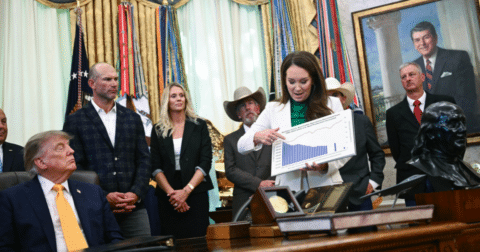
Late last month, President Donald Trump issued a presidential proclamation temporarily allowing more imported beef into the United States. Starting September 1, an additional 100,000 metric tons of beef trimmings can be shipped into the country at lower tariff rates for 90 days. The White House says the move is meant to increase the supply of imported beef trimmings and bring down prices while American ranchers rebuild domestic herds — a priority for the Trump administration.
As reported by the Wall Street Journal, Trump’s announcement came just one day after a meeting in the Oval Office between the president and Joesley Batista, reported by Forbes to be one of the largest shareholders in global meat conglomerate JBS. The two reportedly discussed how beef supplied from Brazil, where JBS is headquartered, could help bring down the cost of beef in the U.S. if Trump dropped a 26% import tax. The Wall Street Journal notes it is unknown who called for the meeting between Batista and Trump.
The announcement was met with criticism by some in the agriculture industry. “Farmers and ranchers are extremely disappointed to learn that President Trump plans to flood the American market with hundreds of millions of pounds of foreign-raised beef. The U.S. is already importing beef at record levels,” said American Farm Bureau Federation President Zippy Duvall in an August 21 statement. He adds that for nearly a year the group has “been advising the administration that America’s ranchers are working to rebuild beef herds that had to be sold off due to drought,” sharing concerns that the plan to import more foreign beef products could undermine recovery and discourage ranchers from expanding their herds.
Earlier this year, beef was featured in the protein, dairy and healthy fats group at the top of the new inverted food pyramid in the revamped American dietary guidelines as part of Secretary of Health and Human Services Robert F. Kennedy Jr.’s efforts to “end the war on saturated fats.” The secretary has faced criticism due to conflicts of interest in the development of the guidelines, with several members of the panel tied to the meat and dairy industries. Climate scientists and researchers have also criticized the guidelines for overlooking the climate impacts of red meat.
While the Trump administration says its intentions are to rebuild the U.S. beef supply, much of the climate research suggests that people living in wealthier nations, or the Global North, need to be eating less, not more beef, in order to help mitigate climate change.
This body of research has been growing for decades. In 2013, the UN Food and Agriculture Organization published its landmark report Livestock’s Long Shadow, which was an early effort to calculate global greenhouse gas emissions for meat production. While the figure varies depending on the researcher’s models, the range is between 12% and 19.6%, according to the Breakthrough Institute.
Two other subsequent reports, one from the World Resources Institute and another from the EAT-Lancet Commission, found that in order to feed the world’s growing population and keep global greenhouse emissions from going past the targets set at the Paris Climate Convention by 2050, most people residing in the Global North would need to eat less beef.
More recent studies have arrived at similar conclusions. A 2023 study found that cutting meat and dairy consumption in half would reduce emissions by a third by 2050.
Trump has repeatedly dismissed climate change as a “hoax” and a “scam,” rolling back numerous federal policies aimed at addressing environmental harms. Now, as the Trump administration moves to increase beef imports to bring down prices, it faces pushback from two very different directions: American beef producers and concerned climate scientists.
Jessica Scott-Reid is Sentient's Disinformation Correspondent covering disinformation, misinformation and the impact of both on culture. A freelance journalist based in Canada, Jessica has covered animals, the environment and food systems for major media in Canada and beyond, for the last decade. Jessica has been a contributor to Sentient since 2019, and her work also appears regularly in The Globe and Mail, Toronto Star, Winnipeg Free Press and Corporate Knights Magazine.
News
Climate•4 min read

Solutions
A new report from the World Resources Institute on its Coolfood pledge initiative observes progress and challenges in curbing cafeteria emissions.
Climate•6 min read
Explainer
It all comes down to burps and land.
Climate•5 min read