Feature
NOAA Fisheries Takes A ‘Sharp Turn Away From Science’
Policy•5 min read
News
Farmworkers on H-2A visas won a rare victory in federal court. But they are still being paid the wages that were just ruled illegal.

Words by Grey Moran
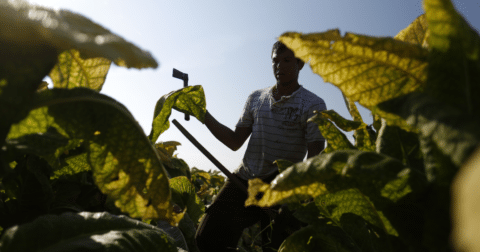
A few weeks ago, after a grueling day of harvesting tobacco in eastern North Carolina, Zapata returned to the house he shared with other farmworkers and began to vomit uncontrollably. He recalls how his chest hurt, how his muscles ached and how he began sweating profusely — all established signs of severe heat illness that can progress to death. By morning, his symptoms didn’t ease up, but he was reluctant to miss a day’s worth of pay. At just $11.15 per hour, every day counts.
“That night I stayed awake until five in the morning, when we were already heading to work. When we got up at 5 am, I was the same, vomiting, vomiting,” he tells Sentient, in Spanish. He tied a girdle around his waist because he felt like his “stomach was open.” Still dehydrated from a night of vomiting, he forced himself to go to work, moving quickly between rows of yellow tobacco under a punishing sun.
Based on his symptoms and the extreme heat that day, he believed that he was most likely experiencing heat illness. He also knew he couldn’t afford to take a day off without cutting into his paycheck, the lowest he’s earned since 2017. (To protect his privacy, he asked to be identified by only his last name.)
Zapata is among the hundreds of thousands of migrant farmworkers who legally travel to the United States — the vast majority coming from Mexico — to temporarily work on farms under an agricultural visa program known as H-2A.
The seasonal H-2A program is the only U.S. guest worker program with no upper limit on the number of visas issued, and is rife with documented cases of labor and human rights violations, including human trafficking. Many farmworker advocates view the program’s structure — tying a worker’s visa, paycheck and housing to a single employer — as exploitative by design.
The Trump administration has made expanding the H-2A visa program a high priority. The Department of Labor projected that the program could expand from 383,000 workers in 2025 to over 500,000 by 2034. In June the Department of Homeland Security also issued a memo effectively encouraging the non-seasonal dairy industry to tap into the seasonal H-2A workforce, which it has largely not been permitted to do before.
Though the H-2A program was designed to fill temporary farm labor shortages, Zapata is hardly temporary. He first traveled to North Carolina to harvest sweet potatoes and tobacco nearly 30 years ago, with over a decade spent on the same farm. This is the season that nearly broke him, a sentiment shared by other H-2A farmworkers. “We all feel that this year has been one of the worst,” he says.
Last October, the Department of Labor dramatically cut the pay of both H-2A farmworkers and domestic farmworkers by abruptly changing the methodology used to determine the baseline wages of H-2A farmworkers. The UFW Foundation, the nonprofit sister branch of the United Farm Workers labor union, has described this as “one of the largest wealth transfers from workers to employers in U.S. agricultural history,” projected to deprive workers of $2.46 billion annually.
This wage methodology also violates federal law. On August 25th, a federal judge sided with the United Farm Workers in a lawsuit, determining this historic wage cut to be unlawful in a rare legal win for farmworkers during the Trump era. The judge ordered the Department of Labor to come up with a new methodology for calculating farmworkers’ wages. Until then, the illegal wages remain in effect.
“It is a half victory, but there’s still a long way to go with the fight,” says Eli Porras Carmona, a farmworker and organizer with El Futuro Es Nuestro, a farmworker rights organization led by H-2A farmworkers in North Carolina. “They still haven’t raised the salary like it was in previous years to $15 or $16, depending on the qualifications of the worker.”
In Zapata’s case, he’ll continue to be paid $11.15, more than 30% less than the $16.16 he was paid in 2025 on the same tobacco farm. This has forced him to make incredibly difficult financial choices between paying for his groceries or sending money back home to his wife and two children, who live in central Mexico.
“We just barely get by,” says Zapata. At the time of the interview, he was preparing to travel into town to send money to his family, but after that, he will be “left with nothing.”
Until a new wage is in place, farmworkers across the United States will continue to work for the dangerously low wages, pushing an already precarious workforce into deeper financial strain. This has disastrous consequences that extend to all aspects of their lives, from their physical health to affording the basic necessities of survival.
“This has caused them to be able to afford less groceries and have to stretch meals for themselves and their families,” says Diego Iñiguez-López, the director of government affairs at UFW Foundation, which represented farmworker plaintiffs in the lawsuit challenging the Trump administration’s rule.
This level of financial strain can heighten the risk of injuries among farmworkers like Zapata who fear missing a day’s wages even for serious health issues. “There is a risk of dying or getting serious conditions because you’re trying to work as hard and as much as your body can take,” says Leticia Zavala, a former farmworker and a staff organizer at El Futuro es Nuestro.
Beyond that, she has observed “mental anguish” among farmworkers from not only financial hardship, but the feeling of being abandoned by the many long-term employers who quickly slashed wages at the first opportunity. People thought “that their grower recognized them as human beings and gave them credit for the success of the business that has grown over years and years of harvesting together,” says Zavala, and then felt “discredited” when those employers handed them a severe wage cut.
In North Carolina, the nation’s fifth largest employer of H-2A farmworkers, the tobacco harvest season is nearing its end. As the leaves ripen from green to yellow, farmworkers typically work six days a week in a rush to harvest the last of the cash crop. It’s always strenuous, but now there is the added pressure of earning the lowest wages in about a decade.
Zapata compares this period to his early years as an H-2A farmworker. “In those years, we were working about 60 hours per week at $7.25,” he says, for a total of about $435 per week. Yet this money stretched further then. Accounting for inflation, $435 in 1997 had the same purchasing power as about $915 today. Back then, his groceries rang up to around $40 or $50 per week.
Now, due to inflation and the rising cost of food in the United States, his effective wages are much lower. “We’re working practically 50 hours a week,” he says. If we multiply that by the $11.15, he earns about $560 a week, but then spends around $130 on groceries and necessities, leaving him with around $430 per week. “So there’s very little left over to be able to send to Mexico,” he says.
This work takes a physical toll for little pay. Tobacco is a particularly noxious crop, doused with agricultural chemicals sprayed by a tractor that leaves the ground and leaves wet and smelling of poison, he says. Then there’s the risk of contracting acute nicotine poisoning from the nicotine on the tobacco leaves, especially after it rains or dew lingers on the leaves, seeping into workers’ skin and bloodstream. Overlapping with many heat illness and pesticide poisoning symptoms, this can also trigger dizziness, nausea, vomiting and insomnia.
“It’s a lot of work, heavy and tiring and dirty,” he says. “All the [agricultural chemical] products are very harsh. Exposing ourselves to the sun, and the [rain] water, and then we get hives on our bodies and get dizzy and we vomit.” (Zapata never received a medical diagnosis, so it’s possible his symptoms were caused by nicotine or pesticide poisoning instead of or in addition to heat illness.)
LIke many H-2A farmworkers, Zapata doesn’t have a car in the United States and only leaves his farm and employer-owned housing once a week to go into town with his coworkers. There, they send paychecks to their loved ones and pick up groceries. The wage cuts have limited H-2A farmworkers to buying just bare necessities on their weekly trips into town. As farmworkers spend as little as possible, it’s affected local economies.
“Even here, at the Mexican stores, the lunch ladies are saying that, you know, it’s affected their economy because there’s less people spending and eating out, less H-2A workers,” says Zavala. “An employee at Walmart asked me, like, ‘Well, why aren’t people spending money like they were last year?”’
While far from set in stone, the new rule offers farmworkers a way forward and rare hope in what has been one of the hardest seasons in the H-2A program’s history.
“This is a great victory for farmworkers and now it’s important to get the word out to them about potential back pay and make sure we understand that this is going to be a long-term legal battle,” says Iñiguez-López of UFW Foundation.
“There’s much more work to be done to actually get new wages,” adds Iñiguez-López. “We have to continue going to court, and getting the Department of Labor and the Trump administration to actually comply with the order under the court, and then we have to still get an order from the judge for the back pay, so that that process can begin.”
On September 2, the Department of Labor issued the first of the updates mandated by the court order, which requires it to give notice on back pay and periodic status reports on the steps toward “producing the required new methodology” to determine H-2A farmworker wages.
The update repeatedly pointed to the possibility of appealing the decision.
“The Department’s compliance with the Order shall not be construed to waive its rights to seek further review of and relief from the Order,” states the update. “Nor shall the Department’s compliance be construed as an admission that a Court has the authority under law to compel DOL or employers to cause back wage adjustments for the reasons set forth in the Court’s Order.”
The update also notes that “certain employers may be required to make back wage adjustment payments” for the period from September 2nd until the Department of Labor issues a new wage methodology. But at the same time, the agency appears poised to fight this prospect, announcing its plans to “advance its position against the future imposition of any back wage-adjustment obligations” and stating: “To be clear, no employer is under an obligation at this time to pay any back wages.”
As the dust settles, Porras Carmona advises that farmworkers hold onto their pay stubs in case they need documentation to receive back pay to compensate for the illegal wages. Beyond that, he encourages farmworkers to continue to organize — whether by sending letters to the Department of Labor or holding vigils to honor the lives of farmworkers who died — and to “not give up halfway through the fight.”
Grey is an award-winning investigative journalist with Sentient who is based in Durham, North Carolina. They have written for Civil Eats, The Guardian, The Atlantic, The New Republic, Al Jazeera, The New York Times, The Intercept, Guernica, The Nation, New York Magazine, Popular Science, Mother Jones, The American Prospect, Teen Vogue, Grist, Autostraddle and The Center for Public Integrity. Their articles have been anthologized in No Planet B, published by Haymarket Books, and The Best American Food Writing, edited by Mark Bittman.

News
Meat Lobby•5 min read
Explainer
The law survived sustained attacks from Congress, the Trump Administration and Big Pork. How is it so resilient?
Factory Farms•7 min read

Fact Check
An expert on migrant farmworker health describes how this population has been blamed and put at risk, but seldom understood.
Policy•6 min read