News
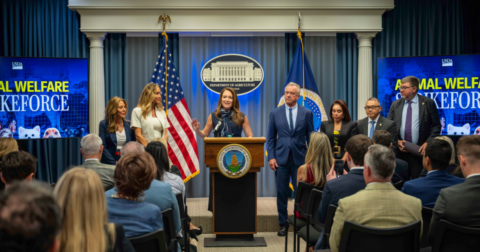
Trump’s ‘New Era of Animal Welfare’ Excludes Almost All Farm Animals
Policy•5 min read
News
When EU parliament members have financial ties to agriculture, environmental laws may take a hit, according to a new study.
News • Meat Lobby • Policy

Words by Sophie Kevany
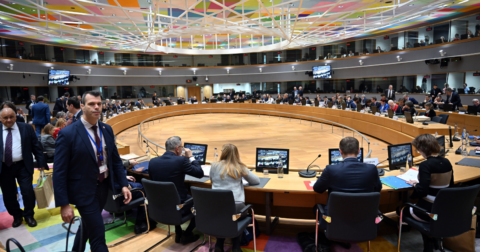
EU Members of Parliament with personal financial interests in the agriculture and food sector were three times more likely to vote against environmental protection laws, a new study finds.
The authors of the study say their analysis could help “explain the lack of consistent legislative support for agri-environmental legislations” and points to the need for stronger transparency and conflict of interest measures.
The study was published in the journal Food Policy on August 13.
Agriculture and food industry interests typically frame environmental laws that seek to protect land and sea habitats, reduce the use of pesticides, clean up water or control emissions as burdensome regulatory overreach that could constrain growth or profits.
“What we wanted to study is: what determines the voting behavior of Members of the European Parliament on agri-environmental legislation. So, legislation that aims to improve the environmental protection or the environmental impacts of the agricultural sector in the EU,” says the study’s lead author, Joaquín Villa-García Liria, a junior researcher with the PLAN’EAT project in Wageningen, The Netherlands.
The study focused on the time period between February 2022 and July 2024, when several major EU environmental and agricultural legislative measures were abandoned or watered down, notably the Industrial Emissions Directive, which in its final version excluded cattle farms from new emissions controls and cut the number of pig and poultry farms covered. Only one of the four measures examined in the study survived without substantial changes. This measure simplified what are called ‘Good Agricultural and Environmental Conditions’ standards, effectively weakening an obligation to keep areas of land unproductive to support wildlife habitats and biodiversity.
To understand the voting behavior of MEPs, as European parliamentary members are known, the researchers examined the voting patterns of 113 politicians. The MEPs were all members or substitute members of the European Parliament’s Committee on Agriculture and Rural Development, a body similar to the Agriculture committees of the U.S. House and Senate. The study found that the odds of the 32 members with private agriculture or food financial interests voting against environmental laws were three times higher than their odds of supporting such laws.
Examples of private financial interests in agriculture or food include owning a farm, owning shares in a meat or dairy company or receiving financial compensation for serving on the board of an agriculture or food corporation. The authors also counted the interests of MEPs’ immediate family members.
Along with private financial interests, the two other main variables included in the study were electoral incentives — the incentive for a politician to act in ways that maximize their chances of re-election — and a politician’s ideological orientation. The researchers found that ideological orientation towards the environment, which the researchers based entirely on MEPs’ national party manifestos, was significantly linked with voting in favor of environmental legislation. Of the three main variables, “the private financial interest was the only one that was statistically significant to vote against environmental legislations,” Villa-García Liria tells Sentient.
Villa-García Liria stresses that while the findings show that these two things are correlated, they cannot answer whether one causes the other.
The findings echo a 2020 study of members of the U.S. House of Representatives during the leadup and aftermath of the 2008 financial crisis. Though the American study did not focus on agriculture or environmental legislation, it similarly found that House members who owned auto industry stocks were more likely to have voted for a significant auto industry bailout law. Likewise, House members who owned stock in banks that failed or were significantly restructured were more likely to have voted for a major bank bailout. “The private financial holdings of elected officials shape how they vote on public policy,” the authors wrote. “This is alarming.”
Limitations of the European study, the researchers say, include its focus on a narrow set of laws and votes, and the difficulty of identifying the exact drivers of individual voting decisions.
European Green Party MEP Thomas Waitz tells Sentient that the basic findings of the paper reflect “the reality I work with.” He added, however, that MEPs operate within a broader structure that aims to produce large quantities of food for the cheapest possible prices. That means that they are working in an environment potentially influenced not only by personal financial interest, but a structure dedicated to producing more animal protein, more agricultural products for less,a goal that usually runs counter to environmental protection.
Another factor of EU political life Waitz highlights is the side earnings that allow MEPs to supplement their MEP salary. Investigative reports find that MEP side earnings have included income-generating activities for feed and dairy companies.
These factors can make it hard to discern whether institutional EU goals or MEP side earnings might be influencing voting more or less than MEPs’ private financial interests.
More concretely, Waitz says, there are practical solutions to limiting outside influences when MEPs vote or work on legislation. Firstly, side earnings should be limited to 50% of an MEPs salary, which stands at about €100,000 a year, or about $120,000. This, he says, would help MEPs define their priorities.
Secondly, Waitz says, senior executives from the agriculture, food and livestock industries who become MEPs should not be allowed on committees where they work on proposed legislation regarding those industries, because “that’s where you include the loopholes” that weaken laws and “have this power of really influencing how the legislation looks.”
And thirdly, MEPs who have worked on agricultural committees should be blocked from top managerial jobs in the agriculture, food and livestock industries for three years. This would help prevent the ‘revolving door’ issue between MEPs and industry, a practice in which a politician can enact laws regulating an industry, giving them inside knowledge of these laws and any loopholes they may or may not contain, and then later lead a company in that industry.
Waitz tells Sentient that he sees MEPs spend “five years making sure that the industry where they’re coming from is served best. And then after their five-year term, three months later, you find them back at the company where they were coming from.”
The European Commission did not answer questions about the study’s findings. Sentient received an email from the European Parliament press office stating that they “do not comment on the votes of MEPs, directly elected by their constituents to exercise their mandate freely and independently.”
Sophie Kevany is a freelance journalist writing for The Guardian, Sentient Media and other publications. She previously worked for Dow Jones and Agence France Presse (AFP) and has a Master’s in Journalism from Dublin City University. She has lived and worked in Ireland, the US, South Africa, France, Peru and Spain.

Explainer
Climate•10 min read

Feature
A survey taken this past spring shows a majority of Iowans say they have experienced negative environmental impacts from industrial animal operations. But plenty are also ambivalent, or ignorant, about…
Elections•11 min read
News
Mama Bear allegedly uses misleading branding on Atlantic salmon cubes sourced by Australis Foods, an aquaculture operation accused of harming Chile’s sensitive marine environment.
Legal Action•6 min read