Feature
We Asked 1,000 Iowans About Factory Farming. Here’s What We Learned.
Elections•11 min read
Explainer
What do Democrat Rob Sand and Republican Zach Lahn say they will do about Iowa’s poor water quality?
Explainer • Climate • Elections • Inside Iowa • Policy
Words by Seth Millstein
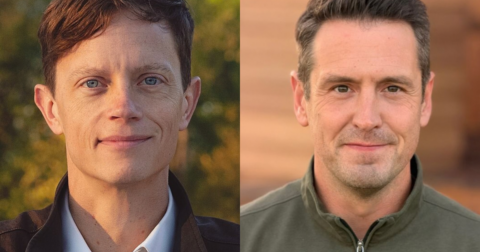
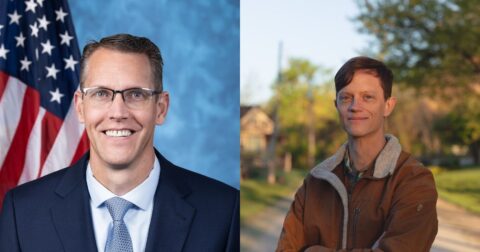
Iowans will soon elect their next governor, and the state’s water quality has become a top issue in the campaign. Democrat Rob Sand and Republican Zach Lahn have both said that something needs to be done to make Iowa’s water safer, and have linked its notoriously polluted water to the state’s elevated cancer rates. But they’ve proposed different approaches to solving the problem.
In the Republican primary, Lahn narrowly defeated a Trump-endorsed candidate in an upset. Sand is currently leading in the polls, and if he wins, he’ll be the first Democratic governor of Iowa in 20 years.
Both have spoken on the campaign trail about the need to address the state’s water crisis; much of the state’s water is badly polluted with agricultural runoff, and its residents are facing the consequences. But the two candidates bring different backgrounds, levels of experience and policy proposals to the race. Whoever is elected will have a tall order in front of them.
Here’s where each of them stand.
Iowa Democrats have nominated lawyer and State Auditor Rob Sand to run for governor. The only Democrat to hold an elected statewide executive position in Iowa, Sand was previously an Iowa assistant attorney general, where he specialized in prosecuting white-collar crime.
Sand has spoken frequently about the urgency of bringing down Iowa’s cancer rate and has pledged to tackle the issue by addressing the state’s water quality problems.
“Biggest thing, I hear it everywhere I go: Iowans are concerned about our sky-high cancer rate,” Sand said in a recent campaign video. “It’s one of the top issues in people’s minds, and rightfully so.”
Sand’s campaign website includes a long section on water quality, with many policy proposals.
Many of the policies Sand proposes, such as reforming the manure management plan law and restoring funding to state water quality monitors, would require approval from the state legislature. Republicans currently control Iowa’s legislature, and will almost certainly continue to control it after the November election, but the Democratic candidate says he is prepared for that.
“Iowa has a tradition, actually, of divided government, because it forces the two parties to work together,” Sand said in an interview with KCCI. “And I know that’s what we’re going to have if I win this race. I think that’s our recipe for getting Iowa back to being Iowa.”
Sand’s campaign did not respond to Sentient’s request for comment for this article.
On the Republican ticket, businessman Zach Lahn is running to be Iowa’s next governor. Lahn’s background is in business and political campaigns and he has never held political office. After founding and investing in a number of companies, Lahn worked for a string of Republican candidates and politicians around the country, including Iowa Rep. David Young, Montana Sen. Steve Daines and former Colorado Sen. Cory Gardner.
Lahn also served as the Montana director for Americans for Prosperity, the conservative political advocacy group funded largely by Koch Industries. Among Koch Industries’ many companies is Koch Ag & Energy Solutions, one of the largest fertilizer manufacturers in the world.
Lahn comes from a farming family. The Des Moines Register reports that Lahn owns a home in Kansas and frequently flies there in his privately owned plane.
Lahn doesn’t have an extensive list of water-related policies on his campaign website. His site contains one sentence that directly concerns water quality: “Give incentives to our farmers to use proven solutions that address agricultural runoff and water contamination.”
In response to Sentient’s request for comment, the Lahn campaign writes in an email: “Cleaning up Iowa’s water quality and stopping the cancer crisis are [Lahn]’s number one issues in this race. High nitrate load in water is one of the top causes of cancer.”
On the campaign trail, Lahn has also spoken about water quality and what he would do to address the issue.
Some have questioned Lahn’s position on this, however, due to his selection of State Rep. Derek Wulf as his running mate for Lieutenant Governor.
Iowa reporter Laura Belin has reported that Wulf supported a bill that would grant immunity to pesticide manufacturers. In 2024, an agricultural lobbying group founded by Bayer ran an ad thanking 28 Iowa legislators, including Wulf, for supporting Senate File 2412, a bill that would have shielded glyphosate manufacturers from lawsuits. (That bill did not pass.)
In response to Belin’s reporting, Lahn’s campaign emailed her. “Wulf has never stated that he supported this legislation,” Lahn spokesperson Meg Deneen told Belin in an email. “Derek Wulf does not support Senate File 2412.”
Lahn supports the Make America Healthy Again movement and has been endorsed by MAHA Action, a non-profit aimed at implementing the movement’s preferred policies. However, he’s also said that he does not support an outright ban of glyphosate, which many people in the MAHA movement have called for.
Lahn and Sand have put forth different sets of proposals to deal with water quality. Although both want to make it easier for farmers to implement practices that clean up Iowa’s water, Sand also wants to increase funding for water quality monitoring systems, build a dirty water notification system, purchase unused land to convert to pollutant-filtering wetlands, implement new conservation tax credits for farmers, and create a cancer task force.
The two candidates agree on several policies as well. Neither have proposed raising taxes or implementing new regulations to clean up Iowa’s water. Both support funding the IWILL program, and both oppose granting immunity to glyphosate manufacturers.
It’s notable that Sand and Lahn agree that the state is in the midst of a water crisis and that Iowa must increase its water quality monitoring for the sake of its residents.
In a sense, it’s a sign of how urgent Iowa’s water situation has become.
Seth Millstein is a writer and musician living in the Bay Area. He has helped launch several early-stage journalism startups, including Bustle and Timeline, and his work has been published in Bustle, Huffington Post, The Daily Dot and elsewhere.
Inside Iowa•8 min read

Find out how much manure is in your backyard.
Inside Iowa•9 min read
Investigation
Executives in the ethanol, egg, and meat and dairy byproduct industries have spent millions of dollars on the ongoing race.
Elections•9 min read