We Mapped All 11,000 Factory Farms in Iowa. Here Are Five Things We Learned.
Inside Iowa•8 min read
Feature
A survey taken this past spring shows a majority of Iowans say they have experienced negative environmental impacts from industrial animal operations. But plenty are also ambivalent, or ignorant, about their presence.

Feature • Elections • Inside Iowa • Policy • Politics
The professor of political science remembers the neighbors emptying the waste from thousands of birds onto fields. She and her brother would break out into rashes.
An Independent voters organization co-founder and farm owner remembers his dad, who raised beef cattle and hogs, calling the smell of manure “the smell of money.” It was the smell that never seemed to wash off, off his hands, off his clothes.
For so many Iowans, factory farms color formative memories. And then there are the Iowans living this now: the polluted private wells and the cancer crisis, the neighbors and the workers, those fighting and campaigning for clean water and the companies themselves, and the people who make their living working for them.
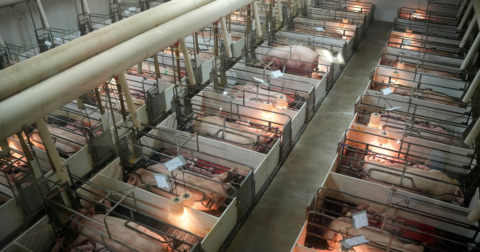
The team at Sentient wanted to know what the state with the most factory farms and agricultural waste really thinks about the large-scale, industrial animal agriculture operations that have come to define Iowa. Factory farms, as they are often informally called, are more formally known and defined by regulators as Concentrated Animal Feeding Operations, or CAFOs. They are characterized by the large number of animals they house, as well as the pollution that shapes surrounding landscapes and water and air quality. These large systems also indirectly drive some of the row crop agriculture that can have other negative effects on the environment. And as the only nonprofit newsroom focused directly on factory farming, we wanted to see where people stand on these deeply entrenched systems.
So we asked them.
With the help of a company called SimpleOpinions, Sentient this spring conducted a 10-minute online survey of a representative sample of 1,051 Iowans about their opinions on factory farming and its role in shaping Iowa’s environment, economy and other facets of life.
Their answers show commonalities between people across the state, and help illustrate why water quality is becoming a defining issue of the upcoming election this fall. But they’re also riddled with contradictions. Some answers fall along expected party lines or demographic qualities like gender, geographic location and education level, but others don’t. Many Iowans aren’t sure how they feel – some because they’re of two minds about the issue, others because they’re ignorant of it.
So to make sense of the results, we sent the survey to professors, community groups and politicians running for and currently holding office at the state and federal level. Our outreach to state and federal leaders included contacting the press teams of gubernatorial candidates Rob Sand (Democrat; currently serving as Iowa state auditor) and Zach Lahn (Republican), Senate candidates Josh Turek (Democrat; currently serving in the Iowa House of Representatives) and Ashley Hinson (Republican; currently serving in the U.S. House of Representatives), House of Representatives candidates Christina Bohannan (Democrat) and Mariannette Miller-Meeks (incumbent Republican), candidates for secretary of agriculture Chris Jones (Democrat) and Mike Naig (incumbent Republican) and Iowa state Senator Catelin Drey (Democrat), whom Sentient has profiled. Lahn and Jones responded to requests for comment.
What we found is an Iowa at a unique moment in its history, with more of its citizens becoming aware of the vast power and environmental toll exerted by factory farming, and yet with many still unaware of or disengaged from that fact. It’s a moment that experts described as ripe for education and change.
Karen Kedrowski is the political scientist who would break out in hives as a kid, a professor at Iowa State University. She tells Sentient that the longer she lives in Iowa, the more she thinks it’s like the rest of the country. What is unique, she believes, is how attached Iowans can be to their homesteading origins.
“I think we are bound together by that sort of mythology, even though that is not really reflective of the reality of Iowa today,” she says.
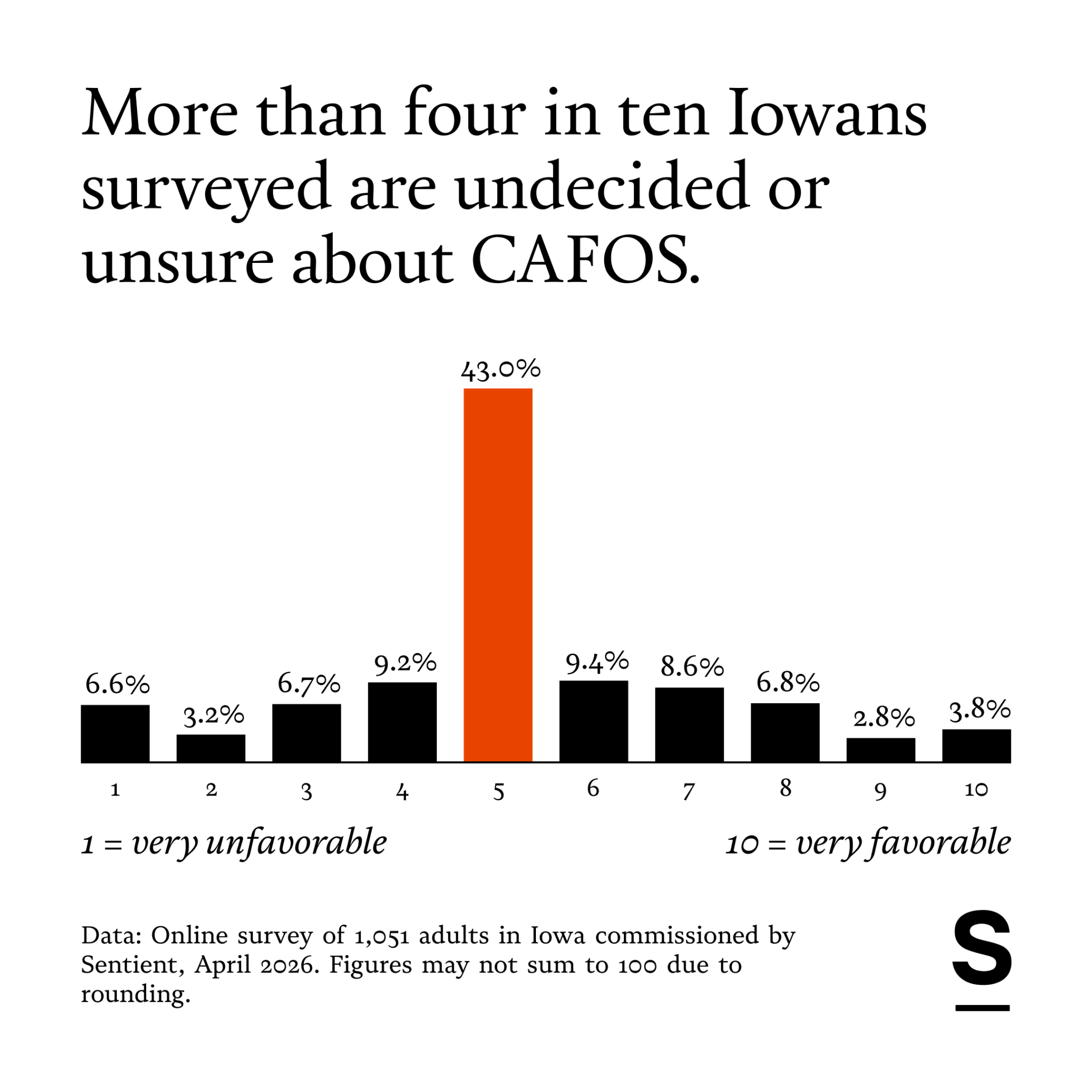
The average Iowan in the survey rated Concentrated Animal Feeding Operations, or CAFOs, just below a five out of 10 (46.5 out of 100) when asked to give an overall favorability score. Forty-three percent of respondents scored them exactly five out of 10, meaning they were neither in favor of nor against them. A smaller number of respondents, in about equal numbers, have more polarized views in favor or against CAFOs.
Republican or Independent voters (and those who identify as Republican-leaning) generally show more support for CAFOs than Democrats, according to the survey. But the differences along party lines are only moderate. The average Republican voter gave CAFOs a favorability score of 51.1 out of 100, compared to 48.2 for Independents and 41.3 for Democrats. Gender is also important: women tend to show less support for CAFOs than men (other genders took part in numbers too small for the results to be reliable), and this effect remains after adjusting for the fact that women are more likely to vote Democrat.
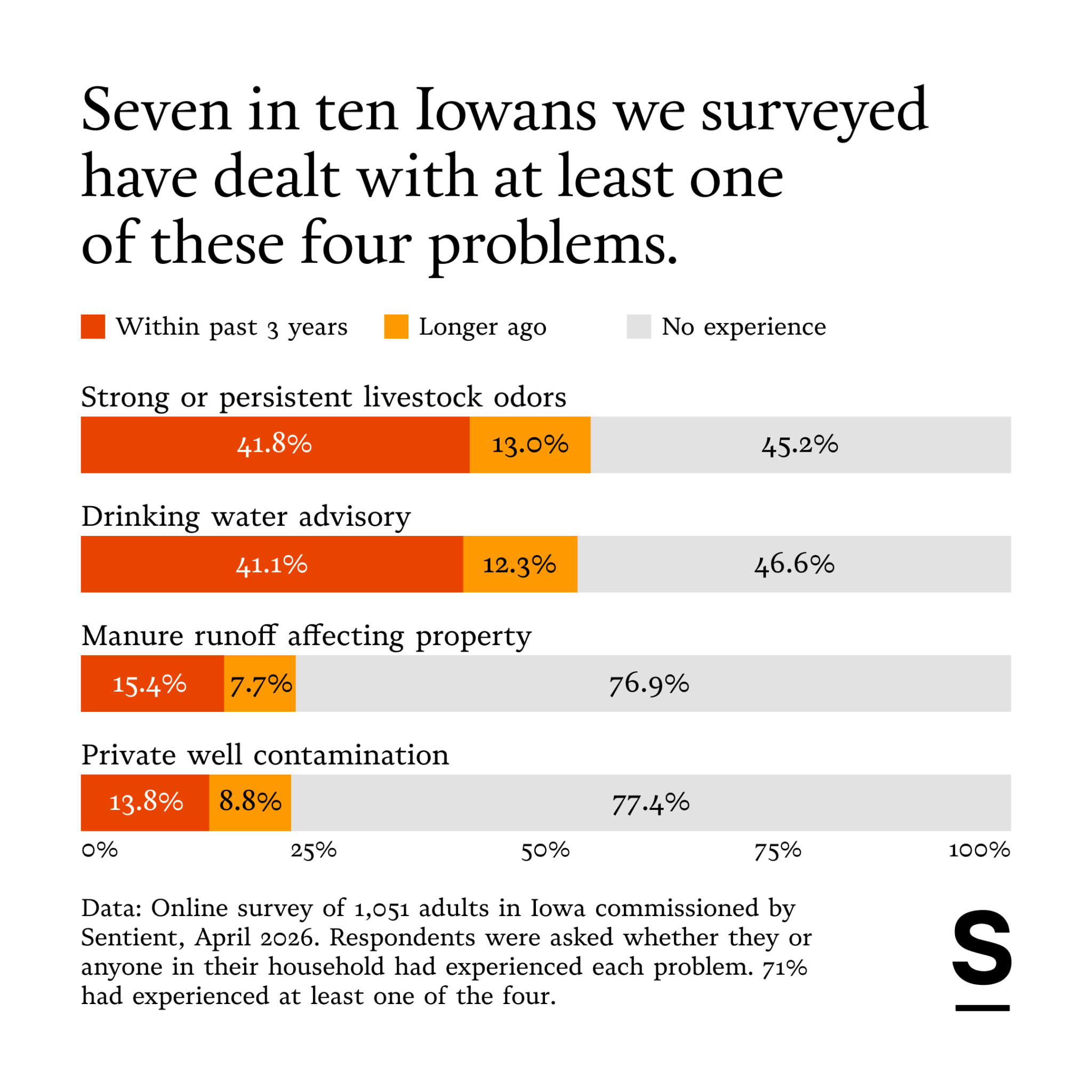
David Peterson, a political science professor at Iowa State University, tells Sentient he had expected Iowans to view agriculture more positively, since it’s so important to the state. But the survey also revealed that many have seen, felt and smelt the consequences of CAFOs, with over half of those surveyed (53%) experiencing a drinking water advisory at some point. People who have experienced at least one negative effect from a CAFO — namely a drinking water advisory, contamination of a private well, livestock odors or manure runoff on their property — are, on the whole, less likely to support them.
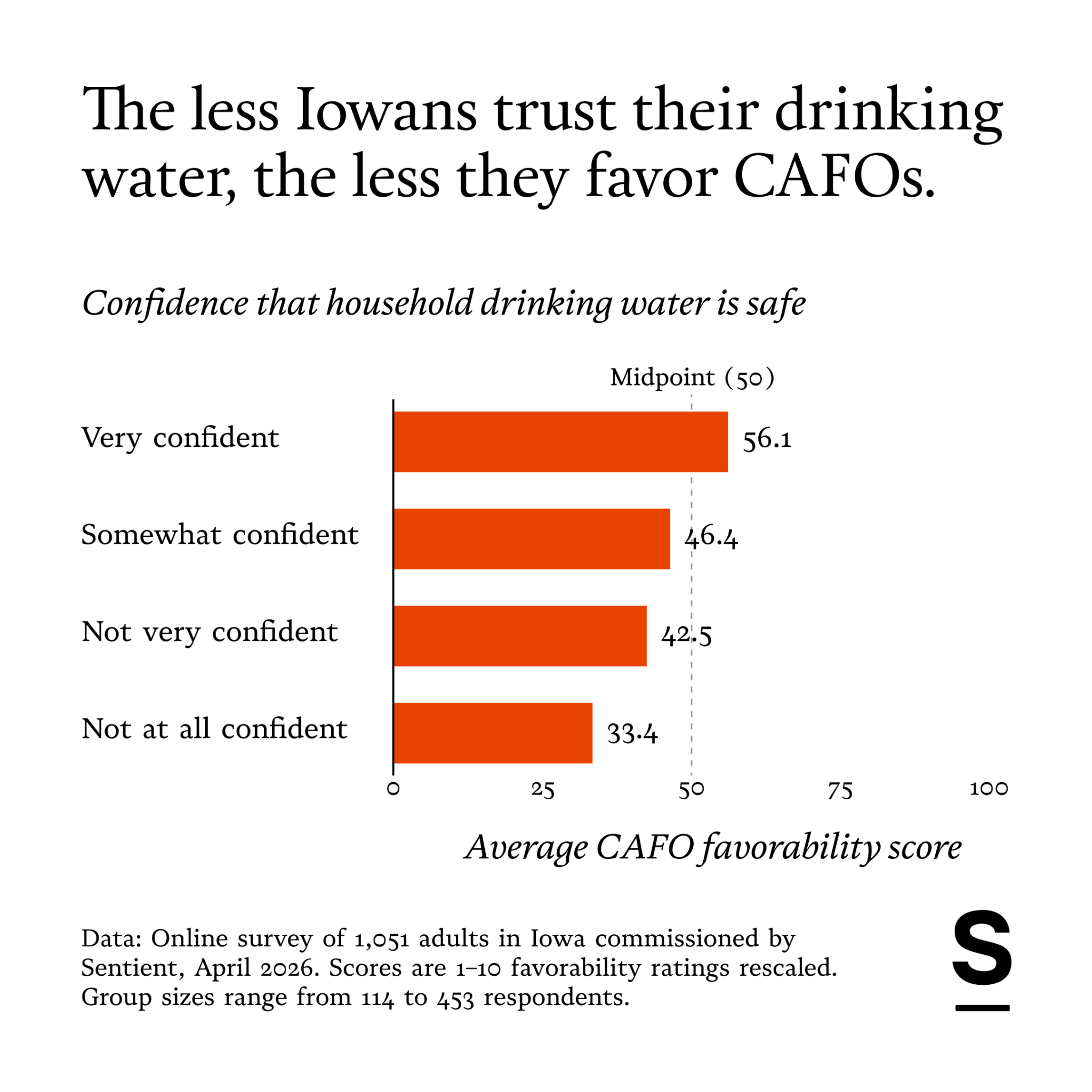
Peterson has noticed that “concerns with water are really breaking through in this state,” which he says isn’t necessarily a partisan issue. Other public opinion research has substantiated that, with a Johns Hopkins Center for a Livable Future-commissioned survey of 800 Iowans from July of this year finding more than half each of Republicans, Independents and Democrats were concerned about water quality. In the Sentient survey, those who lacked confidence in the safety of their drinking water were also far less supportive of CAFOs.
These worries reflect wider health concerns about factory farming in Iowa. It has the second highest cancer rate of all US states — a fact that may be linked to agricultural pollution from pesticides or nitrates from manure runoff. Although it can be difficult to prove definitively that specific environmental factors cause cancer, evidence does suggest an association between nitrates in drinking water and the development of certain cancers.
The environmental and health impacts of factory farms touch everyone, says Katie Roth, co-founder of All Votes Count Iowa, an organization that advocates for Independent voters.
“I think universally, some of these issues that people are concerned about are really across the board. I don’t think they’re identified with Republicans or Democrats. I mean, who can not be concerned about rising cancer rates?” Roth tells Sentient.
Another strong predictor for support of CAFOs was the respondent’s degree of trust in regulators like the Iowa Department of Natural Resources. Those who trust the DNR ‘a lot’ to enforce environmental regulations on livestock facilities were far more likely to support CAFOs (62.2 favorability out of 100) than those who do not trust it at all (24.1).
While many Iowans appear to be on the fence about CAFOs — with 43% of people being exactly five out of 10 in favor — behind that are some mixed feelings.
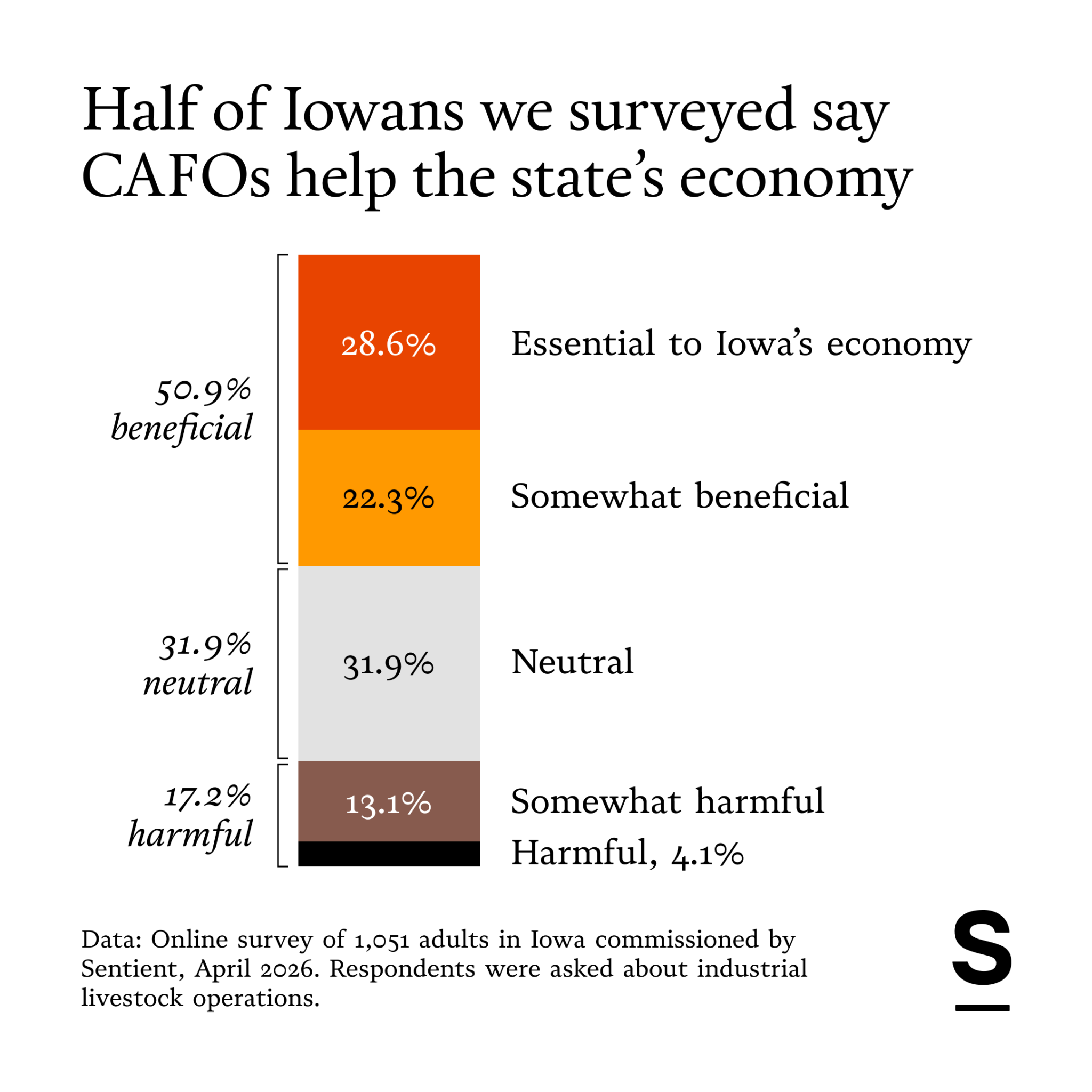
There’s a recognition of the real environmental hazards, but also of the jobs and economic benefits they can bring in a state so centered on agriculture. Over a quarter of survey respondents (29%) said they believed industrial livestock operations were essential to Iowa’s economy and a further 22% said they were somewhat beneficial. People living within 10 miles of CAFOs were somewhat more positive about their economic role. And people with someone in their household working in the agriculture or food processing industries were more supportive of CAFOs in general, although only slightly (51.1 average favorability compared to 46.5 across all respondents).
“I think affordability is top of mind for a lot of people, and so the idea of cutting the ag[ricultural] economy down in some way makes people reluctant to push for changes,” Michael Schmidt, general counsel for the Iowa Environmental Council, tells Sentient. Schmidt doesn’t see a productive farm economy and a healthy environment as mutually exclusive. “But how we get there is not something that I think most people think about very much. And so then it’s kind of this split that they have in their mind.”
That split comes through in some respondents’ answers to open-ended questions about why they gave CAFOs a certain favorability score. “I know the benefits of [them] but I still am unsure of whether [they are] safe or not,” one survey taker wrote on factory farms. “They have benefits for some and provide jobs but diminish air quality,” wrote another.
A spokesperson for Republican gubernatorial candidate Zach Lahn writes to Sentient that “we can have clean water and a prosperous farm economy at the same time,” and that cleaning up Iowa’s water quality issues is one of the main reasons Lahn got into the race.
“It’s like looking at a forest that is dry, that’s just waiting for a match,” agricultural and antitrust expert Austin Frerick, author of the book Barons, tells Sentient. “This production model is directly impacting people’s lives in a negative way, and they feel it. At some point, someone’s going to come along and tap into it.”
Although many Iowans were ambivalent about CAFOs, plenty of others wrote that they simply didn’t have enough information about them to form an opinion. Those who live closer to CAFOs were, unsurprisingly, more likely to say they knew something about them — and tended to have stronger opinions either for or against. But about half of people overall (49%) considered themselves ‘not knowledgeable’ about CAFOs or had never heard of them.
When somebody responds that they “don’t know” or “aren’t sure” how they feel, data can’t always explain the reasoning behind that, says Andreas Jozwiak, an assistant professor at Grinnell College who studies comparative politics.
“We think in political science a lot about the median voter, and this means that that middle person, that pivotal vote, doesn’t know how they feel about this,” Jozwiak tells Sentient. He thinks that suggests “a lot of potential for political messaging to influence” how Iowans and Midwesterners broadly feel about CAFOs.
Democratic Iowa agriculture secretary candidate Chris Jones says it’s common at campaign events to have to define CAFOs to his audience. He says the system has been in Iowa for so long that many people have forgotten what was there before, what he describes as a smaller patchwork of pastoral animal farms.
“I’m trying to communicate these things effectively, and right now at this point in my life, a political campaign was the best way to do that,” Jones says.
It’s a gap that matches with survey respondents’ dissatisfied views on the media. A majority didn’t think local or national media adequately covers factory farms, with 25% saying local media coverage of nitrate pollution is adequate, and that number dropping to under 17% for national media. This contrasted with other environmental issues like road construction (58% thought local coverage is adequate) or water quality more generally (42%).
“I think that in the public debate about water quality, the people who are concerned about water quality have not drawn a clear line to the massive amount of waste — animal waste — that contributes to water quality issues,” says Kedrowski, noting that factory farms have been lumped into a broader category of agricultural practices. “I think that if they did, then you would begin to see more questioning.”
And not all those living with polluted water know it, either, says Diane Rosenberg, executive director of Iowa community education nonprofit Jefferson County Farmers and Neighbors. She pointed out that while the survey shows 23% of people have experienced private well contamination, which is often caused by manure runoff, only a small fraction of those wells are tested, according to research from the Iowa Environmental Council and Environmental Working Group.
Barb Kalbach, a retired nurse who has fought against CAFOs with the organization Iowa Citizens for Community Improvement, writes to Sentient that the survey matches her lived experience. She sees CAFOS playing a central part in the high nitrate levels in waterways, “but it has flown under most Iowans’ radars,” Kalbach writes.
But she thinks it’s possible that reality is changing, as water quality and cancer become prominent issues in the midterms — which Jozwiak says have potential to “reshuffle and reorient Iowa politics.” Multiple experts expressed a desire to see another round of survey questions, this time in the fall.
It’s a shift Jones has seen through his campaign. “I think there’s an increasing interest for sure. I mean, the fact that I have a chance of winning here tells you a lot,” Jones tells Sentient. “I think there is an awareness of the consequences of livestock production here in Iowa.”
“If people aren’t ready for a change now, I don’t know when it would be,” Jones says.

Melina Walling is a features and investigative reporter for Sentient. She reports on agriculture, climate change, science and environment and is passionate about understanding the nuances and intersections of food, labor, culture and planetary health. Her work has been published in The Associated Press, USA Today, Grist, The Arizona Republic and The Cincinnati Enquirer and other outlets. Walling is based in Chicago.

Miriam Quick is a journalist who explores novel and diverse ways of telling stories with data. Her work has been published by the BBC and Scientific American. She is co-founder of the Loud Numbers data sonification studio (loudnumbers.net) and co-author of I am a book. I am a portal to the universe. (Penguin, 2020).
Inside Iowa•9 min read
Investigation
Executives in the ethanol, egg, and meat and dairy byproduct industries have spent millions of dollars on the ongoing race.
Elections•9 min read
News
If passed by the governor, the bill would protect farms from lawsuits surrounding their greenhouse gas emissions.
Factory Farms•4 min read