Feature
What the History of Blue Baby Syndrome Tells Us About Today’s Fight for Clean Water
Factory Farms•14 min read
Explainer
The law survived sustained attacks from Congress, the Trump Administration and Big Pork. How is it so resilient?

Words by Seth Millstein
The farm bill is dead, and with it, the Republicans’ latest attempt to repeal Proposition 12. Widely regarded as the strongest animal welfare law in the United States, Proposition 12 has been under constant attack since California voters approved it in 2018, yet all of these attacks have failed. Why?
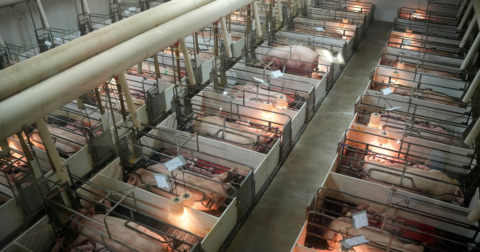
Proposition 12 forbids the extreme confinement of breeding pigs, egg-laying hens and veal calves in California and establishes specific space requirements for each species. It also bans the in-state sale of meat and eggs that were produced using extreme confinement, even if they’re from another state. As a result of this latter provision, many out-of-state producers have adopted Proposition 12’s standards in order to maintain access to California’s market.
The law has seen a large and measurable impact, and not just in California. When it was first passed in 2018, less than 20% of eggs produced in the United States were cage-free, and by July 2025, that had risen to 45.7%.
While Proposition 12 has greatly improved the lives of millions of animals, there are common livestock practices it does not address that experts regard as harmful. Piglets are still castrated, chickens are still debeaked and millions of farm animals still die in transit every year.
Nevertheless, Proposition 12 is a big leap forward in reducing the suffering of farm animals, and it’s survived in part due to the wide variety of folks who support it, from politicians and food producers to voters and judges.
It’s probably no surprise that animal welfare groups have strongly supported Proposition 12, including Animal Wellness Action and The Humane League. And several large farm industry lobbying groups have vehemently opposed Proposition 12. This includes the American Farm Bureau, the National Pork Producers’ Council and the North American Meat Institute.
However, there are exceptions to these trends. The Association of California Egg Farmers has supported Proposition 12, even filing a brief to the U.S. Supreme Court arguing that “the benefits of Proposition 12 are significant.” While the pork lobby has worked to overturn Proposition 12, many small pork farmers have come to support it, either because they’ve already invested in upgrading their facilities or because they want better welfare for their animals. And as we’ll see, a number of Republicans bucked their party and came out against Proposition 12 as well. But that was after all of the lawsuits.
Proposition 12 originated as a ballot proposition and was approved by California voters in 2018. Opposition quickly followed, with claims that Prop 12 violated the interstate commerce clause of the Constitution. First, the North American Meat Institute asked the U.S. District Court in California to issue an injunction against the law, arguing that it was a “protectionist trade barrier whose purpose and effect are to shield California producers from out-of-state competition.” The National Pork Producers Council and the American Farm Bureau filed a separate lawsuit making the same claim and arguing that the law placed an excessive and unfair burden on out-of-state producers.
These lawsuits were both rejected by the courts, including an appeal from the National Pork Producers Council and American Farm Bureau that made it to the Supreme Court. In a 5-4 ruling, the high court allowed Proposition 12 to stand, with Justice Neil Gorsuch writing that “while the Constitution addresses many weighty issues, the type of pork chops California merchants may sell is not on that list.”
Resolution of these lawsuits allowed Proposition 12 to take full effect in 2024, but the Trump Administration took another crack at it and filed a lawsuit against the state of California in 2025, arguing that it violated the Egg Products Inspection Act. But a federal judge dismissed that lawsuit in March, ruling that the administration didn’t have standing to file it, as it didn’t demonstrate any legal injury as a result of Proposition 12.
The courts were just one arena where the battle over Proposition 12 played out. The other was Congress.
Way back in 2013, Rep. Steve King (R-IA) proposed a farm bill amendment that would have banned states from regulating the sale of agricultural products made in other states. The King amendment was removed from the farm bill that same year, but it’s worth mentioning because it served as the template for many of the attempts to repeal Proposition 12 after it was passed.
In 2023, after Proposition 12 survived the Supreme Court, Sen. Roger Marshall (R-Kan) introduced the Ending Agricultural Trade Suppression or EATS Act to the farm bill. It would have effectively repealed Proposition 12, but the farm bill never passed.
Not to be deterred, Marshall and colleagues Sen. Joni Ernst (R-IA) and Sen. Charles Grassley (R-IA), introduced the Food Security & Farm Protection Act in 2025. This word-for-word reproduction of the EATS Act died in the Senate.
Republicans took another swing just months later with the Save Our Bacon Act, which was folded into the GOP’s farm bill; unlike in 2024, that farm bill passed the House of Representatives, coming closer to becoming law than any previous attempt to undo Proposition 12.
Around this time, an analysis by Harvard Law found that if passed, the Save Our Bacon Act would do far more than repeal Proposition 12. It also had the potential to invalidate hundreds of other state agricultural laws, due to how broadly the act was written.
When this version of the farm bill reached the Senate, the Senate Agricultural Committee removed the Save Our Bacon Act, reportedly because members of the committee believed it was too controversial to get 60 votes and overcome a Democratic filibuster. Ultimately, that farm bill was pulled from the calendar and not put up for a vote.
Though there were several attempts to repeal Proposition 12 from the Republican side of the aisle, others diverged. A small contingent of elected Republicans have publicly supported Proposition 12. In Texas, Agriculture Commissioner Sid Miller penned an op-ed arguing that, although he personally opposes Proposition 12, Congress would be running afoul of states’ rights if it passed a law to repeal it.
“While I don’t agree with Prop 12, I’ll defend to my dying day California’s right to self-determination, and any state’s ability to use its constitutional authority as that state’s citizens best see fit,” Miller wrote.
A group of 16 House Republicans wrote a letter echoing this argument in 2023 and urged leadership to reject the EATS Act on states’ rights grounds.
That same year, a different group of Congressional Republicans came out against Proposition 12 repeal for a different reason: They claimed that “the Chinese government, with its profound level of control of pig production in the United States” could benefit from repealing Prop 12 — an issue that’s very animating to some on the American right.
Proposition 12 has been under constant attack for the better part of a decade now, and while its opponents have come close to scrapping it, they’ve never been able to seal the deal. Why is that?
Given the many different arenas in which the fight over the law has taken place — the ballot box, the courts and Congress — there isn’t really a single answer to this.
It’s worth noting, however, how diverse the coalition for Proposition 12 has been. Animal rights activists, egg producers and even some Republicans all supported it for various reasons. It’s rare for a law to gain support from such a disparate set of stakeholders, and that diversity gives the coalition broader pull, which may help explain Proposition 12’s endurance.
“From the failed King Amendment to the EATS Act and now the Save Our Bacon Act,” Sara Amundson, president of Humane World Action Fund, tells Sentient in an email, “the vast majority of lawmakers from both parties have recognized that these proposals undermine states’ rights, disregard voter-approved laws and serve the interests of a small segment of the pork industry rather than the consumers, voters or farmers in general.”
Ultimately, Proposition 12’s survival owes something to all of these groups: Voters and consumers like it, courts approve of it, some agricultural groups support it and Congress doesn’t have the votes to repeal it. At the end of the day, that keeps a law on the books.
Seth Millstein is a writer and musician living in the Bay Area. He has helped launch several early-stage journalism startups, including Bustle and Timeline, and his work has been published in Bustle, Huffington Post, The Daily Dot and elsewhere.
News
Policy•5 min read

Explainer
What do Democrat Rob Sand and Republican Zach Lahn say they will do about Iowa’s poor water quality?
Climate•10 min read
Feature
A survey taken this past spring shows a majority of Iowans say they have experienced negative environmental impacts from industrial animal operations. But plenty are also ambivalent, or ignorant, about…
Elections•11 min read