Explainer
Where Iowa’s Gubernatorial Candidates Stand on Water Quality
Climate•10 min read
Research from over 75 years ago set today’s federal standard for nitrates in drinking water.

• Factory Farms • Health • Inside Iowa • Policy • Politics

Words by Melina Walling
The baby girl had been born healthy. Eight pounds, eight ounces.
Then came the vomiting and crying. She wasn’t gaining weight. Her parents took her to the hospital, and again a few days later for diarrhea. Each time, the doctors sent her home with a new formula mixture, first substituting skim milk for evaporated milk, then one with soybean powder, suspecting a milk allergy.
Two days later, the parents rushed their daughter back to the hospital once more. The baby was drowsy. And her skin was turning blue.
It was the first case in a report written by Dr. Hunter H. Comly in a 1945 issue of the Journal of the American Medical Association, a milestone in medicine because it connected “blue baby syndrome,” as it became known, to nitrate pollution in water from or near farms. The echoes of that report have persisted for decades. Many scientists have cited its findings, and it became a major part of the backbone of federal clean water regulations that still exist today.
Comly’s paper was an achievement, but the world it described, a world of panicked parents and puzzled doctors, has largely faded into history. That history matters, experts say, because it can illustrate what leads to change.
Decades ago, a deadly but treatable disorder threatening kids made headlines and captured the public’s attention. What followed was a well-timed push for regulation that resulted in measurable change. Hundreds of babies got sick and dozens died before the nitrate standard was put in place, but a generation later, blue baby syndrome caused by nitrate exposure has been essentially eradicated.
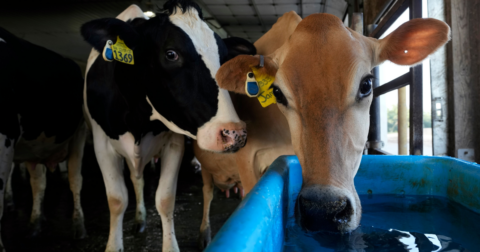
Today, in Iowa, water is treated to that same set standard. But nitrate still proliferates thanks to widespread use of synthetic fertilizer and manure runoff. The state has more factory farms than any other, nearly 11,000, that generate more than 170 billion pounds of manure.
And once again a deadly disorder, cancer, is in the limelight, and so are the effects of industrial agriculture. Many residents see the state’s rising cancer rates as a crisis and want researchers, community organizers and lawmakers to do something about it.
But the data on cancer is less straightforward than data for blue baby syndrome was in the past. And even though many experts say nitrate water limits should be studied further and made stricter, the political will isn’t entirely there yet, in particular in the executive branch.
The latest Trump administration has shuttered the office that would be charged with scientifically reevaluating the standard, and while the U.S. Environmental Protection Agency says that work was “largely transitioned” to a different office, they also say they determined the nitrate standard was not a candidate for revision.
“I think there is more to be done on the standard,” Michael Schmidt, general counsel for the Iowa Environmental Council, tells Sentient. “The blue baby effect is a short term effect, not an effect that is the result of extended exposure. And research is increasingly showing that extended exposure to elevated nitrate does increase risk of cancer, and cancer is complicated.”
According to Comly’s account, the doctors couldn’t figure out what was wrong with the baby, whom they referred to as C.H., for weeks. They wondered if a defective oil burner could be the culprit, and although the baby’s symptoms didn’t match those of carbon monoxide poisoning, Comly wrote that “a peculiar gaseous poison producing methemoglobinemia was suspected.”
Methemoglobinemia affects a protein that helps red blood cells deliver oxygen through the body, and the lack of oxygen in the blood is why the skin and other extremities like the lips and nailbeds sometimes turn blue, according to the Cleveland Clinic. Luckily, if caught in time, it has an antidote: a cobalt blue substance called methylene blue, one of the first synthetic textile dyes, also used to treat malaria by the late 19th century.
The doctors gave C.H. methylene blue on multiple visits, and eventually realized that the only thing changing between home and the hospital was the water being used to mix her formula. Her father, “loath to accept the possibility that his daughter was abnormal,” insisted on bringing a water sample to be tested, thinking maybe the well water and the soy-based formula were somehow producing a poison. Comly praised the admitting physician’s “open-minded attitude” toward this “‘cock and bull’ theory,” which ultimately led them to their answer.
Comly laid out the evidence in his 1945 report. In each of the cases Comly described in detail, in five other samples received by the Iowa State Hygienic Laboratory and in several described by other physicians, the water contained what Comly called “large amounts of nitrates,” which he surmised was ultimately causing the methemoglobinemia.
People in other states also documented the condition. A front-page article in a local Illinois paper, the Rockford Morning Star, in 1948 documented the rescue of a baby girl with the headline “Child’s Life Saved — She May Save Others.” That article, too, referenced Comly’s paper and said blue baby syndrome “has since been frequently observed in central and southern Illinois.” Between the late 40s and early 50s, local papers across the Midwest published articles about methemoglobinemia and urged parents to have their well water tested for nitrates before mixing formula.
Research from Minnesota showed that the state had some of the highest numbers of blue baby syndrome cases in the country between 1947 and 1949. They counted 139 cases of methemoglobinemia, including 14 deaths.
By 1951, hundreds of infants across several states had been diagnosed with the disease, and 39 had died, according to a literature survey published that year by Graham Walton, a sanitary engineer at the U.S. Public Health Service, now a part of the U.S. Department of Health and Human Services.
A little over a decade later, researchers with the Public Health Service issued what would become the first nitrate drinking water standard in the country, pointing to the “many instances of similar occurrences” of blue baby syndrome to support their guidelines.
In 1945, Comly wrote that the nitrate content of well water in Iowa varied greatly, and the severity of symptoms seemed to line up with the dose of nitrate. Though there was little data to go on at that time, he did his best to make a recommendation.
“Although no definite statement can be made, it would seem advisable to recommend that well water used in infant feeding possess a nitrate content no higher than 10, or at the most, 20 parts per million.” (He was referring to nitrate-nitrogen, one way of measuring the weight of a nitrogen molecule. Ten ppm, the same as 10 milligrams per liter, of nitrate-nitrogen is equivalent to about 45 milligrams per liter of nitrate).
In 1951, Walton also had a hard time pinning down a recommendation for a nitrate limit. He ultimately went with Comly’s figure, 10 milligrams per liter of nitrate-nitrogen, but also pointed out the lack of good clinical data.
One problem, he noted, was that water samples weren’t always collected right away. He also quoted from the American Public Health Association Committee, which had found it “impossible at this time to select any precise concentration of nitrates in potable waters fed infants which definitely will distinguish between waters which are safe or unsafe…”
Still, Walton concluded his report by noting a National Research Council scientist’s “urgent” call for further study, including observations of nitrate levels and whether there were other factors that might predispose some infants over others to develop the condition.
By the time the U.S. Public Health Service set about publishing its 1962 drinking water standards, updated from the original written in 1946 and amended in 1956, officials had international standards to consider as well as domestic ones as they decided on a possible nitrate limit. They cited papers suggesting limits of 50 mg/L, 20 mg/L and even as high as a maximum of 228 mg/L in “various South American countries.” They griped about the possibility of improperly sampled well water used for analysis, and said “practically nothing is known of the variation in nitrate concentration in the same well.” They cited studies on rats and dogs fed nitrate and a study of the symptoms experienced by children who ate frankfurters and bologna containing an excess of nitrite, a related compound.
Ultimately, the Public Health Service arrived at the same number as Comly, nearly two decades prior — a number even Comly had not wanted to characterize as a “definitive statement.”
To explain their decision, the Public Health Service authors cited Walton’s literature review, noting also the uncertainty around some of the available data.
Many of the early doctors and researchers who studied blue baby syndrome were concerned about rural wells. “In every one of the instances in which cyanosis developed in infants the wells were situated near barnyards and pit privies,” Comly wrote, referencing animal and human waste near farms and outhouses.
Walton’s report also directly called out animal agriculture as a known contributor to the problem. He noted that in the survey from Minnesota, “83 of 129 wells involved in cases of methemoglobinemia were within less than 50 feet from a barnyard, pig-pen, privy, cesspool or other source of animal or human contamination.”
He wasn’t the only one making the connection to animal agriculture. “Soils that were obviously contaminated with organic nitrogen by livestock had the highest nitrifying capacities. These soils represented barnyards or the feeding lots so common in southwestern Minnesota,” wrote Edwin Schmidt, author of a 1956 paper on soil nitrification and nitrates in water.
Farmers, however, had become increasingly dependent on the new technology of nitrogen fertilizers to grow crops, and on raising and feeding growing numbers of animals. A 1952 issue of The Special-Gazette in Dieterich, Illinois ran a long column warning about blue baby syndrome alongside an illustrated ad for Swift’s Red Steer Brand fertilizer. “Swift’s plant foods make better crops,” read a banner beneath the silhouette of a bull.
Even so, by the mid-1960s, the environmental movement had begun to gain traction, and the media coverage escalated too. An editorial writer at the Southern Illinoisan published a commentary in 1968 calling attention to nitrogen fertilizers, as well as animal feedlots, as sources of nitrogen pollution. Another writer at the Minneapolis Star-Tribune in 1969 mentioned nitrate pollution in a column that lamented how “ecological horror stories become a dime a dozen.”
Pro-agriculture sources, including agricultural association and industry leaders, fired back over the years in kind, expressing their reliance on fertilizers in order to turn a profit or ricocheting blame between row crop fertilizers and industrial animal farms — both deeply interconnected parts of the same problem.
In 1969, The Chicago Tribune Magazine published a multi-part “state-of-the-world report on the earth dweller’s alarming tendency to make his planet uninhabitable,” mentioning methemoglobinemia on the same page as the works of famed environmentalist and writer Rachel Carson.
The environmental movement of the 1960s culminated in the creation of the Environmental Protection Agency in 1970 and the passage of the Safe Drinking Water Act in 1974, which gave the newly formed EPA the ability to set national health standards for drinking water. Just like the U.S. Public Health Service, the EPA referenced Comly and Walton in their 1975 Statement of Basis for the standard. In fact, for the section on nitrate, they were the first and second citations, respectively.
But the federal law’s requirements for testing and monitoring weren’t finalized until the late 1980s, says David Cwiertny, who directs the Center for Health Effects of Environmental Contamination at the University of Iowa. He tells Sentient that the EPA doesn’t treat nitrate as a carcinogen, and even if they did, a cost-benefit analysis would be needed, too.
“All of our standards are based on this concept of acceptable risk. Like, what are we willing to accept because we can’t treat the water to zero because it would cost too much money and it may not be technologically achievable,” Cwiertny says.
Even with the 10 milligram per liter standard now in place, many scientists are concerned that regular consumption of nitrate at lower levels can harm people.
Elizabeth Sorensen Montoya is an assistant professor of agricultural economics at Kansas State University who has studied adverse effects on birth outcomes using measurements from California, where data is more readily available. There, even at nitrate levels compliant with the Safe Drinking Water Act, she’s found “an increase in the likelihood of preterm birth and in low weight birth,” using statistical methods to filter out other possible contributing factors like disparities in income and access to healthcare, she tells Sentient.
Scientists have also been studying the links between cancer and nitrate. In 2006, the International Agency for Research on Cancer found that ingested nitrate and nitrite under certain conditions is probably carcinogenic to humans, Mary Ward, an environmental epidemiologist retired from the National Cancer Institute, tells Sentient.
But Ward says nitrate itself isn’t a carcinogen. She notes that a 2006 paper found there wasn’t enough evidence to link nitrate in drinking water to cancer, but said that nitrate could still contribute to a chemical process in the body that can form cancer-causing compounds because drinking water can contain nitrate without substances that inhibit the process.
“It does make it a more challenging chemical to study, I think, because of all the interwoven factors that kind of need to be considered,” Ward says.
Still, many experts today do think the standard deserves more attention. The EPA announced it planned to take another look at the nitrate standard in 2017, but was stymied by the first Trump administration. Biden’s EPA reopened the protocol for review again in 2023, but the latest Trump administration eliminated the office that would oversee such a reassessment in 2025.
In response to a request for comment, an EPA spokesperson tells Sentient by email that work on nitrate had been transitioned to a different office, and that the EPA completed its six-year review of drinking water regulations in 2024. They concluded “that the nitrate rule was not a candidate for revision at the time based on available information,” adding that it would “examine available new scientific information” at the next six-year review.
“We’ve been sort of stuck since 2010, which I often tell people is the year my daughter was born,” Cwiertny says. “It’s crazy that she’s 16 and driving, and we haven’t been able to actually act on that yet.”
In the meantime, there’s also inequality in who’s more exposed to elevated nitrates, even below levels federally listed as safe. Vulnerable populations, including people of color, low income communities and very young and older groups are statistically more likely to encounter higher nitrate amounts that still fall under the federal limit, says Lu Liu, assistant professor in the Department of Civil, Construction and Environmental Engineering at Iowa State University. She tells Sentient that this might be explained by agricultural nitrate contamination converging with socioeconomic and historical inequities, including problems like underinvestment in water treatment infrastructure in certain communities.
And then there are private wells, which aren’t regulated by the federal standard at all. That’s a focus for Dr. Dominika Jegen, an assistant professor at Mayo Clinic who wrote an editorial in April for American Family Physician on the need for doctors to ask patients about their water sampling in checkups.
“Yesterday I was in clinic and I had a patient who said she hasn’t tested her well in 30 years,” Jegen says. “So that’s more my concern, is to get people to test.”
Even with a federal government interested in making progress, the realities of regulation would continue to make the process difficult, Cwiertny says. Regulators will have to weigh the increased costs of technology to remove more nitrates with the potential public health benefit.
Yet it has been done before. Blue baby syndrome was simpler in some ways, but a puzzle nevertheless. And those in power collectively decided it was worth preventing: in the last 30 years in Iowa, there have been no recorded cases of blue baby syndrome caused by nitrates in drinking water.
“That seems like a success to me,” Cwiertny says.
Melina Walling is a features and investigative reporter for Sentient. She reports on agriculture, climate change, science and environment and is passionate about understanding the nuances and intersections of food, labor, culture and planetary health. Her work has been published in The Associated Press, USA Today, Grist, The Arizona Republic and The Cincinnati Enquirer and other outlets. Walling is based in Chicago.

Feature
Elections•11 min read

Here’s what the data reveal about the country’s factory farm hotbed.
Inside Iowa•8 min read

Find out how much manure is in your backyard.
Inside Iowa•9 min read