Feature
American Horses Are Still Being Slaughtered for Meat
Food•7 min read
Investigation
Different U.S. and U.K. regulations, plus limited FDA testing, leave questions about antimicrobial resistance in imported Scottish salmon.

Words by Daniel Shailer
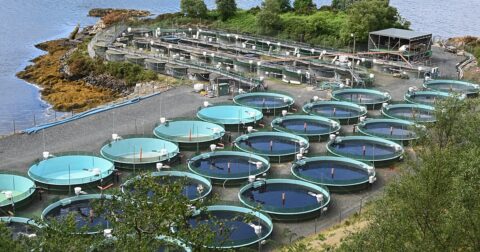
A combination of mismatched regulations and inconsistent seafood testing is leaving U.S. consumers of farmed salmon imported from Scotland at risk of exposure to antibiotics not approved by the U.S. Food and Drug Administration (FDA), according to a U.K. report.
Antibiotics are essential for preventing and treating diseases in farm animals, and there are strict FDA regulations for drugs used in fish raised for food. But these rules are different in other countries, such as Scotland, where some authorized compounds, such as quinolones, flumequine and oxolinic acid. Despite this, the FDA tests only one in every thousand seafood imports for the drugs and rarely follows through with enforcement, according to an audit by the U.S. Government Accountability Office.
The overuse of antibiotics in aquaculture poses a concern to consumers — who risk eating pathogens that have grown resistant to antibiotic treatments in the salmon — and to global public health.
Jennifer Ronholm became a research chair in agricultural microbiology at McGill University after stints with Health Canada and the Canadian Food Inspection Agency, and says antimicrobial resistance is an underappreciated risk to human life. “If we can’t treat these infections anymore, things that we kind of take for granted now — like simple childhood infections, simple dental infections after dental work or simple infections after childbirth — could become untreatable. Things that seem routine and mundane today could be deadly in a very short amount of time.”
In general, U.S. regulations prioritize food safety, whereas the U.K. gives vets greater flexibility in selecting fish treatments. The FDA risk assessment for flumequine, for example, models worst-case scenarios for the drug’s spread throughout the environment. Scottish officials instead use a European Union method for estimating the most likely rate of spread, and concluded that the risk was tolerable.
The unapproved antibiotics have not been detected in Scottish salmon arriving in the US. However, the FDA does not regularly test for them, according to Mark Borthwick, an Open Oxford-Cambridge doctoral fellow who led research on the regulation of antibiotics for campaign organizations Animal Equality and the Aquaculture Accountability Project. “If I was an American and I was eating this salmon, I would be alarmed,” he said. The UK does not test exported salmon for these antibiotics.
When she learned about the FDA’s testing regimen, Ronholm says she was surprised, especially given the mismatch in regulatory layouts.
“If I was at the FDA and I was designing and testing an import system for inspection, I would look at the regulations of the countries where the fish is coming in from, and I would test for the antibiotics that are allowed in that context,” she said. “I am surprised that the FDA doesn’t do that… and I’m surprised they’re following up on as few of the testing when they find the positives.
Seafood farming accounts for a small but rapidly growing share of global antibiotic use. Propelled by claims that aquaculture offers a sustainable alternative to wild-caught salmon, the U.K. industry, Salmon Scotland tells Sentient, sold 35,000 metric tons of salmon to the U.S. in 2024. This is more than 17 times the amount of beef traded between the two countries that year.
Salmon Scotland, a lobby group representing the sector, said in a statement to Sentient that Scottish farmers do not use any of the antibiotics that are unauthorized in the United States and that “there is no evidence whatsoever of any consumer safety issue linked to Scottish salmon.”
In March, the group released a letter in response to questions raised at a rural affairs evidence session. In response to questions about antibiotics, Salmon Scotland acknowledged that in “any responsible livestock sector, veterinarians need access to antibiotics and use them if necessary to avoid unnecessary suffering.” This is immediately after sharing that the group “strives for zero use and has made demonstrable progress in this regard.”
Yet, earlier this year, Salmon Scotland admitted to mistakenly understating the sector’s antibiotic use by 66% when it reported the sector used 1,564 kg of antibiotics in 2024, calling it a “record low.” Despite producing about 8 times more salmon than the U.K., Norway used half the amount of antibiotics on salmon farms the same year. The U.S. does not publish annual statistics on antibiotics used by its aquaculture industry.
Compared to British cattle operations, the Scottish salmon industry uses just 12% fewer antibiotics per kg of fish or beef produced.
Dosing fish with antibiotics comes with its own specific risks, however. When a person is prescribed an antibiotic, the dosing and duration are precise, but fish are receiving far from exact doses, says aquaculture and public health researcher Dave Love, a professor at Johns Hopkins University. It’s assumed that each fish eats the same amount of feed, with the appropriate dosage of antibiotics. He points out that “sick fish may not eat, they may not eat at the same rate, they may not eat anything at all. And so it’s very hard to treat a population and get all the animals getting the same dose.”
“And under-treating is problematic,” adds Love. “Because if you’re not killing all the bacteria, that’s how you could develop some antibiotic resistance.”
Abigail Penny, executive director of Animal Equality, writes to Sentient that “the problem is not only whether these chemicals are being used today, it’s that they could be.” She is concerned that “the current regulatory framework in Scotland makes it essentially impossible to know” what is actually prescribed because records “are not readily available for public view, and testing is so infrequent that it would be difficult to catch a problem even if one existed.”
According to the FDA, every seafood import undergoes an electronic screening upon arrival that evaluates the importing supplier’s “historical compliance records and emerging public health trends,” the agency shares with Sentient in a written statement. The results of this screening determine whether or not the shipment is high-risk and should be tested.
Borthwick writes in the report that “the United States import system is failing to meet its own criteria for enforcement in 95% of cases, and lacking in internal systems for tracking progress on food safety. It is based on a trust system which is fundamentally flawed, with a series of biases and blindspots.”
The FDA flags any supplier that violates U.S. law, its statement continues, which automatically impounds future shipments until lab results come back clean. In its review of 125 FDA warning letters issued over five years, the GAO found that only 11% received a follow-up inspection within the agency’s six-month target. Another 45% were followed up on later, with an average delay of about two years.
Love tells Sentient that when a sample of fish is tested by the FDA, the first pass focuses on routine food safety issues, such as labeling, allergens or metals, while antibiotics are low on the list.
Animal farming accounts for around three-quarters of global antibiotic use and is a key driver of antibiotics becoming less effective through overuse. This process, bacterial antimicrobial resistance (AMR), has been linked with almost 4.7 million human deaths each year and increases “the risk of disease spread, severe illness, disability and death,” according to a fact sheet published by the World Health Organization.
More consistent antibiotic regulations across nations would offer an easier fix, says Love. “The U.S., Canada and Europe should have a broad agreement on what drugs are okay to use,” he said, “given that we all have this shared planet, the shared ecosystems and the shared mutual respect for antibiotics and their power to heal and to harm through resistance.”
When it comes to regulatory and scientific priorities, Ronholm says, “I’d rather take those resources and make new antibiotics and make new vaccines.” She tells Sentient that she’d also like to see more effort dedicated to reducing the use of current antibiotics, particularly because “there’s not much use left for humans or animals.”Human deaths associated with antimicrobial resistance could rise to eight million by 2050, according to a benchmark study from the University of Washington’s Institute for Health Metrics and Evaluation.
“People should be alarmed about it,” Ronholm adds. ”You can’t lay it on the consumers, so I’m not frustrated with consumers. But when you read the policy stuff, that is what is sad and frustrating.”
Update: A reference to the report on Scottish antibiotic use in salmon and U.S. import policies should cite both Animal Equality and the Aquaculture Accountability Project, and the latter has been added.
Daniel Shailer is a British reporter covering climate and the environment. His work has appeared in the Guardian, Scientific American, Mongabay and other outlets.
Feature
Fisheries & Aquaculture•9 min read

Investigation
JBS and Cargill plants across the country are accused of pressuring unions into either accepting the same low wage structure, or mere nickels apart. The result? The largest meatpacking strikes…
Food•13 min read

Feature
In Nebraska, Blackshirt Feeders LP is building the country’s largest feedlot for 200,000 beef cattle on a square-mile slab of concrete.
Food•31 min read