Feature
What the History of Blue Baby Syndrome Tells Us About Today’s Fight for Clean Water
Factory Farms•14 min read
Investigation
Executives in the ethanol, egg, and meat and dairy byproduct industries have spent millions of dollars on the ongoing race.
Investigation • Elections • Inside Iowa • Policy • Politics

Words by John McCracken
This year’s Iowa governor’s race is a pivotal moment for the state, as voters want their next governor to address the state’s declining water quality.
The state’s industrial agriculture practices are linked to this water pollution, with nitrate concentrations in Iowa among the highest in the United States.
Livestock waste is a major factor in high levels of nitrates in the state’s drinking water. The state has seen an increase in nitrate pollution in its waterways at the same time that new cancer rates have increased.
Current Republican Gov. Kim Reynolds announced a Farm to Faucet initiative in early May, investing more than $100 million in water treatment, but critics warn the plan is “too little too late” and doesn’t have the teeth to hold polluters to account.
The impact of water pollution is felt across the state, from Des Moines water utilities spending upwards of $10,000 a day on water filtration when nitrate levels spike, to the frequently undrinkable water in rural towns such as Early.
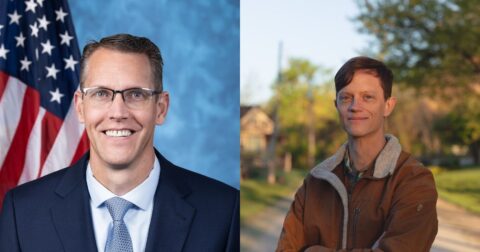
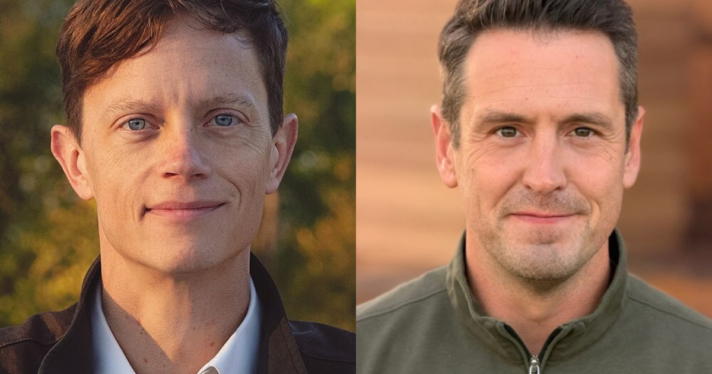
As agricultural practices and water quality remain a hot-button issue, Iowa voters will slim down the choices for governor’s office in the primary election on June 2, 2026. Rob Sand, the uncontested Democratic candidate, and Randy Feenstra, Republican candidate and current Iowa Congressman, are the frontrunners of the race, according to polling.
Behind the scenes, major industrial agriculture companies and agribusiness firms across the state of Iowa have thrown their money behind both sides of the Iowa governor’s race.
The largest individual donor to Feenstra’s campaign is the CEO of the largest ethanol and biofuel company in the world, which has a history of air pollution. The family fueling Rob Sand’s campaign has deep ties to the industrial livestock industry and has donated more than double the total raised by his opponent, according to campaign finance reports.
Aaron Lehman, president of the Iowa Farmers Union, tells Sentient that his organization is vigilant about the involvement of agribusiness in the state’s legislative and political process, saying its influence has grown in recent years, especially in the last 18 months.
“We know that there’s going to be tremendous pressure put on our elected leaders and candidates” by agribusiness, Lehman says, “but in the end I think Iowans still expect their elected leaders to speak up and speak first for the people on the ground.”
He says Iowa farmers are often used as a talking point in politics on issues from trade wars to local water pollution, but there hasn’t been much action at the state level to support the food system or water quality.
“There’s been a lot of lip service given to farmers without being backed by real policy that makes investments that make a difference in a farmer’s fields and pastures,” says Lehman, “and then makes a difference in our waterways and drinking water systems.”
Randy Feenstra, the Republican gubernatorial frontrunner, told local media he wants to showcase soil conservation efforts in the state and not demonize farmers. But his fundraising documents show donations from massive industrial agriculture companies with histories of pollution.
He has received donations from the founder of a meatpacking company, a major egg production company executive and leadership of the world’s largest ethanol firm.
Feenstra is currently a member of the U.S. House of Representatives representing the fourth district in Iowa, which includes portions of Sioux City and Des Moines. A former Iowa state senator, he has held his House position since 2021.
In the June 2 Republican primary, Feenstra is running against businessman Zach Lahn, current state representative Eddie Andrews, former state representative Brad Sherman and former director of Iowa Administrative Services Adam Steen.
Feenstra has served on the House Committee on Agriculture and its livestock, dairy and poultry subcommittee since 2023. This position as one of the nation’s most influential agricultural policy decisionmakers has gained Feenstra a lucrative relationship with major meat and ethanol companies during his tenure.
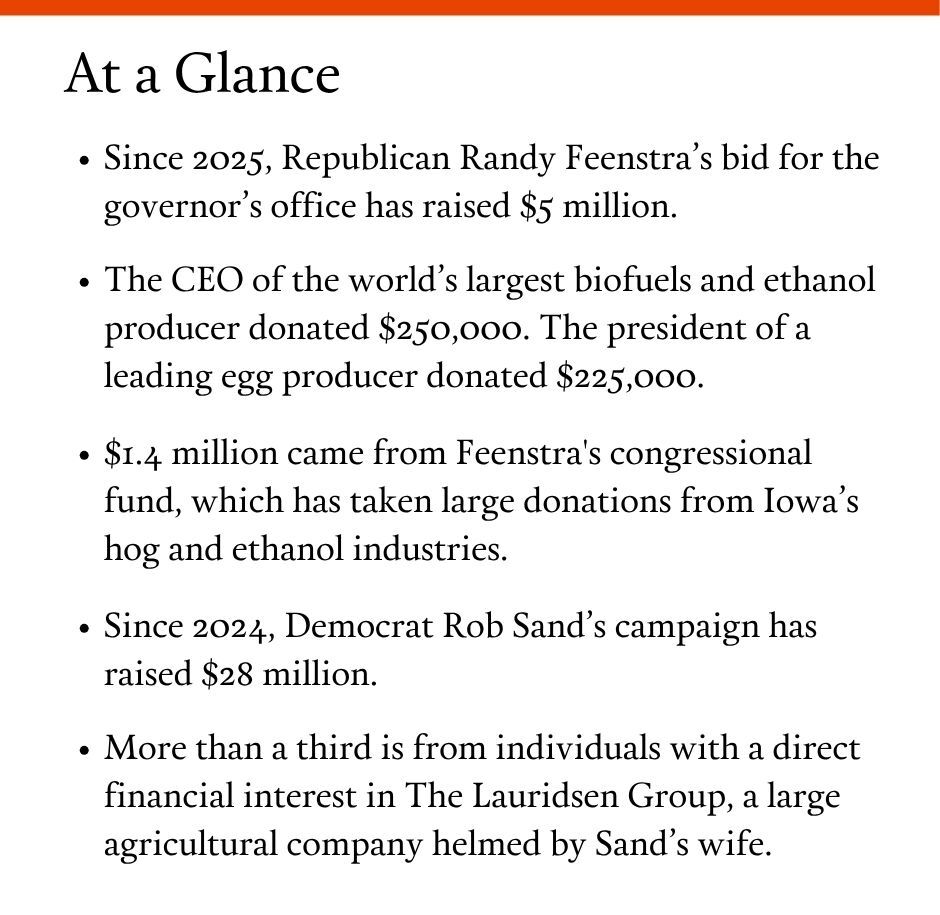
Since 2025, his bid for the governor’s office has raised $5 million.
The campaign’s largest individual donor, according to state finance records, is Jeff Broin, CEO of POET LLC, the world’s largest biofuels and ethanol producer. Broin donated $250,000 to Feenstra’s gubernatorial campaign.
The company operates with $8 billion annual revenue as of 2019 and employs roughly 2,000 employees. POET is headquartered in Sioux Falls, South Dakota and has grain bins and ethanol processing plants across Iowa.
A subsidiary of POET was fined roughly $90,000 by the Environmental Protection Agency for excessive levels of air pollution at its Menlo, Iowa plant in 2022. The next year, the company was fined by the Iowa Department of Natural Resources for continued air pollution.
POET did not respond to Sentient’s request for comment.
Iowa is the largest producer of ethanol in the country, producing roughly 5 billion gallons annually, according to the U.S. Energy Information Administration. Much like the corn-based fuel, the hog industry looms large in the state. Iowa is the top producer of hogs in the country, making the sector a nearly $11 billion industry.
Feenstra’s finance reports reflect the dominance of both ethanol and pork in the state.
When Feenstra launched his governor’s campaign in 2025, he started with a $1.4 million donation from his congressional fund, which itself has received large donations from the Iowa hog and ethanol industries. The Pork PAC, a political action committee representing the nation’s largest pork companies, donated $30,000 to his congressional campaign, and major ethanol companies and refineries POET, Valero Energy Corporation, Bunge North America and Growth Energy donated a combined $132,000.
Feenstra did not respond to Sentient’s request for comment.
Earlier this year, South Dakota meatpacking founder Elden Roth donated $100,000 to Feenstra’s gubernatorial campaign. Roth founded Empirical, a lean meat processing company operating out of South Sioux City, Nebraska, located just across the Missouri River on the western edge of Iowa.
Empirical was formerly Beef Products Inc., or BPI, the company that sued ABC News in 2012 over its coverage of their “pink slime” products. The company stated that the defamatory news coverage caused drops in sales and forced them to close plants in Iowa, Kansas and Texas. The lawsuit was settled in 2017.
Another major donor to Feenstra’s gubernatorial campaign is an executive of one of the country’s largest egg companies. James Dean, the president of Versova Holdings, one of the nation’s top five egg production companies, donated $225,000 to Feenstra’s bid for the seat of Iowa governor.
State campaign finance records show Dean’s long-standing history of supporting Republican politicians across Iowa. Dean has been a major donor to current state agriculture secretary Mike Naig as well as current Republican Gov. Kim Reynolds.
Versova Holdings is the parent company of industrial egg production farms across Iowa, Ohio, Washington and Oregon. The company operates Iowa egg farms Center Fresh Group in Sioux Center, Centrum Valley Farms in Clarion, Iowa Cage-Free in Goldfield, Hawkeye Pride Egg Farm in Corwith and Ovation Farms in Thompson.
Versova is a $1 billion company annually and owns roughly 20 million laying hens across all of its facilities, according to industry estimates. Farms owned or operated by Versova have been repeatedly cited by the Iowa DNR for violating wastewater permits and manure leakage from their facilities.
In an emailed statement to Sentient, a Versova spokesperson writes that Feenstra has been a long-standing advocate for the farm community.
“Our families have known Congressman Feenstra for years both personally and during his time in elected office, and we are proud to support him. We believe in his vision for Iowa and appreciate his consistent support for farmers and agribusinesses, not just in Iowa, but across the United States,” the company writes.
Rob Sand, the uncontested Democratic candidate for Iowa governor, has been the Iowa state auditor since 2019.
Sand’s platform includes increasing funding for water quality monitoring and making the state’s opaque manure management plans available to the public.
Since 2024, his campaign has raised $28 million.
More than a third of that $28 million is from individuals with a direct financial interest in The Lauridsen Group, a large agricultural company helmed by Sand’s wife.
Christine Sand, Rob Sand’s wife, is the CEO of The Lauridsen Group, Inc, an Iowa-based health, feed and nutrition company. The company owns multiple firms that create and distribute various dairy products, livestock feed, pet food ingredients and additive products for the medical, food and animal feed industries.
The globally operated business sources ingredients from dairy and meat byproducts and brings in an estimated $1 billion in annual revenue.
Christine Sand and her parents (former operators of The Lauridsen Group), alongside her two brothers (current executives at the company), have donated a total of $11.5 million to Rob Sand’s gubernatorial campaign since 2024.
Essentia Protein Solutions is a subsidiary of The Lauridsen Group with a plant in central Iowa which produces powders and other protein products out of animal byproducts. The plant was fined $8,000 in 2026 and faced repeated issues with releasing blood and processing waste into the rural town of Lytton’s wastewater system in part due to issues with its processing waste lagoon.
Rob Sand’s campaign did not respond to Sentient’s request for comment.
Sentient Media reached out to The Lauridsen Group for comment and was hung up on when talking to a company representative.
His campaign has also received large donations from other individuals such as $200,000 from Fred Hubbell, advisory council member of the Midwest-based environmental advocacy group Environmental Law and Policy Center.
Other major and notable individual supporters include Illinois governor J.B. Pritzker, LinkedIn founder Reid Hoffman, heirloom fruit and vegetable conservation advocate Amy Goldman Fowler, former Iowa DNR commissioner Joyce Conklin VanKirk and Iowa animal rights philanthropist Margo Blumenthal.
Robin and Kirk Kirkegaard, a crop share manager and farmland owner in Indianola, Iowa, have donated $500,000 to Sand’s campaign. Kirk says agriculture is a major issue for him, but not the reason he has thrown his weight behind Sand.
He declined to go into details about what agriculture issues he agrees or disagrees on with the candidate, but says he wants mismanaged finances in state agencies to be cleaned up, a key point of Sand’s campaign.
Diane Rosenberg, executive director of Jefferson County Farmers and Neighbors, an Iowa-based anti-factory-farm organization, says the issues facing Iowans are bigger than partisan politics.
Rosenberg says the state’s corporate agriculture businesses and lobbyists have been influencing Iowa politics for decades, with legislation and funding meant to protect people and waterways often left on the cutting room floor.
“It took us a long time for us to get to the place we’re at now and it’s going to take a long time to extract ourselves from this,” she says.
John McCracken is an investigative reporter whose work examining the nation's consolidated meat industry, industrial agriculture and climate change has received awards and recognition from the Chicago Book Club, North American Agricultural Journalists, Wisconsin Newspaper Association, Iowa Newspaper Association and more. He has been invited to speak about his reporting at the Society for Environmental Journalists, NICAR and more.
Explainer
Climate•10 min read
Feature
A survey taken this past spring shows a majority of Iowans say they have experienced negative environmental impacts from industrial animal operations. But plenty are also ambivalent, or ignorant, about…
Elections•11 min read
Find out how much manure is in your backyard.
Inside Iowa•9 min read