Feature
American Horses Are Still Being Slaughtered for Meat
Food•7 min read
News
Stronger enforcement of U.S. import law could spare marine mammals from deadly fishing gear around the world, advocates say.

Words by Gaea Cabico
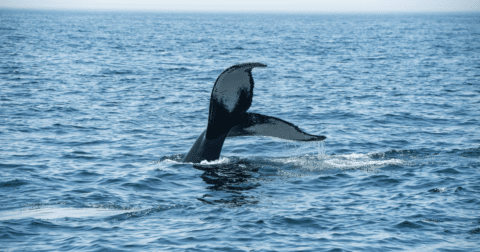
You might think that the greatest threat to whales, dolphins and seals worldwide would be climate change, or perhaps whaling and other deliberate hunting of the animals. But their biggest threat is actually bycatch — when they are accidentally caught or hurt by commercial fishing operations that are trying to catch fish and other seafood.
Each year, more than 650,000 marine mammals are killed as bycatch worldwide, scientists estimate.
Now, in a new tactic to fight this, conservation and animal welfare organizations are suing the U.S. government in an effort to halt seafood imports from eight countries whose fisheries allegedly entangle and kill large numbers of whales, dolphins and other marine mammals.
The plaintiffs — Center for Biological Diversity, Natural Resources Defense Council (NRDC) and Animal Welfare Institute (AWI) — argue that federal regulators are failing to enforce the existing Marine Mammal Protection Act, which requires the U.S. government to ban seafood imports from foreign fisheries that harm or kill marine mammals beyond limits allowed under U.S. law.
The lawsuit, filed in the U.S. Court of International Trade, challenges the authorization of seafood imports from Argentina, Ecuador, India, Norway, Taiwan, Tunisia, the United Kingdom and Vanuatu, where commercial fishing practices are accused of killing marine mammals at levels that exceed U.S. standards.
“American fishers invest in monitoring, gear modifications and bycatch reduction to meet those standards,” Zak Smith, director of global biodiversity conservation at the NRDC, tells Sentient in an email. “Foreign fisheries selling into the same market should meet the same bar.” The U.S. imports nearly 90% of its seafood supply.
A spokesperson for the National Marine Fisheries Services, also known as NOAA Fisheries, says the agency cannot comment on matters of litigation. NOAA Fisheries — the primary agency responsible for managing and protecting whales, dolphins, seals and sea lions under the law — is a defendant in the case.
Multiple fishing methods contribute to the more than 650,000 marine mammals killed as bycatch each year. The animals often drown or are caught and then discarded at sea. Fishing methods such as longlining, trawling and the use of gillnets are among the practices most commonly associated with bycatch.
The vaquita, a porpoise species found only in the northern Gulf of California, has been pushed to the brink of extinction largely because it becomes entangled and drowns in gillnets. Considered the world’s most endangered cetacean, the species is estimated to number as few as 10 individuals.
To address the issue of bycatch, the Marine Mammal Protection Act requires the U.S. government to reduce the number of marine mammals seriously injured or killed in this way to nearly zero.
In 2016, this mandate was extended to international trade: the United States must block seafood imports from any country whose fisheries injure or kill marine mammals at higher rates than allowed domestically. Foreign nations must provide evidence that their standards match those of the United States.
In September 2025, NOAA Fisheries declared that about two-thirds of 135 countries met those comparability standards for all of their export fisheries. Meanwhile, about a quarter of countries had some fisheries that did not meet U.S. standards, and in 7% of countries, no fisheries met U.S. standards. Fisheries that receive positive comparability findings are allowed to export seafood to the U.S., while those that fail to meet the standards face import restrictions.
But after reviewing NOAA Fisheries’ findings, the conservation and animal welfare groups argued that some approved fisheries do not, in fact, comply with the law. They alleged that findings for the eight countries named in the lawsuit are based on “incorrect assumptions, flawed and inadequate evidence, and other logical and factual errors.”
“Those fisheries don’t actually meet the high bar that the MMPA sets and [NOAA Fisheries] is thus unlawfully authorizing imports from fisheries that catch and kill marine mammals in excess of U.S. standards,” Georgia Hancock, director of the marine wildlife program and senior attorney at the Animal Welfare Institute, tells Sentient in an email.
The plaintiffs allege that fisheries in Argentina kill franciscana river dolphins at rates that contribute to population declines and that Vanuatu’s tuna fishery does not use the special hooks required for American fishers to reduce the bycatch of false killer whales. In Norway, meanwhile, the groups allege that gray seals and harbor porpoises are dying at levels that exceed U.S. standards.
The groups cite assessments showing that in the U.K., the accidental capture of porpoises and common dolphins is happening at unsustainable levels and that entanglements could harm small populations of North Atlantic humpback whales. Meanwhile, they allege that bycatch from Taiwan fisheries threatens the critically endangered Taiwanese humpback dolphin, vulnerable Indo-Pacific finless porpoise and near-threatened Indo-Pacific bottlenosed dolphin.
Meanwhile, the plaintiffs also claim that bycatch estimates in Ecuador, India and Tunisia are not reliable because some fisheries lack the necessary monitoring systems.
Andrew Read, a biologist at Duke University studying marine mammals, says the approach of imposing trade restrictions poses an important question: “Can the actions of a single state impose conservation standards on other states?” Because the United States is the world’s largest seafood importer by value, Smith says its economic leverage is effective at forcing international policy changes. It’s worked before. He notes that after the United States threatened to ban seafood exports from countries that did not meet its standards, multiple countries took steps to clean up their acts. Grenada implemented new bycatch reporting requirements, Ireland committed to banning the killing of seals and New Caledonia passed a legislation outlawing the intentional killing of mammals. These three countries are now allowed to export their seafood to the United States.
U.S. regulations against dolphin bycatch in tuna nets and sea turtle bycatch in shrimp trawls were also upheld at the World Trade Organization, Read notes.
Simple changes in fishing practices, such as lowering driftnets below the surface, as well as technologies like acoustic alarms attached to fishing nets, can reduce bycatch, according to Read.
Consumers and retailers also play a vital role, by demanding “transparent, consistent and trustworthy” seafood certification labels and making information on catch locations and gear types readily accessible to the public, writes Hancock of Animal Welfare Institute. But she points out that the most effective action is eating less seafood and replacing it with plant-based options.
Gaea Cabico is Sentient's editorial fellow, and an award-winning journalist from the Philippines who reports on climate change, environmental issues and energy through a social justice lens. She holds a master's degree in science journalism from New York University.
Feature
Fisheries & Aquaculture•9 min read

Investigation
JBS and Cargill plants across the country are accused of pressuring unions into either accepting the same low wage structure, or mere nickels apart. The result? The largest meatpacking strikes…
Food•13 min read
Feature
In Nebraska, Blackshirt Feeders LP is building the country’s largest feedlot for 200,000 beef cattle on a square-mile slab of concrete.
Food•31 min read