Explainer
A Handful of Cooperatives Control the U.S. Milk Market
Food•1 min read
Explainer
Some pig and poultry farmers incorporate tiny fish into feed because of the nutritional benefits, but critics warn that overextraction of these fish could disrupt the marine food web.

Words by Gaea Cabico
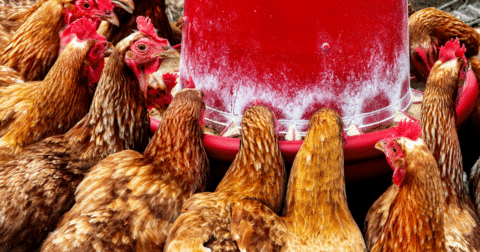
People usually associate livestock feed with soy and grains like wheat and corn. But farmers also feed pigs and chickens fishmeal, a protein-rich powder made from small wild fish such as anchovies and sardines, and fish-processing scraps like internal organs and trimmings. Each year, hundreds of billions to more than a trillion tiny forage fish are caught and processed into fishmeal and fish oil.
Critics argue that producing fishmeal requires harvesting enormous numbers of forage fish — species that are the cornerstone of marine food webs and that help transport and store carbon in the ocean — which can ripple through entire ecosystems, adding pressure to oceans already stressed by climate change.
“When you remove them, you’re not just removing a fish, but you’re jeopardizing the health of other fish that are dependent on them, which then means that you’re also jeopardizing the health of human communities that depend on larger fish,” says Andrianna Natsoulas, campaign director of a coalition opposing offshore finfish farming called Don’t Cage Our Oceans.
Aquaculture consumes more than 90% of the world’s fishmeal, and pet food uses another chunk. Pig and poultry farming today account for about 3% of global demand, but before aquaculture expanded in the 1960s, pigs and chickens were the main consumers of fishmeal.
Terrestrial farm animals like pigs, chickens and cattle “never ate fish until we began to feed it to them,” Jennifer Jacquet, professor of environmental science and policy at the University of Miami, tells Sentient in an email.
Hog and poultry producers use fishmeal because it provides a highly digestible, dense source of protein and essential amino acids, vitamins, minerals and omega-3 fatty acids. Research shows that adding fishmeal in the diets of young animals can improve feed intake, growth and immune function. However, one study found that replacing fishmeal with soybean meal or poultry byproduct meal in broiler chicken diets resulted in heavier birds and higher feed intake, without affecting the amount of feed needed to gain weight.
Alternatives to forage fish for animal feeds include insect meal, algae meal and feed crops such as soy. “Several of these options have a much lower environmental impact than fish meal, while providing equivalent or higher nutritional value,” Ellen Pikitch, executive director of the Institute for Ocean Conservation Science at Stony Brook University, tells Sentient in an email.
While these alternatives could help reduce pressure on wild fish populations, they also come with trade-offs. Soy production, for example, can contribute to deforestation and biodiversity loss, while insect-based feeds face challenges related to scalability and energy use. Plant-based sources of protein like beans, however, do produce fewer greenhouse gas emissions than seafood.
Forage fish — species such as sardines, sand eels and menhaden — play a vital role in marine ecosystems. They feed on plankton and serve as prey for larger fish like tuna, sea bass and salmon, as well as seabirds and marine mammals such as whales, seals and dolphins. As a result, harvesting large quantities of forage fish for fishmeal and fish oil can affect the biodiversity and resilience of marine ecosystems, advocates and scientists warn.
A task force led by Pikitch and composed of marine and fisheries scientists found that at least one predator relies on forage fish for half or more of its diet in 75% of the ecosystems they examined. In nearly 30% of ecosystems, at least one predator derives 75% or more of its diet from these tiny fish.
According to the task force report, an anchoveta fishery in Peru — the world’s largest single-species fishery by volume — illustrates the importance and vulnerability of forage fish. Nearly all of the catch is processed into fishmeal and fish oil. In the 1960s, Peru’s anchoveta harvest had reached 10 million metric tons, contributing to sharp declines in seabird population that depended on anchovies for food. When a strong El Niño struck in the early 1970s, the combination of high fishing rates and low stock productivity triggered a collapse of the anchoveta population.
Another example is heavy fishing of Atlantic menhaden in the Chesapeake Bay in the U.S., which likely reduced food available to striped bass, bluefish, ospreys and bald eagles. Scientists have also raised concern that technological advances in fishing could lead to the potential depletion of Antarctic krill, considered forage fish even though they aren’t technically fish, slowing the recovery of severely exploited baleen whales.
Although forage fish can recover quickly under favorable conditions, scientists say several populations that collapsed because of overfishing have failed to rebound, such as the anchovy and sardine stocks in Northern Benguela off Namibia and southern Angola.
In 2024, more than 18 million tons of wild-caught fish were processed into fishmeal and fish oil, according to the United Nations Food and Agriculture Organization. This is a considerable decrease from the peak in 1994, when around 30 million tons were processed for these products. Based on this trend, the organization has concluded that “aquaculture growth has not increased pressure on reduction fisheries at global level.” Reduction fisheries are those that catch fish for fishmeal and fish oil. However, the Food and Agriculture Organization also says the total amount of fishmeal produced is expected to increase by 13% over the next decade.
Jacquet argues that catch data alone does not fully capture the pressure on fisheries. She stresses that industrial fishing fleets have increasingly used advanced technologies that allow them to maintain catches even if fish populations decline.
“We should be ecologically concerned with any farmed animal systems,” Jacquet writes. “We know this is unsustainable.”
Increasing forage fish capture also requires fleets to travel farther and use more fuel, Matthew Hayek, an environmental science professor at New York University, tells Sentient in an email. “This could deplete marine food webs further and emit more greenhouse gas emissions,” Hayek writes.
In many parts of the world, forage fish are also an important source of food and income. News outlets DeSmog and The Guardian reported earlier this year that industrial vessels were illegally catching sardinella within or near Bijagós Archipelago — a biodiversity hotspot often called the “Galápagos of West Africa” — to supply offshore floating factories that process fresh catch into fishmeal and oil for export to global salmon and shrimp farming companies. DeSmog and The Guardian also reported that this extraction disproportionately affects local women who traditionally process and sell these small fish, reducing their ability to earn money.
Scientists are calling for precautionary strategies to protect forage fish and their predators. “At this point in time, the stringency and enforcement of forage fish management regulations are not sufficient to prevent overfishing,” writes Pikitch.
In 2012, the task force she chaired recommended limiting catch rates to 50% of the level typically used to achieve the largest average catch and doubling the amount of forage fish that must remain in the ocean. Later that year, California adopted a policy recognizing the importance of forage fish to the state’s marine ecosystems and preventing the development of new forage fishers and expansion of existing ones without full scientific review. In 2016, the National Marine Fisheries adopted similar precautionary measures, restricting direct commercial fishing for several forage species in West Coast waters.
For Natsoulas, using forage fish in animal feed reflects an industrial food system that, she argues, benefits a handful of corporations at the expense of the environment and coastal and rural communities. These fish, she says, should not be used to feed either farmed fish or terrestrial livestock, but instead “should stay in the seas.”
Gaea Cabico is Sentient's editorial fellow, and an award-winning journalist from the Philippines who reports on climate change, environmental issues and energy through a social justice lens. She holds a master's degree in science journalism from New York University.
Feature
Fisheries & Aquaculture•4 min read
Solutions
While the country’s farms tend to have high animal welfare standards, Bhutan also imports most of its meat.
Farms•7 min read
Feature
Fewer than 15% of veterinary school graduates are opting to care for farm animals.
Food•6 min read