News
Sustainable Seafood Labels Aren’t Always What They Seem
Food•6 min read
News
A growing body of research scrutinizes how the meat industry can shape scientific research.

Words by Jessica Scott-Reid
“You know, we’re a close-knit family in some ways,” says Andrea Brockelbank, then the executive director of the Canadian Beef Cattle Research Council, about three minutes into the informational video. “And I think,” she continues, “from a researcher standpoint, that can be hard to appreciate sometimes.”
The video gives an overview of one of the council’s initiatives called the Beef Researcher Mentorship Program. Launched in 2014, the program pairs early-career researchers with industry stakeholders — farmers as well as marketers and others who work in the business. Brockelbank goes on to say that she’s “really proud that this program allows us to open it up,” welcoming researchers to “make them part of that family.”
In a new article published June 18, Vasile Stanescu, associate professor of communications studies at Mercer University, argues that this beef industry mentorship program is “the opposite of the way it should go.”
That’s not because the industry-funded research is technically wrong or invalid, argues Stanescu. The problem is that this partnership and others like it are enabling the industry to avoid addressing larger existential questions about what the future of the beef industry should be given its role in climate change: roughly a third of all food-related emissions are caused by food production, and the highest driver of those emissions is beef, thanks primarily to cattle burps and land use.
Stanescu writes that “scientists do not mentor animal agriculture on the best scientific practices” in programs such as these. Instead, “representatives from animal agriculture mentor scientists on their research questions and methodological choices.”
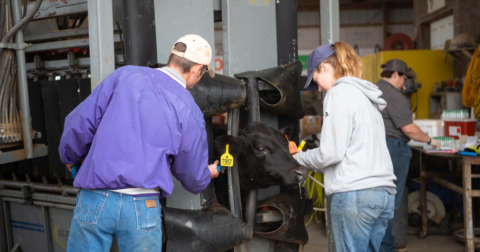
Stanescu quotes government research scientist Robert Gruninger, who was mentored by two owners of a ranch and feedlot, and a cattle feed and nutrition consultant. Gruninger credits the mentorship program with knowledge that proved “invaluable” for him to “get the job that I’m in.”
Another researcher, Trevor Coates, who was mentored by a cattle producer and a former executive director of Alberta Beef Producers in 2020, tells Sentient via email that the experience was positive, in particular the networking. “Discussions with my mentors were an important part of that experience helping me gain a better understanding of some of the challenges facing the industry and where my research interests would best fit,” he says.
Scarcity in research funding is a longstanding problem, particularly in food and agriculture research. The industry — whether it’s meat, walnuts or strawberries — has long played an outsized role (though the beef industry’s size and scale dwarfs fruits and vegetables, legumes and plant-based alternatives).
According to the U.S. Department of Agriculture, “the private sector has historically been the dominant player in the conduct of research and development,” accounting for about 76% of U.S. agricultural research funding in 2013.
Subsequent USDA analyses published in 2022 found that public spending on agricultural research and development has fallen by about one-third from its 2002 peak. Meanwhile private investment has continued to grow.
While Canada does not track the national percentage of academic agricultural research funded by industry, Canada’s regulatory department for agriculture, Agriculture and Agri-Food Canada, has also noted that industry is now the dominant funding source for several of its research programs.
The upshot of this is researchers who study animal agriculture and want to “tell the good news” about livestock production are more likely to find a career and research opportunities.
Stanescu is careful to say that the research on Canada’s beef industry is technically accurate. But funding certain areas of study over others creates “a research landscape where certain research questions flourish — ‘How can we make feedlots more efficient?’ — while others remain unasked and unanswered — ‘How many cattle should Canada raise at all?’”
The program Stanescu studied pairs early-career researchers with cattle producers, according to the group’s website, and also pairs each researcher with another beef or forage industry professional.
For example, Canadian government researcher Stephanie Terry was paired up with a feedlot executive. Yet the beef council’s website does not address what Stanescu calls “the ethical implications” of a scientist working on greenhouse gas mitigation efforts in beef production being mentored by “the CEO of a large-scale feedlot operation.”
Terry went on to research the effects of different on-farm strategies on reducing methane, like feed additives. Though the paper describes the climate effect of methane, it never cites research showing the positive climate impact of reducing herd sizes or eating less meat, according to Stanescu.
There is no evidence that the beef council was the industry group to start Terry on this research path. In fact, prior to the mentorship, Terry had already researched cattle nutrition and its effect on greenhouse gas emissions. And Terry’s research focus has stayed on much the same path, studying the same questions. In 2024, she was part of a team of researchers awarded $7.89 million to study and develop methane mitigation strategies to lower emissions “without reducing the productivity of Canadian dairy and beef cattle.”
Today, Coates also works for the federal agriculture department and tells Sentient in an email that as a scientist within that department, his role is to “help find solutions to problems producers may be facing, including those due to weather or climate challenges.”
Stanescu’s work is part of a growing body of research investigating the meat industry’s influence on academic research to steer and use it for communications strategy.
In a 2024 paper, researchers Jennifer Jacquet and Viveca Morris investigated two industry-funded academic centers: CLEAR, which stands for Clarity and Leadership for Environmental Awareness and Research, at University of California, Davis, and AgNext, at Colorado State University, and their ongoing role “shaping public understanding and public policy related to the livestock industry’s climate impacts.”
In other words, Stanescu argues, the livestock industry responded to its environmental impact “not by transforming production, but by reframing climate science as a communications problem.”
Research scientist for the province of Manitoba Getahun Legesse was paired with a feedlot owner and a former chair of Alberta Beef Producers as well as current executive director of Canfax (the market analysis division of the Canadian Cattle Association) and chair of the Global Roundtable for Sustainable Beef’s Climate Science Committee.
According to the council’s website, Legesse had been working on a “collaborative project that aims to define the environmental footprint of Canadian beef,” at the time he was selected. The research, funded in part by the council, would go on to become the cornerstone of one industry group’s messaging on beef’s climate impact — defining sustainability by one cherry-picked metric.
The research compared emissions per kilogram of beef in 1981 to 2011, and found that emissions were14% lower in 2011. This was attributed to a number of on-farm efficiencies, including feed changes and reduced time to slaughter.
But that same research also found that overall greenhouse gas emissions for Canadian beef production went up during that same period, and by 28%.
Legesse’s research was used to inform the Canadian Roundtable for Sustainable Beef’s sustainability standards. In 2020, McDonald’s Canada drew on those standards when it advertised its Quarter Pounder burger as “now sustainably sourced.” In fine print the advertisement stated “at least 30%” of the beef is sourced from farms and ranchers that met the roundtable’s standards.
Canadian animal law organization Animal Justice lodged a complaint about the McDonald’s advertisement to the Competition Bureau of Canada and the Canadian Food Inspection agency, calling the ads misleading and greenwashing. The company then pulled the ads on their own.
Sentient contacted Legesse for comment, but did not receive a reply. A representative for Agriculture and Agri-Foods Canada told Sentient that Terry was out of office when reached for comment at the time of publication, but this story may be updated.
Sentient also contacted the Canadian Beef Cattle Research Council multiple times to ask for a comment on Stanescu’s claims. The organization did not respond. But a number of agricultural researchers who have come under public scrutiny for their relationship with the meat industry have argued that their work improves agriculture and that agriculture research is severely underfunded as compared to other areas of scientific research.
Stanescu tells Sentient that mentorship programs like the one initiated by the Canadian Beef Council have larger consequences for scientific research. “They are picking winners or losers,” he tells Sentient. “They are picking who gets this really big leg up,” he says, and “they’re picking which research gets funded.”
“The goal,” he argues, “is to shape science for what is good for the industry.”
Jessica Scott-Reid is Sentient's Disinformation Correspondent covering disinformation, misinformation and the impact of both on culture. A freelance journalist based in Canada, Jessica has covered animals, the environment and food systems for major media in Canada and beyond, for the last decade. Jessica has been a contributor to Sentient since 2019, and her work also appears regularly in The Globe and Mail, Toronto Star, Winnipeg Free Press and Corporate Knights Magazine.
News
Farms•7 min read
Investigation
A chemical additive helped stop fishmeal from catching fire on ships, but it carried a downstream carcinogenic risk to modern food systems.
Food•6 min read
Explainer
Three of the largest dairy co-ops market the vast majority of milk sales; some have expanded into milk processing and other parts of the dairy industry.Farmers say these organizations —…
Food•1 min read