News
Sustainable Seafood Labels Aren’t Always What They Seem
Food•6 min read
News
Biologists are uncovering short-term and long-term genetic changes in fish biology.

Words by Claudia Steiner
Commercial fishing has had a profound impact on the diversity and sustainability of fish populations. The fishing industry has removed nearly half of the global biomass of targeted fish since pre-industrial times, scientists believe, and fishery biomass is currently declining in virtually every climate zone on the planet.
But it isn’t just the quantity of fish that suffers at the hands of the $400 billion global industry. Commercial fishing influences the molecular biology of fish — both their DNA sequences and the way their DNA is interpreted.
A study published in July on wild fish in the Mediterranean adds to a growing body of scientific research on how fishing is driving biological shifts in fish, both in the short term and across generations, as a form of human-caused evolution. These changes can reduce genetic diversity in overfished populations.
The deviations in genetic code and expression can interfere with the ability of fish populations to withstand the stress of climate change and disease and maintain healthy ecosystem interactions with other species.
“We are making populations less resilient to what is to come,” says Margarida Barceló-Serra, a molecular ecologist at the Mediterranean Institute for Advanced Studies in Spain and author of the paper on the biological effects of fishing pressure.
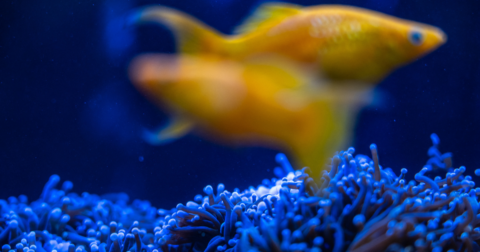
Wild fisheries throughout the world’s oceans are responding to the effects of fishing by evolving, and the literature shows it. Craig Primmer, an evolutionary genomicist at the University of Helsinki in Finland, has been studying fisheries-induced evolution for over a decade. His research has shown that wild-origin zebrafish can start to exhibit smaller adult body sizes and become less explorative over generations due to artificial selection, a typical condition observed in fisheries. Thanks to the natural tendencies of the fish themselves and policies set by the people managing these fish populations, characteristics like size and dominance tend to win out in an operation’s catch.
Similarly, Kwi Young Han, an evolutionary biologist at the GEOMAR Helmholtz Centre for Ocean Research in Kiel, Germany found that the body lengths of a sample of Eastern Baltic cod had shrunk by 48% over a 25-year study period. In parallel, the genetics of these fish also changed to be more slow-growing.
How commercial fishing impacts fish genetics, and the extent to which it’s driving evolution, is still not clear, Barceló-Serra says.
But the last quarter century has seen the explosive growth of the field of epigenetics. Epigenetics refers to short-term, reversible changes to DNA expression that can be studied in a single generation, a promising tool for studying environmentally-driven change. Offspring can also inherit some epigenetic markers from their parents in ways that we still don’t fully understand.
If genetics is interested in whatgenes we have, then epigenetics deals with which of our genes are activated and how. If you think of our genetic code as a book, epigenetic changes don’t change the words on the page. They are more like sticky notes directing the reader to ignore or pay close attention to certain pages, Janay Fox, an evolutionary biologist at the Moffitt Cancer Center in Florida, tells Sentient.
Most people learn about genetic evolution as something that happens over many generations, says Fox. Epigenetics “opens the door for more experience-based things to have an effect on evolution within a lifetime and also across generations.”
Barceló-Serra and her colleagues aimed to evaluate the correlation of fishing with both genetic and epigenetic changes in pearly razorfish, a culinary delicacy in Spain’s Balearic Islands. Authorities strictly enforce off-season fishing bans, though the authors report that recreational fishers catch up to 60% of a local population in just the first few days of open season.
In July of this year, they published the results of their study comparing populations of pearly razorfish off the coast of three locations in the Balearic Islands. Each location hosted a pair of adjacent study sites: one within the bounds of a recreational fishery and the other in a nationally designated marine protected area that prohibits all fishing.
The idea that fish populations of the same species would show epigenetic differences based on their environments, such as in a hatchery versus the wild, is not new. What is novel here, Primmer says, is that the two sites are in geographically similar environments. The variable is whether they’re being fished — and the team found that the epigenetic markers they looked at in fish living in the fishery sites and fish in the neighboring no-take protected areas were indeed different.
The mechanism the researchers studied, DNA methylation, serves as a kind of on/off switch for genes. Methylation can switch off the expression of a gene, partially dim its effects or fully activate it.
Here’s how this works. Conditions in the environment can trigger the addition of a specific chemical, a methyl group, to DNA, which then turns a certain gene off— affecting how its instructions are manifested by the fish outwardly. Alternatively, environmental influence can remove these chemicals from DNA in a process called demethylation and turn the gene back on. In the study, the genes in question had functions related to immune responses, melanin production, neural development, protein synthesis and more.
In the case of pearly razorfish, the researchers found that fishing seemed to have a pronounced effect on DNA methylation of certain genes. Some genes were more highly methylated at the sites with fishing, and other genes were more highly methylated in the marine protected area.
Many factors can influence DNA methylation patterns — especially an organism’s age. And in fisheries, the oldest (largest) fish may be plucked from the pool over their younger counterparts. However, the team applied a statistical model to correct for this, and the patterns persisted.
The differences in methylation were not mind-blowing, and not all of the genes they looked at demonstrated a difference based on protection level. But that doesn’t make the results insignificant — Fox says that even a small change in methylating patterns can have large downstream effects on an organism’s behavior or characteristics.
She also emphasizes that the study was done on a recreational fishery, rather than a large-scale commercial one. However, she believes that could actually mean the epigenetic effect of commercial fishing would be even more potent.
The genetic results were less conclusive than the epigenetic findings. Still, overall, the marine protected areas did contain higher genetic diversity than the fishery populations. Barceló-Serra says that could have been because of the age effect of fishing. When a lot of fish of the same age are removed from a population, such as the larger, older individuals, that reduces genetic diversity.
The study is correlational, and cannot rule out the multitude of other factors that can cause biological variation. However, epigenetic plasticity — or the ability of the genetic material to yield varying behavior or physical characteristics based on environmental pressure — says something about our impact on the animals that become our food. But not in the exact way that traditional evolution does.
“We see that when fishing induces genetic shifts, these are very difficult to reverse,” Fox says. “But if the changes are plastic, maybe that offers some hope that if we are able to reduce pressures or reduce the stresses that the individuals experience, that these can then be reversed more quickly.”
The study builds on a prodigious body of research documenting the impact of overfishing on species and population health.
Many Indigenous communities fish with ancestral methods that keep the long-term sustainability of these populations in mind, such as by catching only what the community needs to subsist, using small traps and avoiding the use of large boats.
But industrial fishing followed a very different path, eventually leading to the decimation of fish biomass across the world’s oceans and rivers.
A representative for the Marine Stewardship Council declined to comment on the significance of the aforementioned scientific studies or the general phenomenon of fisheries-induced evolution, citing genetic research as outside of their purview.
Gavin Gibbons, Chief Strategy Officer of the National Seafood Association, formerly known as the National Fisheries Institute, tells Sentient over email, “All food production has an impact. Feeding people requires land, water, energy, and other natural resources, and can affect ecosystems, biodiversity, climate, soil, and species abundance but it is essential to human survival. Whether it’s agriculture, fishing, and other food systems, no method of food production is entirely without environmental effects. While feeding a growing planet is difficult, entirely eliminating the impacts of food production is all but impossible.”
Primmer says it’s important to continue research on genetic evolution and epigenetics linked to commercial fishing — and in fact it may be the best hope of preserving the ability to fish at all. “The more we know about the biology of species and the effect of external factors, be it fishing or climate change or pollution or anything, they can all help to improve the health and the viability of populations and stocks,” Primmer says.
Correction: The following sentence was corrected to state the conditions were due to artificial selection not compared to: His research has shown that wild-origin zebrafish can start to exhibit smaller adult body sizes and become less explorative over generations due to artificial selection, a typical condition observed in fisheries.
Claudia is Sentient's Editorial Fellow. Her background is in science journalism and environmental communications and she received a master's of Science Communication from the University of California, Santa Cruz. Her work has appeared in Science, Nature, Knowable, Mongabay, the Monterey Herald, Knee Deep Times and other publications.
News
Farms•7 min read
Investigation
A chemical additive helped stop fishmeal from catching fire on ships, but it carried a downstream carcinogenic risk to modern food systems.
Food•6 min read

Explainer
Three of the largest dairy co-ops market the vast majority of milk sales; some have expanded into milk processing and other parts of the dairy industry.Farmers say these organizations —…
Food•1 min read