Feature
What the History of Blue Baby Syndrome Tells Us About Today’s Fight for Clean Water
Factory Farms•14 min read
News
The move was meant to appeal to ranchers but the industry’s response was muted.

Words by Jessica Scott-Reid
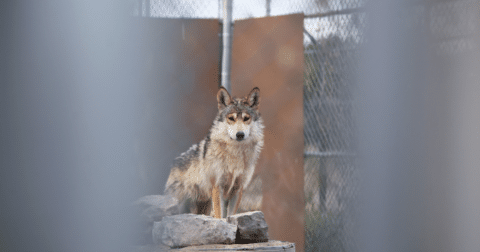
President Donald Trump has pledged to give farmers and ranchers the ability to shoot federally protected wolves who are threatening their herds. Some farmers believe lethal methods are the most effective way to protect livestock from wolves, but state protections and legal challenges may undercut the president’s efforts. Wildlife advocates oppose the move, while some researchers argue killing wolves is ineffective, and question the severity of wolf-livestock conflicts.
In a televised meeting in the Oval Office on September 4, the president discussed the challenges facing ranchers whose animals are being attacked by wolves protected under the Endangered Species Act — namely gray wolves. Agriculture Secretary Brooke Rollins was in attendance, noting at the time of farmers, “They can’t shoot them. They have to sit and watch them destroy their herd.”
Trump responded: “But you can shoot them as of today.”
Rollins followed up to clarify that first the Secretary of the Interior Doug Burgum “has to do a little magic,” meaning Burgum’s approval is still required, “but yes.”
The executive order gave Burgum 90 days to determine whether gray and Mexican gray wolf populations have recovered enough for the animals to be delisted or downlisted under the Endangered Species Act. It also directs federal agencies to work with states on wolf protections, lethal-removal rules and compensation for livestock losses.
As Rollins indicated, the order does not immediately lift wolves’ federal protections or give farmers a license to shoot them. Still, some wildlife and environmental advocates are already expressing concern that prioritizing ranching interests over wolf protections could weaken safeguards before populations have fully recovered and divert attention from effective non-lethal methods of wolf management.
“Mexican wolves aren’t the problem, but the administration’s approach to solving purported conflict is,” said Regan Downey, director of education and advocacy at the Wolf Conservation Center, in a statement. “If the administration truly wanted to support ranchers, they would prioritize increasing funding for non-lethal initiatives to create long-lasting solutions.”
Leia Barnett, New Mexico conservation lead for WildEarth Guardians, said in the statement, “Once again we see this administration attempting to override the checks and balances provided by bedrock environmental laws like the Endangered Species Act in order to create industry carve outs and distract from other bad policies that are proving unpopular.”
Wolves play an important role in ecosystems. As apex predators, a change in their behavior can “cause a ripple effect through other species and habitats, shaping the entire ecosystem,” according to the National Park Service.
Yet wolves and ranchers have been in conflict across much of the U.S. since the early 19th-century. When European colonizers first expanded rangelands westward, they brought large numbers of cattle into wolf habitats. Turning wild land into farmland reduced the availability of wild prey in some regions, which in turn caused wolves to turn to hunting livestock. As a result, efforts were made to reduce wolf populations through a number of methods, including mass poisoning.
By the mid-20th century, wolves had been killed off across much of the United States. This led to the creation of federal protections for gray wolves under the Endangered Species Act. Wolves were reintroduced to Yellowstone National Park in 1995, and have since returned to some of their former territories.
According to the U.S. Forest Service, wolves have been expanding into cattle grazing lands, including federal lands where cattle graze, which has led to an uptick in some places of wolves attacking livestock.
Today, gray wolves remain federally protected across the country as the U.S. Fish and Wildlife Service still considers them endangered in most regions, and threatened in Minnesota. The Mexican gray wolf also remains endangered across the U.S. though according to Fish and Wildlife data, population recovery efforts are surpassing goals.
Previous efforts to remove federal protections for gray wolves have had mixed results. The Obama administration oversaw the delisting of Northern Rockies wolves in 2011. But in 2014 the federal proposal was withdrawn after a peer review by the National Center for Ecological Analysis and Synthesis unanimously concluded it was not based on the best available science. In 2020, the Trump administration also delisted gray wolves (a decision supported by the Biden administration according to the Sierra Club), but that decision was ultimately overturned by a federal court.
Some ranchers believe that killing wolves is necessary. A 2017 survey of 274 Wyoming ranchers found most perceived lethal methods of predator control as more effective than nonlethal. And today, Trump’s reinvigorated plans to remove protections for gray wolves is part of the administration’s broader efforts to support those ranchers and “rebuild our great American cattle herd.”
But, as Adrian Treves, professor of environmental studies at the Nelson Institute, University of Wisconsin Madison, and founder of the Carnivore Coexistence Lab tells Sentient, perceived evidence isn’t the same as actual evidence. “Wyoming ranchers may have their perceptions. They may talk to their neighbors. But barstool biology is not biology.” Treves’s work focuses on the ecology of coexistence between people and large carnivores. He calls the Trump administration’s efforts to remove wolf protections misguided. “Our evidence does not support that causal claim.”
Federal delisting of wolves would not necessarily remove their protections in all areas due to state laws. In California, for example, gray wolves are also protected under the state’s Endangered Species Act, which means California could maintain restrictions on killing wolves even if Trump’s federal protections are removed. In a Sept. 8 edition of California Cattleman Weekly, the California Cattlemen’s Association speculated that it is “unlikely that the state would act to delist the species under pressure from the Trump Administration.”
Though the National Cattlemen’s Beef Association has previously called for gray wolves to be delisted, a representative told Progressive Farmer the group was not briefed until roughly one hour before the September 4 executive order was signed. It has not issued a public statement regarding the order, but a September 4 social media post from NCBA reads, “Policies affecting cattle producers should be led by cattle producers.”
Sentient contacted the National Cattlemen’s Beef Association for comment on the order to delist or downlist gray and Mexican wolves, but did not receive a reply.
Before considering how successful wolf culling is in safeguarding livestock, the first question is how much of a threat wolves actually pose to cattle ranches to begin with.
A September investigation by Inside Climate News of 2025 state and federal data found that “wolves account for a tiny percentage of total cattle deaths.” For example, according to USDA records only 0.2% of all cattle deaths and losses in Oregon were related to wolves, meaning wolves were responsible for a very small number of deaths compared to other causes. And in California, where the highest number of cattle were killed or injured by wolves, that still only amounted to less than 1% of the cattle population. The journalists do acknowledge that actual numbers are likely higher though, due to some kills going undiscovered or unconfirmed due to decomposition.
Nonetheless, USDA data shows that overall, 98% of adult cattle deaths in 2015 were due to nonpredator causes, with respiratory illness being the top cause.
Through his work at the Carnivore Coexistence Lab, Treves along with 12 other researchers recently published a paper reviewing how removing wolves impacts domestic animal losses. The researchers looked at five independent studies from five countries and all came to the same conclusion that in most cases, killing wolves to protect farm animals doesn’t work. “The losses continue,” says Treves, and only in a minority of cases was a reduction in farm animal losses achieved. The researchers also found “in an equal or even larger minority of cases, it backfired, and farm animal losses increased,” Treves says, as other predators can fill what he describes as an “ecological hole” left by the killing of wolves.
So how can ranchers better protect their animals from wolves?
Wolves don’t have to be killed to prevent conflicts with cattle. Examples of non-lethal methods of wolf control include sounding sirens or shooting paintballs, as well as deterrents like electric fencing. According to a 2025 analysis, these methods had a greater impact on reducing predation than hunting wolves.
“Living on a landscape with wolves can be stressful to a rancher,” Eric Clewis, Northern Rockies senior representative at Defenders of Wildlife, told Sentient in an email, “but that’s why investing in real solutions, like non-lethal tools, is so important and has great impact.”
Another example returns to traditional range-riding, meaning staff are positioned near livestock, often on horseback or ATV. A study of three range-riding programs in western Montana reported fewer livestock losses than hunting.
Wolves account for less than 1% of total livestock loss, writes Clewis, who calls “the Big Bad Wolf narrative” “blatantly wrong,” adding that Trump’s executive order “focuses on a narrow issue that attempts to create a scapegoat in the larger scheme of things.”
“We call for governments who claim that killing wolves will protect farm animals,” says Treves, “to stop, look at the evidence, because it could backfire.”
Jessica Scott-Reid is Sentient's Disinformation Correspondent covering disinformation, misinformation and the impact of both on culture. A freelance journalist based in Canada, Jessica has covered animals, the environment and food systems for major media in Canada and beyond, for the last decade. Jessica has been a contributor to Sentient since 2019, and her work also appears regularly in The Globe and Mail, Toronto Star, Winnipeg Free Press and Corporate Knights Magazine.

News
Policy•5 min read

Explainer
What do Democrat Rob Sand and Republican Zach Lahn say they will do about Iowa’s poor water quality?
Climate•10 min read

Feature
A survey taken this past spring shows a majority of Iowans say they have experienced negative environmental impacts from industrial animal operations. But plenty are also ambivalent, or ignorant, about…
Elections•11 min read