Explainer
Where Iowa’s Gubernatorial Candidates Stand on Water Quality
Climate•10 min read
Feature
Could animal welfare and clean water motivate American voters?
Words by Emily Payne
For decades, Danish pig farming has seemed untouchable. The country of 6 million people produces approximately 28 million pigs per year, and its pork industry is deeply embedded in the economy, politics and national identity.
But this spring, animal welfare was a defining issue in what became known as the “pig election.” After Danish Prime Minister Mette Frederiksen secured a third term, the government coalition announced a historic program aimed at shifting the industry away from ultra-intensive, export-driven factory farming.
The campaign’s success offers a case study for advocates elsewhere. In the United States, where more than 70 million pigs are raised annually and animal welfare is rarely a major electoral issue, advocates have long struggled to build political momentum on farm animal welfare issues. Yet one of the biggest lessons from Denmark’s campaign has little to do with money, politics or policy: Keep the message focused on the animal.
“We thought we would have to make really complicated arguments,” says Britta Riis, chief executive officer of Animal Protection Denmark, the country’s largest animal welfare organization. “Suddenly, it was just about the pig.”
It was also about the water. Polling in Denmark found 95% of respondents wanted “urgent action to protect the country’s drinking water.” Similarly, the fight for clean water is a rising political issue in parts of the U.S. where factory farms are fueling water pollution. In Iowa, a poll conducted by the advocacy group Food and Water Action found 82% of Iowa voters said they would be more likely to vote for a candidate who makes clean water protection a “top priority.”
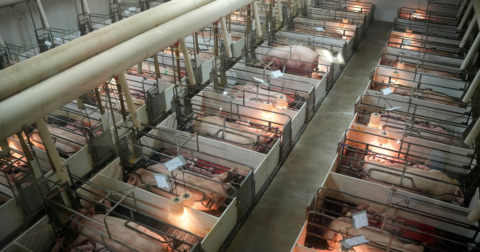
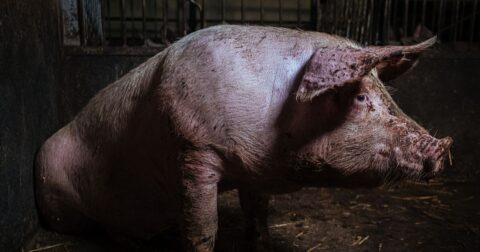
Danish pig production has significant welfare problems despite decades of initiatives aimed at reform. About one-fifth of all piglets raised on Danish farms die before they reach weaning age — more than 26,000 piglets each day — due to practices like sow confinement and breeding for extreme productivity.
As in most industrial pig farming systems, pigs in Denmark have been bred to produce about 20 piglets at a time, but research suggests this increased efficiency negatively impacts the animals’ welfare. Sows usually only have 14 teats, so piglets are forced to compete for breastmilk. The stress and confinement result in starvation for some piglets and aggressive behavior for many others. Surviving piglets’ tails are routinely cut off in painful procedures to mitigate tail biting.
Danish concerns also extend beyond animal welfare: Nitrate pollution linked to factory-farm runoff became a prominent election campaign issue this year, as about one-third of the country’s shallow groundwater and agricultural wells exceed the 50 mg/L nitrate limit, the current standard for safe drinking water.
Historically, voluntary initiatives to address these issues have proven ineffective, says Riis.
“For the last 30 years, there has been 15 working groups on voluntary change for the pigs, for animal welfare…There has been a lot of negotiation around this in Denmark,” says Riis. “Nothing has come out of all the working groups.”
Riis was “tired of not getting anywhere,” and she decided to go all in: “I went to my board and said, I need more money. I need people…We need to raise the effort. We need to be stronger. We need to be more powerful.”
No single event or strategy can explain the campaign’s success, says Riis, but rather a convergence of increased public awareness, high-profile investigations and new coalitions.
Two years ago, Animal Protection Denmark made a “huge” investment in communications and public affairs around animal welfare issues, including hiring politically strategic personnel. In 2025, multiple undercover investigations exposed the Danish public to factory farming conditions for pigs, one of which led the organization to report a prominent industry leader for violating the country’s animal welfare laws.
All of the above heightened Danish media coverage of animal welfare issues by January 2026. In just 72 hours, a citizens’ initiative collected the 50,000 signatures necessary to trigger a parliamentary debate on animal welfare. Animal Protection Denmark collaborated, joining the Danish Society for Nature Conservation, Greenpeace Denmark and the National Association against Pig Factories to form the “alliance for a pig election.” And by the March election, 53% of polled Danish voters said that animal welfare would definitely influence how they cast their ballots, and 95% said urgent action was needed to protect the country’s drinking water.
For Riis, the tides had turned. “What I felt at that time was really a push from the Danes saying, this is now enough,” she says.
The new government announced a program in June pledging to end routine tail docking and extreme breeding of pigs and give the animals more space to move. The nitrate limit in drinking water will be dramatically reduced from 50mg to 6mg per liter. A special commission will be tasked with comprehensively restructuring the entire sector to meet these commitments, and the country’s agriculture minister will be replaced by a minister for nature and animal welfare.
For animal advocates, the reforms are a historic political victory. But whether the same playbook could work in the United States is less certain.
The Danish and American democracies have fundamentally different cultures that shape how animal welfare issues are treated, says David Cassuto, a law professor at the Elisabeth Haub School of Law at Pace University, who specializes in animal and environmental law.
“The notion that it is our God-given right as Americans to do whatever we want, as long as it doesn’t hurt anybody, has created a lot of the political antagonism that we have as a nation,” says Cassuto. When this is applied to animal agriculture, he says Americans are “not going to care enough about it to alter their diet, much less vote based on it” — even if polls show widespread disapproval of factory farming’s confinement and slaughter methods.
Indeed, numerous industrial farm animal cruelty videos have gone viral in the U.S., without the groundswell of public support or legislative action that Denmark saw this year. Instead, “the result is that states pass ag-gag laws,” says Cassuto.
The U.S. wealth gap has also increased significantly over the past several decades, while Denmark’s is among the world’s lowest.
In Iowa, where nearly one-third of the United States’ pigs are raised, and there are almost eight pigs for every human, most people aren’t aware of how animals are treated on factory farms, says Austin Frerick, an antitrust researcher from Iowa. But increasingly, they are paying attention to factory farming issues by way of the ongoing water, cancer and economic crises: The state has the fastest-growing cancer rate in the United States and some of the most polluted waterways.
“So many people are barely getting by. We live in such a gilded moment…most people are struggling,” says Frerick. “If they actually knew the state of how pigs are raised, they’d feel bad, but they just want bacon. What really matters to them is they can’t enjoy the lake. This is how the system impacts them.” Still, state-level legislation has produced some high-profile animal welfare victories in the past decade: In 2016, Massachusetts voters passed Question 3, which established strict minimum size requirements for breeding pigs, veal calves and egg-laying hens to stand up, turn around, lie down and extend their limbs. California voters passed similar legislation in 2018 with Proposition 12.
Congressional Republicans have repeatedly introduced legislation to block state laws regulating out-of-state livestock production, most recently through the Save Our Bacon Act, but there have also been bipartisan efforts to oppose this measure. Conservative political commentator Tomi Lahren has called factory farming practices “disgusting” and “downright abusive,” and entrepreneur Vivek Ramaswamy, candidate for the 2024 Republican presidential nomination, posted on X that animal cruelty is becoming a “genuine concern for conservatives.”
These examples point to a broader shift regarding animal welfare in the U.S., says Liam Gray, founder of the Wilberforce Institute, a conservative nonprofit animal advocacy organization. Historically, animal welfare has been seen as a left-versus-right issue. But increasingly in the United States, Gray argues, it is about “people versus special interests.”
Factory farms are heavily subsidized by the federal government through direct payments, support programs, public infrastructure and trade and market policies. While economies of scale, vertical integration and industry consolidation keep costs low, federal crop insurance and commodity programs also help support the large-scale production of corn and soy, the primary ingredients in industrial livestock feed. This goes against values on both sides of the political aisle, says Gray.
“The old paradigm was that the left was for big government and the right was for big business, but I think increasingly people are realizing that those two forces are colluding and creating this big terrifying combination,” says Gray. “There’s an appetite now to push back on that. That’s coming from both sides. And I think that factory farming really represents one of the best examples of that exact kind of collision.”
Riis notes that lobbying in the U.S. is “quite intense,” so advocacy groups need to be highly connected and to raise more funding. “Make yourself powerful,” says Riis. “It’s all about power and money and influence.”
But for Riis, one of the biggest takeaways from the Danish campaign was the message’s simplicity.
When Prime Minister Frederiksen spoke about pig industry reform during the campaign, she didn’t focus on common arguments against pig industry change, such as economic and job loss concerns, for which Animal Protection Denmark had prepared counterpoints. Instead, “she came out and said that the welfare for the pigs are not okay. So she did not use financial arguments. She used the pigs,” says Riis.
Riis advises advocates looking to learn from Denmark’s success to “go back to the basics on the story on the pigs.” She often asks people to consider, what’s the difference between a dog and a pig? “One we choose to put in our bed, we’ll take into our home. The other one, we put it through the stable, and we eat it.”
Gray says that “simplifying the message makes a lot of sense” for U.S. voters. While conservative influencers do talk about issues like foreign relations or federalism related to the Save Our Bacon Act, many ultimately focus on the same basic issue of animal cruelty. Concern for animals crosses party lines.
For Frerick, Americans — including farmers — have always been against animal cruelty, but “the corporate capture of our government” has created a race to the bottom for meat producers. Now, with the rise of the Make America Healthy Again movement and growing awareness of food system issues across party lines, animal welfare reform could be just around the corner for the U.S. — and the messaging could be just as simple.
“Everyone’s coming at it from a different [angle], but they’re all talking about the same thing,” says Frerick. “We all know the food system in America is broken, especially meat production…When things are so broken, it’s going to come from a place where you least expect it, and it’s going to be so simple.”
Emily Payne is a journalist covering the intersection of food, agriculture, health and climate. Currently based in Denver, Colorado.
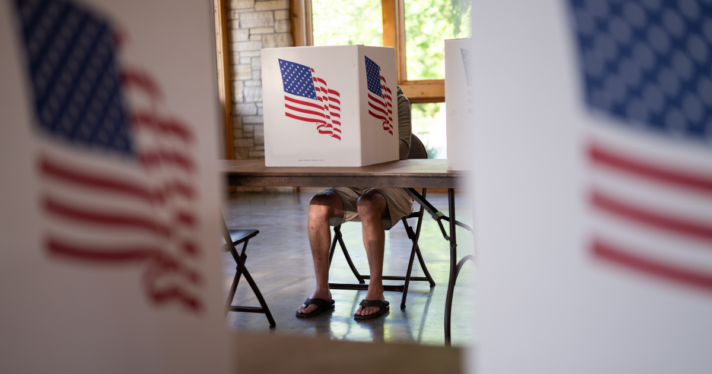
Feature
Elections•11 min read
News
Mama Bear allegedly uses misleading branding on Atlantic salmon cubes sourced by Australis Foods, an aquaculture operation accused of harming Chile’s sensitive marine environment.
Legal Action•6 min read
Feature
Thousands of them have died in the last decade, and environmental groups might sue the Trump administration for ignoring their plight.
Policy•7 min read