News
Inside Big Beef’s ‘90s Campaign to Rewrite Its Climate Story
Big Meat•6 min read
News
There are no federal methane standards for manure digesters, leaving operators to rely on voluntary guidance.

Words by Gaea Cabico
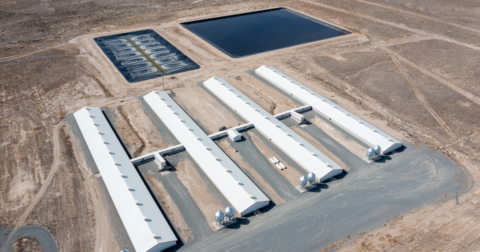
In the United States, a technology called anaerobic digesters has become a key part of the livestock industry’s efforts to curb planet-warming emissions, in part by capturing methane from manure and processing it into renewable natural gas. This fuel can generate electricity and power vehicles. But critics argue these digesters are being built across the country — mostly on factory farms — even though the U.S. lacks a comprehensive system to monitor and verify their promised climate benefits.
A new report from global environmental organization Clean Air Task Force suggests that without robust monitoring and oversight of methane emissions and leaks, proposals and existing programs for this application of anaerobic digesters could overstate the technology’s benefits and steer funding toward projects that fall short of their climate promise.
Anaerobic digesters “can be beneficial in certain situations for certain systems if they have the strong guardrails to make sure that they’re working properly,” Fernanda Ferreira, director for agriculture methane at Clean Air Task Force and one of the report’s contributors, tells Sentient. “If they’re not, they may not deliver the expected environmental benefits.”
Agriculture is the largest source of methane emissions, which are released during cattle digestion and from manure stored on farms. Digesters tackle emissions from that second source, manure management.
Methane accounts for 12% of U.S. greenhouse gas emissions from human activity. While it is short-lived in the atmosphere, methane is a more potent greenhouse gas than carbon dioxide. That means reducing these emissions could have a rapid impact for climate change mitigation.
A number of federal and state programs have offered loans, grants and other incentives to support construction of anaerobic digesters. As of 2024, around 400 manure biodigesters were operating across the country.
According to the Clean Air Task Force report, a major source of methane emissions from these systems is related to leaks from digestate storage — where leftover materials after digestion are kept — because some tanks aren’t airtight and some are actually open. Methane leaks from storage typically range from 2% to 4%, but they can reach up to 15% during warmer months. In the U.S., digestate emissions are largely untracked and facilities are not required to cover digestate storage.
The Clean Air Task Force is calling for mandatory standardized procedures for facilities to measure, monitor and report their methane emissions, along with third-party verification. Today, however, emissions reported in the U.S. are estimates that largely rely on models rather than direct measurements, Ferreira says.
The report also recommends leak detection and repair programs that would require regular inspections of the digester equipment, including specialized cameras to detect methane leaks.
There need to be specific rules for monitoring manure biodigesters, writes Swati Hegde, Global Manager of Agricultural Methane at the World Resources Institute’s Food, Land and Water Program. In an email to Sentient, she writes that these rules should include what should be covered to prevent leaks, frequency of inspections, how quickly leaks must be repaired and the process for verifying compliance.
Without federal standards for anaerobic digester facilities, operators in the U.S. are often left to voluntarily develop procedures for monitoring methane emissions and inspecting for leaks.
“One may say, ‘I’m following all these guidelines.’ But are they really? We don’t know and there’s no way to verify that,” says Ferreira. “I think having binding regulations would allow us to make sure that these systems are functioning well.”
The American Biogas Council “supports continued improvements in system design, operation monitoring and leak detection because capturing more methane benefits both the climate and facility operations,” its executive director Patrick Serfass writes to Sentient.
“Without a biogas system, the organic materials that feed these facilities would still produce methane — but that methane would be released directly into the atmosphere. Biogas systems capture that methane and put it to productive use, preventing the vast majority of those emissions,” he adds.
But the climate impact of a digester depends largely on the manure management system it replaces, Hegde says. She explains that digesters provide bigger benefits when they are used instead of uncovered lagoons on livestock farms in warm climates. However, if they replace storage tanks or deep pits that release less methane, their relative climate benefits are much smaller.
The U.S. is not alone — according to the Clean Air Task Force, most of the nations examined lack anaerobic digestion-related regulations. Some of these countries focus mostly on worker safety. In Germany and the United Kingdom, facilities do not use third-party verification. The strongest regulatory framework of those reviewed is found in Denmark, which requires monitoring plans developed by a third party and leak reports to be verified by a third party. The government may also withhold subsidies for non-compliance. But regulators still do not require continuous methane monitoring or set emissions limits for digestate storage.
The report also notes that measuring actual emissions — rather than relying on estimates — would make carbon credit programs more credible by ensuring that claimed climate benefits reflect real-world performance.
One major incentive program for manure biogas is California’s Low Carbon Fuel Standard, which aims to reduce the carbon intensity of the state’s transportation fuels by encouraging the use of lower-carbon and renewable alternatives. Under the program, livestock operations across the U.S. can earn credits by capturing methane from manure and converting it into biomethane, which is then sold to transportation companies to offset emissions from gasoline and diesel.
But according to Brent Kim, a public health expert at Johns Hopkins University’s Center for a Livable Future, incentivizing anaerobic digesters to offset emissions is problematic. Manure biogas is “hardly considered low carbon,” he writes to Sentient in an email, because digesters only address methane from manure management, not emissions from cattle digestion, rearing calves or producing feed crops.
He also points out that digesters encourage farms to expand to pay off their high costs, which leads to more animals, more waste and more pollution. A 2026 preprint supports this concern: it found that California dairy farms with digester incentives increased herd size by an average of 4.3% within three years of digester construction, leading to an increase in greenhouse gas emissions. But the California Air Resource Board, which manages the Low Carbon Fuel Standard program, said there was not enough evidence to conclude that digesters led to faster growth of dairies.
“So yes, monitoring methane emissions is a good thing,” Kim says. “But if we’re monitoring methane so we can get more industrial livestock operations with digesters participating in incentive programs, we fundamentally need to rethink what we’re incentivizing farmers to do, and why.”
But government support for the technology may be waning. In April, the U.S. Department of Agriculture announced that it was extending its pause on loans for anaerobic digesters through the end of the year.
A World Resource Institute analysis concludes that anaerobic digestion is too expensive to meet methane reduction goals in manure management and points out that one in four digester facilities closed between 2014 and 2024, in part due to cost.
Ben Lilliston, director of climate and rural strategies at the Institute for Agriculture and Trade Policy, argues that manure digesters are not the most effective climate solution. But if federal funding resumes, he says, it should be paired with stronger monitoring requirements and long-term evaluations.
“One of the things we were calling for and continue [to call] is if we’re going to fund digesters, we need to understand whether this is a smart investment,” Lilliston tells Sentient. “Are these projects working? Are they a good use of our money?”
Gaea Cabico is Sentient's editorial fellow, and an award-winning journalist from the Philippines who reports on climate change, environmental issues and energy through a social justice lens. She holds a master's degree in science journalism from New York University.

News
Climate•4 min read

Solutions
A new report from the World Resources Institute on its Coolfood pledge initiative observes progress and challenges in curbing cafeteria emissions.
Climate•6 min read
Explainer
It all comes down to burps and land.
Climate•5 min read