Solutions
Bhutan’s Food System Ethos Offers an Alternative to Factory Farming, but Can it Survive?
Farms•7 min read
Solutions
An octopus farm proposal sparked global uproar from animal welfare advocates, scientists and ordinary people – including one 9-year-old.

Words by Gaea Cabico
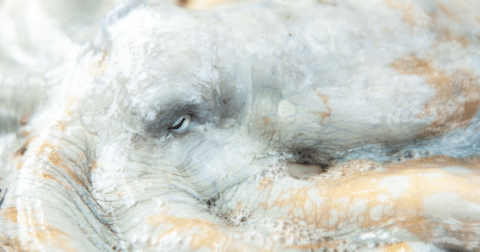
Plans to build the world’s first commercial octopus farm are dead. On July 22, the Port Authority of Las Palmas announced that Nueva Pescanova, the Spanish seafood giant behind the proposal, had withdrawn its application to build the octopus farm in the Canary Islands.
How did this happen? It followed a coordinated effort by more than a hundred scientists, dozens of conservation and animal advocacy groups and tens of thousands of ordinary citizens, including a 9-year-old girl in Portugal.
The campaign benefited from a fortuitous convergence of circumstances: Elena Lara of Compassion in World Farming dug into why octopuses — wild animals now widely recognized as intelligent and sentient — should not be confined in tanks or cages. In 2024, more than 100 scientists wrote a letter to the journal Science detailing the remarkable intelligence of octopuses and the ecological foolishness of farming a carnivorous species. And the 2020 documentary My Octopus Teacher captured the imaginations of millions of ordinary people.
Nueva Pescanova confirmed to Sentient that it had cancelled the project, but said it would not be making any statements about the reasons behind the decision.
In the Port Authority’s press release, Nueva Pescanova attributed the decision to new administrative requirements for environmental review. The company said these circumstances changed the project’s scope, timeline and regulatory obligations, prompting it to reconsider its plans. Nueva Pescanova had reportedly invested $63 million in the proposed facility on Gran Canaria, one of Spain’s Canary Islands. The farm was projected to produce around 3,000 tons of octopus meat annually and according to campaigners would have housed roughly one million octopuses a year in tanks.
For scientists, ocean advocates and animal welfare campaigners, the outcome shows what happens when science, advocacy and public outcry converge against an industry before it has a chance to entrench itself.
In an increasingly industrialized world, octopuses represent “a kind of desire to keep what we have that is wild, wild,” Jennifer Jacquet tells Sentient. Jacquet is an environmental science professor at the University of Miami who has called for stronger protections for octopuses.
When Lara first learned of the plan to build the world’s first commercial octopus farm in the Canary Islands, her immediate reaction was: this cannot happen. “It looks like we have not learned from our past mistakes,” Lara, a senior research and policy advisor at animal welfare organization Compassion in World Farming, tells Sentient. “We have seen what we are doing to land animals in intensive farms, in factory farms.”
In 2021, Compassion in World Farming published her findings in a report titled “Octopus Farming: A Recipe for Disaster,” which laid out the animal welfare and environmental concerns: crowded conditions that could trigger aggression and cannibalism among a territorial species, lack of humane slaughter method and a carnivorous diet that would demand vast quantities of wild-caught fish, placing additional pressure on marine ecosystems.
That report also became an important tool in a five-year campaign that would involve scientists, conservation groups and members of the public worldwide.
Lara did not start from scratch. She credits a 2o19 article by researchers Jennifer Jacquet, Becca Franks, Peter Godfrey-Smith and Walter Sánchez-Suárez arguing that farming octopuses for food was a bad idea before the industry had even begun.
Much of the discussion at the time, according to Jacquet, centered on solving one of the biggest technical hurdles to commercial octopus farming: breeding Octopus vulgaris — common octopus — in captivity. What concerned Jacquet was the absence of any conversation about the ethics of farming octopuses.
In their paper, Jacquet and her co-authors raised concerns about the humane treatment of octopuses and the sustainability of the wild-caught fish used to feed them. They also argued that octopus farming was never really about improving food security. “It seemed to me that it was hard to make a strong case that this was about feeding the world,” she says. It was much more about creating a luxury product, not a dietary staple like rice.
Octopus is considered a delicacy in a number of countries. The top importers include Spain, Italy, Japan, the United States, South Korea, Portugal and China, according to the Food and Agriculture Organization. Global demand has climbed even as wild catches have not kept pace. Nueva Pescanova has claimed that farming octopuses could reduce pressure on wild populations by providing an alternative supply.
Jacquet and her co-authors also warned that octopuses are carnivores, meaning they must be fed other animals such as fish, squid and crabs. Raising a carnivore for food can be an inefficient way to produce protein. In the case of octopuses, it takes about three pounds of feed to produce just one pound of octopus. In other words, seafood that could be eaten directly by people would instead be funneled into producing octopus.
Lara took Jacquet’s early warning and turned it into a sustained campaign. She says that when Compassion in World Farming published its initial report, “people were not aware that practice was happening and it’s why I think it awoke a lot of the public.” Jacquet describes the Compassion in World Farming as a “catalyst” for turning the issue into a campaign.
What followed was five years of mounting pressure. Compassion in World Farming published additional reports — one examining the Canary Islands government’s concerns about the project’s environmental impacts, including pollution, energy and water use and the large amounts of wild-caught fish needed for feed and another one tracking the public funding spent on research to develop octopus farming. Compassion in World Farming also lobbied policymakers in Spain and beyond and built a coalition that stretched well beyond animal welfare circles.
One of the more striking features of the campaign was who showed up for it.
Getting the public to care about the welfare of aquatic animals has historically been an uphill climb for advocacy groups. But octopuses proved to be an exception. Jacquet believes octopuses themselves played a major role in building public support against farming the species, noting their intelligence and behavior are both recognizable and fascinating to people. She also points to the timing of the Oscar-winning 2020 documentary My Octopus Teacher, which introduced millions of viewers to wild Octopus vulgaris just as plans for the farm were emerging.
That connection translated into action. According to the Compassion in World Farming, more than 43,000 emails were sent to the Los Palmas Port Authority urging it to reject the proposal.
Not everyone involved in the campaign was a scientist or professional campaigner. Lara points to Lily Niederhofer, a young girl from Portugal, as a source of inspiration during the campaign’s hard moments. After hearing about the proposed farm, Niederhofer organized a 2-kilometer charity swim in the Atlantic Ocean to raise over $12,000 for Compassion in World Farming’s campaign. She was 9 years old at the time.
“Octopuses are such incredible and intelligent creatures; they fascinate me,” Niederhofer said in a 2024 release. When she learned about the proposed octopus farm, she thought it was “really cruel to these amazing creatures.” She decided to use her love of swimming to protect her “Octofriends.”
Niederhofer later spent part of her summer vacation traveling to the United States to urge lawmakers to support a ban on the production and sale of farmed octopus.
“If my work — or all the work that Compassion has been doing — has arrived to this kid and she has this energy to fight against octopus farming,” Lara says, “I think it’s worth it.”
Scientists and conservation organizations joined the opposition, too.
In 2023, dozens of organizations — including Greenpeace España, Oceana UK and the World Cetacean Alliance — and academics signed a letter led by Compassion in World Farming urging the Canary Island government to reject Nueva Pescanova’s plans. A year later, scientists led by Jacquet published a letter asking the U.S. Congress to support a bill that would prohibit commercial octopus aquaculture operations in the U.S., along with imports of farmed octopus.
“It’s not only about our beliefs. It’s just what science is saying,” Lara says.
Lara and Jacquet are careful not to overstate the significance of Nueva Pescanova’s decision. In announcing the withdrawal, the company emphasized the move should not be interpreted as a conclusion that the project is no longer viable under different technical, environmental or location-based conditions.
“This sends an important signal to the industry that wants to invest in this practice,” Lara says. “At the same time, I think that we cannot relax ourselves.”
Jacquet says she would give the company credit if the decision reflects a genuine shift toward sustainability. “What I hope is that this is a sign that they’re thinking about how to grow their company sustainably, and that would be a great achievement if that was the case.”
Still, Jacquet sees the withdrawal as part of a much larger fight over the future of aquaculture. “Aquaculture requires major transformation and this was one small step along the way,” she says.
Both Lara and Jacquet hope to see more focus on legislations that regulate octopus farming at the national and regional level as well as ending public subsidies for this kind of aquaculture. In the United States, Washington and California have preemptively banned octopus farming. Last year, Senators Sheldon Whitehouse (D-RI) and Lisa Murkowski (R-AK) reintroduced a bill that would prohibit octopus farming at the federal level.
One thing that continues to give Jacquet hope is that commercial octopus farming is still a nascent industry, unlike terrestrial factory farming. “Maybe it was easier in any kind of setting to stop something before it starts rather than to try to undo harm once it begins. Once you have the infrastructure, once you have that capital in motion, it creates an inertia that’s really hard to unravel,” Jacquet says.
Gaea Cabico is Sentient's editorial fellow, and an award-winning journalist from the Philippines who reports on climate change, environmental issues and energy through a social justice lens. She holds a master's degree in science journalism from New York University.
Feature
Food•6 min read
Feature
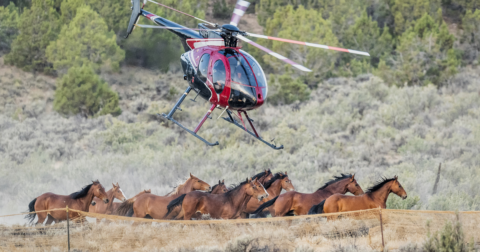
3,700 federally protected wild horses were sold in 2025, and a new investigation reveals some end up at the slaughterhouse.
Food•7 min read
Feature
Cooke Aquaculture touts the jobs its salmon farms bring to the state, but local critics say the potential costs to their waters, livelihoods and wild Atlantic salmon outweigh the benefits.
Fisheries & Aquaculture•9 min read