News
The Fishing Industry Is Changing Fish DNA
Fisheries & Aquaculture•8 min read
Investigation
Neither StarKist nor its parent company responded to union leaders' requests to negotiate amid the allegations raised in an investigation by Global Labor Justice.
Investigation • Food • Workers

Words by Gaea Cabico
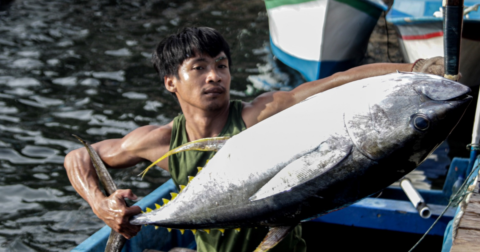
“As long as there is breath in your body, you can work.” That’s what the captains think, migrant fisher Adrie Nelwan observed after a fishing hook snapped back and struck his right eye aboard a Taiwanese tuna longliner in July 2021. According to him, his captain did not believe he was in pain and refused to head to shore so Nelwan could seek medical treatment.
Nelwan’s testimony is one of 92 Indonesian migrant fishers interviewed for a Global Labor Justice investigation and report on forced labor in StarKist’s supply chain released in September.
According to the report, Nelwan said that his captain withheld food and threatened to cut his wages because he couldn’t work. Fearing the consequences of not working, Nelwan returned to his duties around one week later. It was not until August 31, nearly two months after the injury, that he finally saw a doctor who prescribed eye drops.
When Nelwan asked for additional care, the captain accused him of exaggerating his injury and told him to transfer to another fishing vessel. Nelwan refused and returned home to Indonesia with no savings, as he had spent his wages repaying some of the debt he incurred to secure the fishing job. He eventually paid about $3,500 out of pocket for his surgery, but the procedure did not restore his vision. His manning agency — the company that recruited him and arranged his job on the fishing vessel — continues to demand repayment of the remaining debt.
A 2023 survey found that recruitment fees averaged about $817, with some surpassing $1,500. It can take migrant fishers up to six months to pay off the debt, which can also deter fishers from quitting, even under abusive conditions.
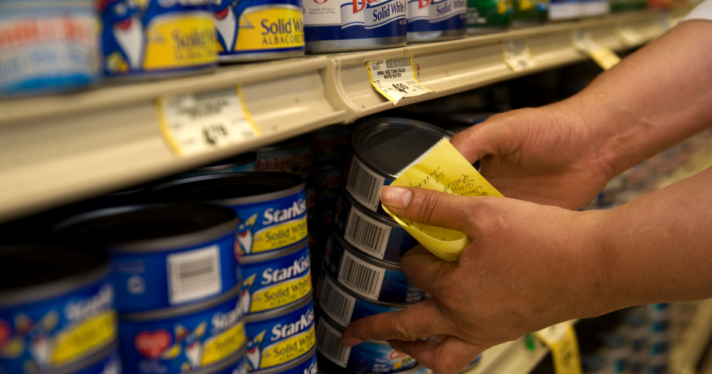
Nelwan’s vessel supplied tuna to StarKist since March 2021. As the largest canned tuna brand in the United States, StarKist sources much of its albacore tuna from Taiwan’s distant-water longline fleet. These vessels operate beyond the country’s territory and are at sea for months, relying heavily on migrant fishers, particularly from Asian countries such as Indonesia and the Philippines.
The Global Labor Justice investigation found indications of forced migrant labor aboard all 37 Taiwanese vessels they had worked on. StarKist did not respond to the fishers’ repeated request to negotiate with them, according to the report.
“To my knowledge, this is the largest investigation of its kind that links forced labor at this scale to a specific company,” Allison Gill, legal director of Global Labor Justice, tells Sentient. While the vessels examined represent only 17% of StarKist’s Pacific albacore supply chain, Gill believes the findings show that workers in this part of the fleet are at risk of abuse.
Jessica Sparks, an assistant professor at Tufts University who studies forced labor in global food systems, adds a note of caution, however. While the findings reflect the experiences of the workers interviewed, they cannot be used to establish that “identical conditions exist on every vessel throughout the entire supply chain.” Supply chain tracing also has limitations, she tells Sentient in an email, because of opaque practices and limited information.
Forced labor, per the International Labour Organization, a U.N. agency, is “work or service which is exacted from any person under the threat of a penalty and for which the person has not offered himself or herself voluntarily.” The practice is persistent across the world’s distant-water fishing fleets. The 2021 Global Estimates of Modern Slavery reported that approximately 128,000 fishers were entrapped into forced labor aboard fishing vessels globally in 2021. The United States prohibits importing goods produced, even partly, using forced labor.
What made abusive conditions so hard to escape, the Global Labor Justice report says, was isolation. Fishers spend months at sea without reliable communication, cut off from unions and unable to report abuse or call for help. For Nelwan, that isolation took a lasting toll. He believes receiving medical intervention sooner might have saved the sight in his right eye.
“The lack of communication at sea was one of the several major issues driving not only forced labor, but their barriers to exercising their fundamental labor rights,” Gill says. Fishers also reported being allowed very little rest. Many fishers said they worked 16 to 22 hours a day, every day, with some forced to work 24 without rest.
Another fisher, Hasan, also provided an account in the report. Crew members were expected to keep working even when sick or injured, he said. He once slipped and hit his back against the lid of a fish hold, he also recounted, injuring his tailbone. But he had to carry on with his duties despite the pain.
A different fisher, Adrian Dogdodo Basar, described in the report how shifts lasted as long as 23 hours and voyages as long as 10 months. Recounting the death of a crewmate who fell ill, Basar said their captain ordered the man’s body placed in the freezer and that the crew continue fishing.
Workers who speak out or try to switch employers may face severe consequences. Deportation is one possible outcome and can send them back into the recruitment system, where securing another job may mean taking on even more debt, Gill says. And when a migrant fisher wants to leave, barriers can go beyond finances, including confiscated passports and employer-tied visas.
StarKist did not respond to Sentient’s request for comment as of publication time. But StarKist’s code of conduct explicitly bars forced labor. “Manufacturers are expected to uphold the human rights of workers and treat them with dignity and respect,” the code of conduct reads.
StarKist is a “longtime member, in good standing” of the National Seafood Association, Gavin Gibbon, the trade organization’s chief strategy officer, tells Sentient in an email. Gibbons says the group “takes allegations of worker mistreatment seriously” and that its members are committed to supply chains free of labor abuses. He also urges anyone with specific concerns to immediately alert law enforcement and regulators.
Workers in Indonesia may seem far removed from the United States, but their work brings canned tuna to American households. By analyzing vessel, shipping and trade records, Global Labour Justice traced StarKist’s albacore supply chain from fishing vessels in the Pacific to its processing facility in American Samoa and the United States.
Consumers should be able to expect that the products they buy are not linked to exploitation. That should be the “bare minimum,” says Zacari Edwards, senior seafood campaign coordinator at Global Labor Justice. “The way that brands and supermarkets market their products leads consumers to believe that the products they’re buying are sustainable and have been ethically sourced,” Edwards tells Sentient.
StarKist posts on its website that all tuna and salmon it buys comes from suppliers whose fisheries are either certified by the Marine Stewardship Council (MSC) or working toward certification through a Fishery Improvement Project (FIP). According to its website, StarKist also aims to source all its tuna and salmon from MSC-certified fisheries by the end of this year.
In response to a request for comment, the Marine Stewardship Council tells Sentient in an email that companies convicted of forced or child labor are barred from certification. “While some NGOs believe that MSC should offer social assurance, our focus and expertise are best directed towards addressing the enormous environmental challenge posed by overfishing,” the organization says. The Marine Stewardship Council also adds that independent third-party assessors decide which fisheries qualify for certification.
With existing certification programs offering limited protection, some workers are increasingly seeking other ways to hold companies accountable.
Following the report’s release in September, Forum Silaturahmi Pelaut Indonesia – Pingtung County Migrant Fishers Union (FOSPI-PMFU), a labor union representing migrant fishers in Taiwan who work aboard vessels in StarKist’s supply chain, launched a campaign calling on the company to negotiate a binding agreement directly with workers.
The union’s demands include guaranteed Wi-Fi access aboard all vessels, safe and healthy workplaces, fair wages and employment contracts, the right to organize without intimidation or retaliation and transparent grievance procedures.
Gill says the campaign is unprecedented and notes that few, if any, unions have pursued this kind of direct, binding agreement with a seafood company despite longstanding reports of labor abuses across the industry.
The labor union and Global Labor Justice also filed a complaint against Dongwon Industries, the South Korean parent company of StarKist, accusing it of failing to meet the Organisation for Economic Co-operation and Development’s Guidelines for Multinational Enterprises on Responsible Business Conduct over forced labor in its Pacific albacore tuna supply chain.
Union leaders tried to contact StarKist and Dongwon Industries twice before the report’s publication to discuss their demands, but received no response, according to Gill. The companies had yet to respond after its release, either.
There has been no shortage of reports documenting conditions on distant-water fleets over the years but little action has been made, Gill says. She stresses, however, that these abuses are not impossible to address.
“The union has made demands and their interest here is sitting down with the company and negotiating a solution because the interest is not to shut down trade or to stop the supply chain or to end the jobs,” Gill says. Fishers want to keep working, she adds, but under decent working conditions.
Gaea Cabico is Sentient's editorial fellow, and an award-winning journalist from the Philippines who reports on climate change, environmental issues and energy through a social justice lens. She holds a master's degree in science journalism from New York University.
News
Food•6 min read
News
Researchers found a hidden feature steered the AI-generated images towards more idyllic scenes.
Farms•7 min read
Investigation
A chemical additive helped stop fishmeal from catching fire on ships, but it carried a downstream carcinogenic risk to modern food systems.
Food•6 min read