Investigation
StarKist Tuna Supply Chain Linked to Forced Labor
Food•8 min read
Feature
Trump and other lawmakers want to expand local meat processing, but both small and industrial facilities have spotty animal welfare records.

Words by Jessica Scott-Reid
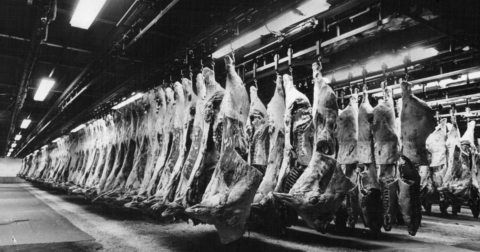
In the U.S., around 10 billion land animals are slaughtered for food each year, the vast majority in large industrial facilities. Slaughterhouses are supposed to comply with at least minimal animal welfare standards — one law for poultry birds and one for other animals raised for meat. Yet when these guidelines are violated, records show that enforcement itself is modest: often limited to shutting down slaughter for a day or two until facilities promise to fix the problem.
A recent undercover investigation by the non-profit advocacy group Animal Outlook filmed conditions at a chicken slaughterhouse in North Carolina operating at a 175-birds-per-minute kill-line speed. The investigator documented workers slamming birds into shackles, some being hung by one leg and some being cut while fully conscious.
This is what meatpacking increasingly looks like today. Industrialized meatpacking has “enabled us to slaughter vastly greater numbers of animals,” Zack Strong, senior attorney and director of Animal Welfare Institute’s farmed animal program, tells Sentient. “We are currently killing many tens of millions more mammalian livestock than we once were 100 years ago, 150 years ago, and we’re slaughtering billions more poultry.” What that means, he says, “is there is just far higher risk and likelihood that a much higher number of animals are being mistreated.”
American meat production didn’t always look like this. In the early 19th century, meat processing generally took place at smaller, regional abattoirs on or near farms, where a limited number of animals were processed to serve the local community.
That’s not to suggest this kind of slaughter was without animal welfare concerns. As Strong explains, “There were no federal laws, or very many if any, state laws or regulations governing how animals were killed.” At that time there were “a lot of local decisions made about the best way to slaughter animals,” with primitive methods that would be considered inhumane by current standards, such as using a four-pound sledgehammer on conscious cattle.
But the transition to fully industrialized slaughter has not been without costs. Today, American meatpacking is consolidated, industrialized and monopolized — more focused on production speed and efficiency than animal welfare and worker safety.
At the turn of the 19th century, animal slaughter in the U.S. was still largely decentralized. Farmers either slaughtered their own animals for household consumption or sold them to local butchers, who then sold them to customers or local markets.
Things began to change in the early 1800’s. Amid the country’s westward expansion and railroad development, slaughterhouses opened in city centers.
By 1850, Cincinnati was known as “Porkopolis,” and by 1865 the Chicago Union stockyards emerged as a competitor. Business was booming.
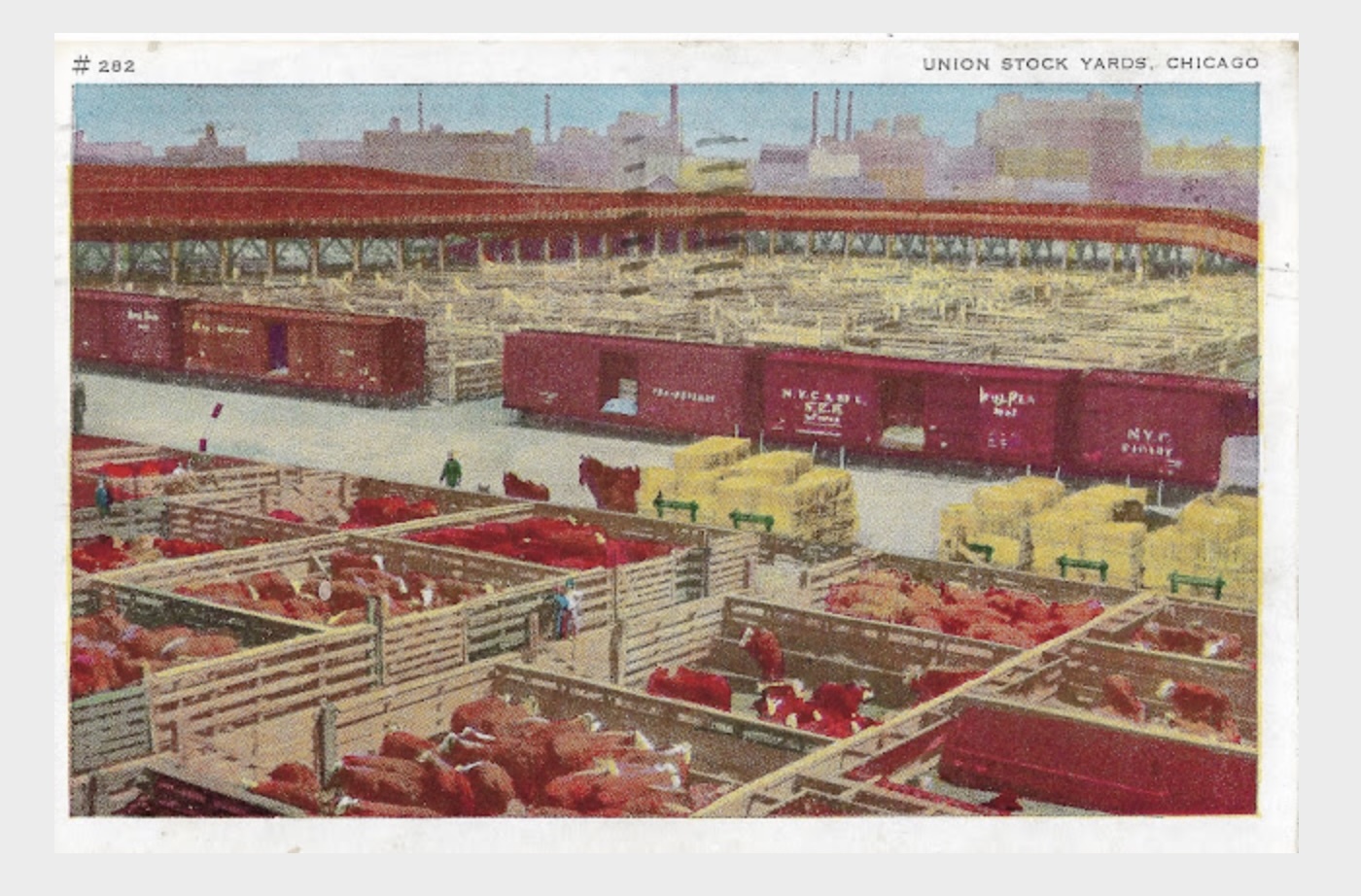
“Some of the slaughterhouses actually gave tours,” says Amy J. Fitzgerald, a professor of sociology at the University of Windsor, who has published research on the social history of slaughterhouses in America. “They were like a visitor hotspot,” as early industrialization was considered “a positive development” that the industry was “very proud to show off to tourists and visitors. Some of them even had like visitor shops and postcards.”
Towards the end of the century, animal advocates and investigative journalists began to look past the public facade and expose conditions inside.
In the 19th century, the American Society for the Prevention of Cruelty to Animals, or ASPCA, began investigating meat processing plants as part of a broader movement toward humane treatment of animals.
A 1889 report of animal cruelty cases in New York City describes how an ASPCA officer investigated a slaughterhouse, where it was “almost impossible for the Society’s officers to enter such places undetected.” The report went on to say: “In this instance, however, the officer entered through a window in the rear of the building, just as the offender was in the act of abusing the animals [calves] with a heavy club.” The employee was fined ten dollars by the Court of Special Sessions.
A few years later, journalist Upton Sinclair’s 1906 novel The Jungle, widely exposed the hidden realities of Chicago’s meatpacking industry, particularly the filthy and dangerous conditions. The book spurred public concern and federal reforms around sanitation and food safety, namely the Federal Meat Inspection Act, which then required the government to oversee the slaughter of most farm animals (not birds) for human consumption.
The law did not touch animal welfare, however. At the time, slaughterhouses were not required to stun animals to render them unconscious before they were hoisted up and cut. Any stunning was manual and imprecise, such as repeatedly hitting cattle with sledgehammers.
Meanwhile, industrial agriculture as a whole, including meatpacking, kicked off an unparalleled era of consolidation. Between 1977 and 1992, large meatpacking plants rapidly displaced smaller ones, driven in part by technological changes and automation that made bigger facilities more efficient and profitable, according to the USDA’s Economic Research Service.
In 1992, America’s largest pork producer Smithfield Foods experienced what it calls a “defining moment” when it opened the “world’s largest and most advanced pork processing facility” in North Carolina, able to slaughter about 24,000 pigs per day.
Today, most cattle, pigs and poultry are now slaughtered in just a few very large industrial facilities.
The USDA’s Economic Research Service reported that the four largest beef packers in 2019 — JBS USA, Tyson Foods, Cargill and National Beef — accounted for about 85% of all U.S. beef cattle supply. Just 15 plants owned by the four largest pork packers — Smithfield, JBS USA, Tyson and Clemens Food — slaughtered more than 4 million pigs each in 2024, accounting for nearly 64% of the nearly 129 million pigs slaughtered at federal facilities that year. And 9.4 billion young chickens were slaughtered in 2024 by 257 federally inspected plants.
It took decades of lobbying by animal welfare groups including the ASPA and the American Humane Association, working with industry group The Meat Institute, to persuade President Eisenhower to sign the Humane Methods of Slaughter Act into law in 1958.
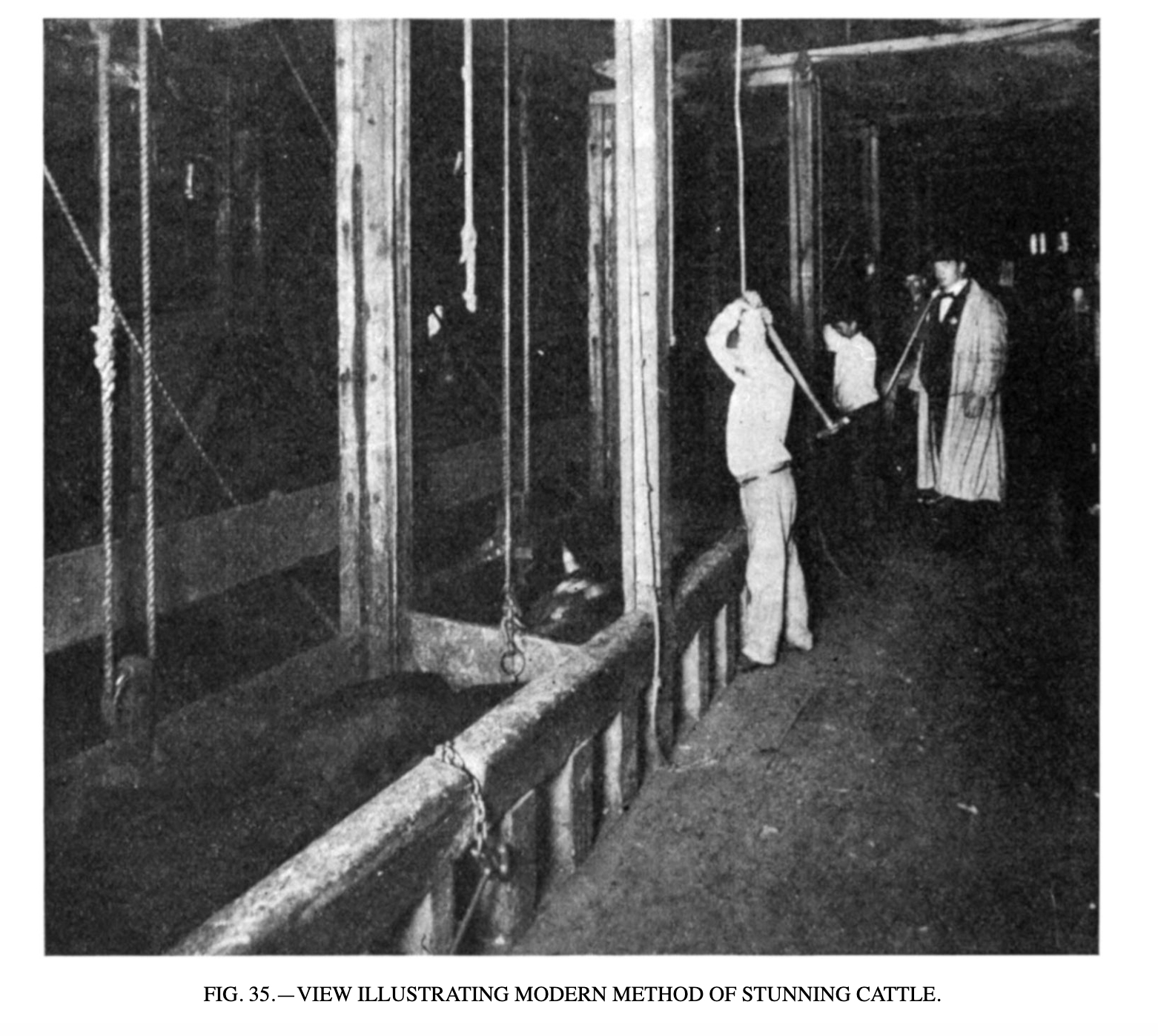
Initially, the law applied only to livestock slaughtered at plants supplying meat to the federal government. Though the law left out birds, it required other farm animals to be rendered unconscious by a “single blow or gunshot or electrical, chemical or other means that is rapid and effective.” In 1978, the law was amended to cover animals slaughtered at all federally inspected plants in the U.S. — though poultry were still left out — and give inspectors authority to shut slaughterlines down due to violations.
According to Strong, there have been some “potentially positive impacts to animal slaughter that we see today as a result of modernization.” Along with the adoption of “at least some” federal laws and regulations governing animal slaughter, he also points to “some improved stunning and slaughter technologies,” like captive bolt devices and electrical stunning systems, which “do have the capacity, if used correctly and effectively, to stun and kill animals more quickly than we were able to in the past.”
There have been a number of meat industry insiders who helped improve animal welfare. “People like Temple Grandin have been able to influence the development of [slaughterhouse] facilities, so things like non-slip floors and curved livestock chutes are now used that I think can help reduce stress for the animals and injuries as they’re being processed for slaughter.”
Grandin, an animal scientist and industrial designer, detailed how the livestock industry’s approach to animal treatment has evolved over the past 50 years from a focus on economic losses due to things like bruising and deaths during transport to include animal welfare. “In the past, the ability of animals to feel fear was questioned and today, research clearly shows that animals have emotions,” she wrote in 2025.
Yet Grandin acknowledges there is still room for improvement. For example, stunning pigs with CO2 gas — which is widely used in the U.S. and considered inhumane by many animal advocates — could be replaced with better methods, she told the American Medical Association in 2023. Electric stunning and captive bolt guns result in more instant unconsciousness when used correctly, she offered, whereas the CO2 gas method can cause pigs to suffer and panic for a minute or more.
For Strong, overall, the shift towards industrialization has led to more animal suffering. Today’s facilities are slaughtering animals faster than ever before. In 1959, for example, chickens were slaughtered at about 30 birds per minute. Today, facilities can legally slaughter 140 to 175 birds in that same time frame.
The shift to faster and faster slaughter lines “increases the risks of a long list of impacts to welfare,” says Strong, including “ineffective stunning” which can increase suffering, and “reduced ability of inspectors to see when abuse or suffering is occurring and intervene.”
Another Animal Outlook investigation documented disturbing conditions in a high-speed hog slaughter facility where some animals were pushed and dragged to their deaths.
“The faster you’re moving, the more likely it is an animal is not going to get stunned before their throat is slit, and sometimes they’re still going to be alive when they go into the scald tank,” Delcianna Winders, director of the Animal Law and Policy Institute at the Vermont Law and Graduate School, told Inside Climate News earlier this year. “We know they’re going to be violently handled to just keep pace with the line. And we know that from eyewitness testimony.”
Another downside of industrialization is that fewer local processors mean animals must travel farther to reach a slaughterhouse. Farm animals are legally permitted to travel up to 28 hours without food, water or rest, in trucks without mechanical climate control and regardless of weather. That long-distance travel can be especially dangerous for young animals such as calves and chicks, and compromised animals such as cull dairy cows, particularly during extreme temperatures. Some large facilities also can’t always handle the intake of so many animals at once, so animals sometimes wait in cramped, parked trucks for up to several hours.
President Donald Trump announced in late August plans to give U.S. farmers the ability to slaughter their own animals to help break up the monopoly of the Big Four meat-processing companies.
Agriculture Secretary Brooke Rollins said the measures would support smaller meat processors, help expand interstate sales and roll back what the administration calls outdated processing regulations. The executive order was signed on September 4 with a 60 day deadline for reports due to the president.
There is no evidence such a move would benefit farm animal welfare. “The problem with those situations is that very little, if any, federal inspection occurs,” Strong says. “Reports we’ve seen from custom slaughter plants,” Strong adds, are “some of the most egregious examples of cruelty.”
There are other challenges too, says Fitzgerald. “A lot of farmers aren’t going to be comfortable doing their own slaughtering,” she says. Some research suggests that some farmers find the killing of animals they’ve raised emotionally difficult, and that the separation between raising animals and slaughtering them helps some manage that discomfort. “That’s one way that they can kind of feel like they’re not necessarily the ones getting their hands dirty,” she says. “They raise the animals and then they send them off.”
Some members of Congress have also proposed measures to expand small-scale slaughter, including the Processing Revival and Intrastate Meat Exemption, or PRIME Act, introduced by outgoing Rep. Thomas Massie (R-KY) and Rep. Chellie Pingree (D-ME). The bill would let states allow for local sales of custom-slaughtered meat such as beef, pork or lamb directly to consumers. Though a version of the act was included in the Farm Bill passed by the House in April, it was not included in the Senate Agriculture Committee’s version. Then in October of this year, Massie introduced the Red Meat Inspection Exemption Act, along with Pingree and Rep. Eric Burlison (R-MO), to allow “qualifying small farmers to slaughter and process their own livestock for direct-to-consumer sale without federal interference,” according to Massie’s website.
Ultimately, these smaller slaughterhouses will not replace the larger, more industrialized facilities. Agricultural economist David Anderson of Texas A&M University told Reuters in August that on-farm slaughter would likely remain a very small part of the market. Despite Trump’s promise of a ‘new era of animal welfare,’ the administration has proposed no policies to improve farm animal welfare, including how they are slaughtered.
The results of the November 3 midterms may also make it harder to advance policies favoring more local slaughterhouses. Much depends on whether the Democrats want to pass loosened regulations on local slaughterhouses — not to mention whether animal welfare will be considered at all.
Jessica Scott-Reid is Sentient's Disinformation Correspondent covering disinformation, misinformation and the impact of both on culture. A freelance journalist based in Canada, Jessica has covered animals, the environment and food systems for major media in Canada and beyond, for the last decade. Jessica has been a contributor to Sentient since 2019, and her work also appears regularly in The Globe and Mail, Toronto Star, Winnipeg Free Press and Corporate Knights Magazine.
News
Fisheries & Aquaculture•8 min read
News
Market-driven sustainability initiatives were touted as a way to incentivize better environmental practices but a new study finds most of the retail price fails to reach the actual fishers.
Food•6 min read
News
Researchers found a hidden feature steered the AI-generated images towards more idyllic scenes.
Farms•7 min read