Explainer
Why Beef Is Bad for Climate Change, Explained
Climate•5 min read
News
Animal agriculture drives 71% of biodiversity damage from food production on farmland.

Words by Emily Payne
Animal agriculture has an outsized impact on global carbon and biodiversity loss, according to a new study in Nature Food. Animal-sourced foods provide less than 15% of humanity’s calories but are responsible for 71% of biodiversity losses and 59% of carbon losses on agricultural land used to produce food worldwide. The study excluded fish, focusing on land-based foods.
The findings point to opportunities to address two global crises at once. By mapping carbon and biodiversity loss on agricultural land, researchers found hotspots where both are concentrated. Targeting those hotspots — many in India, Southeast Asia and Brazil — could deliver benefits for both climate and biodiversity, the study authors say. Even targeting just half of them could spare about 11% of species from extinction, they found.
Looking at both at once is important, the authors say. Solely considering the hit to carbon storage — that is, carbon stored in the plants and soil of an ecosystem — may underestimate the environmental toll of animal agriculture.
“When we account for biodiversity, it becomes a more alarming message,” says study author Baoxiao Liu, a geospatial modeler and industrial ecologist at Leiden University in the Netherlands. “These two crises are interconnected, but they have been discussed as separate issues for long.”
More than one third of global land area is used for agriculture. When forests and grasslands are converted into farm or pasture, some of the carbon stored in vegetation and soils is released in a process called carbon loss. The study’s authors estimate that agricultural land has experienced 300 billion metric tons of historic carbon loss — equivalent to about 140 years of current emissions from agricultural activities.
Meanwhile, that same conversion of natural ecosystems isa primary driver of global biodiversity loss, with some estimating that agriculture threatens 86% of species at risk of extinction.
Importantly, these impacts vary significantly between food products. The study found that the average carbon loss of animal-sourced foods is 8 times higher per calorie than that of plant-sourced foods, and their biodiversity loss is 14 times higher.
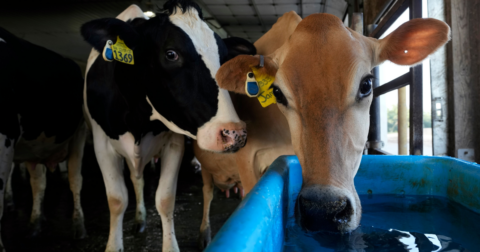
Meat and dairy from cattle alone account for 29% of carbon loss and 41% of biodiversity loss on agricultural land.
Researchers say that land use is responsible for much of this impact. Animal-sourced foods, excluding fish, comprise the majority (79%) of food-related agricultural land but provide less than 15% of humanity’s calories and just 37% of total protein.
When measured per calorie, animal-sourced foods often have much larger environmental footprints than plant-sourced foods. Animals require land to live on, to graze and to grow the crops used to feed them. Most crops in the world are grown using methods, like widespread monocultures and soil disturbance, that result in higher per-acre carbon and biodiversity losses than pasture for grazing, not that using land for grazing is environmentally harmless either.
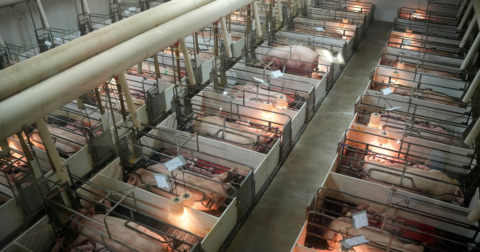
“Cattle meat is impactful because cattle just require so much land,” says Matthew Hayek, associate professor at New York University’s Department of Environmental Studies, who was not involved in the study. This is true whether the cattle are grazing on open grassland or packed in a factory farm eating feed that was grown on acres of cropland somewhere else. “Pigs and chickens still require a lot of cropland, because they can’t eat pasture,” he explains. “It takes multiple times more grams of protein to feed to a pig and chicken to get their protein than it takes to just consume those calories or that protein directly.”
The study also found that the environmental impacts of food production often occur far from the people eating that food. Through international trade, food can degrade the ecosystems in one region but ultimately be eaten on the other side of the world. The researchers found that Brazil is the largest net exporter of carbon and biodiversity loss, while China is the largest net importer.
But the study also offers a more nuanced perspective. The authors analyzed agricultural land at a much finer geographic scale than a country-level analysis, using data including global crop area maps, maps of rangelands and biomass and soil carbon data.
Carbon levels can vary significantly across biomes, countries and ecological regions. And within areas with similar carbon levels, the richness of biodiversity can vary, too. “So by drilling down into that resolution, they can better see where the actual trade-offs between carbon and biodiversity likely lie,” says Hayek.
This revealed historical and current hotspots of both carbon and biodiversity loss, which, according to Hayek, has not been done before.
The findings point to where potential interventions might have the greatest impact. Authors estimate that restoring half of these hotspots globally — more than 8.3 million square miles — could sequester carbon equivalent to 24 years of global fossil fuel emissions and potentially spare about 11% of species from extinction. These hotspots include large swaths of India, Southeast Asia and Brazil, among other areas.
Liu says the study is intended to provide a baseline for other scientists to analyze more specific land-use scenarios and the effects of changes in dietary patterns. Meanwhile, she hopes the findings can better inform decision-makers as climate mitigation increasingly enters policy discussions worldwide.
“This is very important information for the food system transition, so that we can target these high-impact products and high-impact regions, so that we can reorganize the global agricultural land use. This is a good opportunity,” says Liu.
“Climate change and biodiversity loss are interconnected, and we can do something on land use to benefit both,” she says.
The findings could also help bring the food system more directly into climate and biodiversity policy discussions. Historically, both climate and biodiversity mitigation plans have largely ignored the food system, says Hayek, and very few have united climate and biodiversity agendas, “despite the fact that the food system sits at the intersection of those two concerns.”
While the study focuses on global-level crises, both Liu and Hayek say it also provides a call to action for consumers: What you choose to eat matters.
“It’s personally empowering to know that your consumption decisions matter,” says Hayek. While only a small percentage of people decide what food is produced and how, “it’s the decision of everyone in that country to decide what to consume,” he says.
“Power is on our plates as consumers.”
Correction: The story was updated to reflect that the statistics “Meat and dairy from cattle alone account for 29% of carbon loss and 41% of biodiversity loss on agricultural land” were based on analysis of all agricultural land and did not exclude land used to grow non-food crops like biofuels and textiles.
Emily Payne is a journalist covering the intersection of food, agriculture, health and climate. Currently based in Denver, Colorado.
Feature
Climate•4 min read
News
Warming waters alter where fish and shellfish live, push them beyond what they can tolerate and increase risk of disease.
Climate•6 min read
News
Planetary emissions are already in a dangerous phase, scientists warn.
Climate•4 min read