Feature
Will British Columbia’s Wild Salmon Escape Aquaculture’s Disease Trap?
Fisheries & Aquaculture•4 min read
Investigation
JBS and Cargill plants across the country are accused of pressuring unions into either accepting the same low wage structure, or mere nickels apart. The result? The largest meatpacking strikes and lockouts in four decades.
Investigation • Food • Policy • Workers • Workers

Words by Grey Moran
Update: A few hours after this story’s publication on August 17, Cargill’s union members in Fort Morgan voted in favor of a new contract and will begin returning to their jobs in the coming weeks.
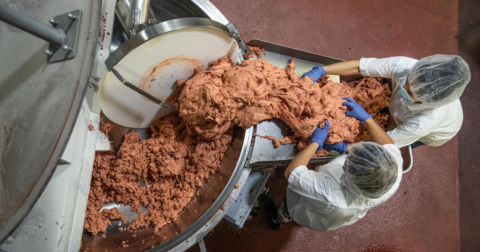
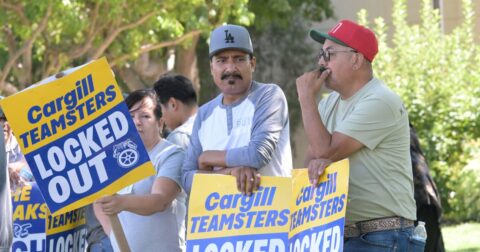
Cargill Meat Solutions rises from the flat plains of Fort Morgan, Colorado like a windowless fortress, guarded by a steep metal fence. The employee and visitor entrance is barricaded by large yellow blocks. The once constant procession of trucks, unloading cattle onto holding pens, or leaving the factory with vacuumed-sealed cuts of beef, has ground to a halt. The over 1,700 workers who made it all possible — the 24/7 production of meat, from slaughter to the conveyor belt — have been without jobs for nearly three months. After negotiations with the union failed, Cargill locked out its employees who are calling for a return to work.
This highly unusual, prolonged lockout comes in the quick aftermath of another major labor dispute with one of Cargill’s only competitors: JBS. In March, negotiations between a local union and JBS plant in Greeley, Colorado similarly unraveled, prompting over 3,800 workers to walk off their jobs. This was the first major meatpacking strike in four decades. And in April, union workers at another JBS meat processing plant in Denver authorized a strike, signaling that they are prepared to walk off their jobs if negotiations remain at an impasse.
What is driving these historic standoffs behind labor unions and major meatpacking companies? Union leaders suspect wage fixing.
In interviews with Sentient, union leaders questioned why JBS and Cargill pushed for nearly identical wage proposals, raising concerns about the world’s largest meatpackers conspiring to suppress wages, known as wage fixing, during recent, unusually tense contract negotiations in Colorado. It’s part of a broader pattern, union leaders allege, of meatpacking plants across the country pressuring unions into either accepting the same wage structure, or mere nickels apart.
“They can’t force you to take somebody else’s contract, and that’s what they essentially were doing,” says Kim Cordova, the president of the Unified Food and Commercial Workers Local 7, who led the JBS strike in Greeley. Although the strike was successful, she wants the federal government to examine what she claims is a much wider, coordinated effort to cap wages. “We want to show the government: ‘Look at the pattern here. This is them consolidating with each other to set a wage standard for the industry.”
A standardization of wages, across different labor markets, can be an indicator of collusion between companies to suppress wages, says Elena Prager, an applied microeconomist at the University of Rochester.
“If you get extremely similar levels or trends in wages across geographic markets, where presumably competition for workers is different. That is suspicious,” says Prager, who was not directly commenting on JBS or Cargill. “It’s not dispositive, as lawyers like to say. It’s not enough to know that there’s for sure collusion going on, but it’s the kind of thing that would make you look twice.”
Back in February, both JBS’s Greeley plant and Cargill’s Fort Morgan plant were in separate closed-door negotiations, with no public information shared about the offers on the table at either company. Yet Chris Suazo, a business agent for Teamsters Local 455, which represents Cargill’s meatpacking workers, alleges that JBS’s offer to workers in Greeley was leveraged as a cap in their negotiations.
“During our negotiations in February, the lead negotiator for the company, he essentially made comments like over and over and over about that they were not going to do more than JBS did,” Suazo alleges. “He said that we’re not going to put ourselves at a competitive disadvantage.”
This prompted the union to directly question how Bob McLauchlin, the negotiator on Cargill’s behalf, knew about the figures under discussion in JBS’s negotiations. “We just asked him to his face, ‘Well, what do you mean by that? How do you know what the JBS’s [deal] is?’” They never received a direct answer, according to Suazo.
Cargill denies this allegation. “We told the union that we were seeking a settlement that was market competitive and consistent with our other Cargill beef processing settlements,” writes Hli Yang, a spokesperson for the company, in an email to Sentient. “Cargill negotiates labor agreements independently and in good faith.” JBS and McLauchlin did not respond to a request for comment.
Throughout the long, tense negotiations process, Suazo says that Cargill was unusually inflexible. “It’s just their approach, their unwillingness to move,” he says. “We’ve never seen anything like it.” On May 20th, Cargill stopped negotiating entirely, locking workers out of the building. “A lockout of this magnitude is absolutely unheard of,” says Suazo. However, this could end soon as workers push to vote on the contract again.
Just before locking workers out, Cargill made an offer to Fort Morgan workers: a 70 cents hourly raise in the first year, followed by 40 cents, 40 cents, 30 cents and 35 cents, over the course of the five-year contract, according to Suazo. The proposal is strikingly similar to JBS’s new contract in Greeley, which includes a raise by 70 cents upon ratification, followed by 40 cents in July of the following two years.
“These workers here with Cargill, they’re locked out right now because they don’t want to accept that wage rate that has been set by JBS,” says Cordova, who is the first woman to lead UCFW Local 7 in its 150 year history.
UCFW Local 7 represents the workers at JBS’s plant in Greeley, who walked off their jobs for three weeks to fight for the wage structure in their new contract. Yet Cordova is quick to point out that a favorable agreement for her union isn’t necessarily right for other meatpacking workers at different plants, nor should it serve as a cap wielded to limit the wage of meatpacking workers at other plants and companies.
In a press release, UCFW Local 7 argues that this is industry wage-fixing.
“Cargill is insisting on a wage increase structure for Teamsters workers at its Fort Morgan plant directly tied to those recently negotiated between UFCW Local 7 and JBS for its own workers,” the union alleged in a press release from May 21st, just a day after Cargill shut its doors to workers pushing for higher pay.
The question of whether this amounts to wage fixing — the illegal practice where competing employers work together to control, set or cap employee wages — is ultimately decided by the courts. The Department of Justice, alongside the Federal Trade Commission, is responsible for investigating suspected violations of antitrust laws, including wage fixing.
“We’d like the government to intervene on this,” says Cordova, referring to meatpackers, like JBS and Cargill, offering nearly identical wage structures in recent union negotiations and contracts. “There is no one enforcing the Sherman Act in this country.”
A landmark antitrust law, the Sherman Act was passed in 1890 to curb the unchecked power of the Gilded Age monopolies, including by outlawing agreements, cartels and conspiracies that restrict competitive markets; courts have interpreted this as extending to labor markets and banning wage fixing. Yet there remains significant debate over what proof is needed to establish wage fixing in contract agreements.
“The question of what constitutes a contract combination or conspiracy under the Sherman Act is one of the most contested issues in conspiracy law because usually there’s no direct evidence of that agreement,” says Peter Carstensen, a professor of law at the University of Wisconsin-Madison Law School and a senior fellow at the American Antitrust Institute.
“Courts have struggled with this problem,” he adds. “How much overt communication does there have to be? How much overt statement of or recognition of an understanding?” (Given this complexity, Carstensen didn’t feel in a position to directly comment on the union agreements with JBS and Cargill.)
In the final days of the Biden administration, the Federal Trade Commission issued guidelines that laid out explicitly how it identifies anticompetitive labor practices — making it clear that antitrust enforcement has a duty to protect not only consumers, but workers, from monopolies.
“The Treasury Department estimated that labor market concentration accounts for a 20 percent decrease in wages,” said Lina Khan, former head of the FTC in a 2024 speech. “It is striking — shocking even — that America’s workers are making a fifth less than they should be in a more competitive, less consolidated economy.”
The beef industry is one of the most profound examples of industry concentration: just four firms, Tyson, JBS, Cargill and National Beef, control 85 percent of beef production. Cordova of UFCW Local 7, which represents 23,000 workers across Colorado and Wyoming, would like to see federal regulators take steps that crack down on anti-competitive behavior in the meat industry.
“The only thing that will resolve this is they need to break up the Big Four,” says Cordova, referring to the four largest meatpackers. “They have so much market consolidation that these meat processing corporations that they can just work together to keep the employee pay artificially low.”
The high-profile labor disputes in Colorado are part of a broader pattern, union leaders allege, of meatpacking plants pushing for nearly identical wages structures in union negotiations across the country. Cordova traces this wage structure back to an agreement between UFCW International and 14 JBS plants that was ratified in May of 2025. This agreement represented a victory, in many ways, including the first pension fund for meatpackers since 1986. Yet she also argues that it has been wielded in separate negotiations with plants outside of this framework to cap wages.
“[JBS] reached an agreement with these other locals, thinking that they have the right to force it down the other locals that didn’t agree,” says Cordova. “They can’t do that. That’s a violation of labor law. They have to bargain separately with us, and they were not going to move.”
Case in point: Cordova claims that the wage structure in this agreement — which includes a 60 cents raise in the first year, followed by 30 cents, 30 cents and 35 cents, with contract lengths differing at each plant — was pushed by JBS negotiators at the plant in Greeley, and it was JBS’s insistence on these terms that caused the negotiations to stall and prompted the strike. It was only after the strike that JBS agreed to raise this offer by 10 cents per wage increase, over two years.
“That’s what they were trying to force down our throats,” says Cordova. “We weren’t part of what they frame as the ‘national agreement,’ and every local [UFCW union] negotiates separately. And it just didn’t work here,” she says, adding that “the cost of living in Colorado is so high here that those small wage increases just were not going to be doable for us.”
JBS has publicly acknowledged that they were basing their contract offer to workers in Greeley on this national framework. “The JBS offer aligns with our 2025 agreement reached with UFCW International and includes higher wages, improved benefits, and a historic pension plan,” the company stated in a Facebook post.
Cordova claims that the offer is setting an industry-wide standard, including at Cargill plants. For instance, in late April of 2025, a month prior to JBS ratifying the national framework, a Cargill plant in Friona, Texas inked a five-year contract with a local UFCW union, resulting in raises each year by 60 cents, 30 cents, 30 cents, 45 cents and 50 cents, mirroring the wage structure in the national framework.
“Friona, Texas and Schuyler, Nebraska both had contentious negotiations and they agreed to contracts…I’m talking within nickels of each other,” says Suazo, referring to separate Cargill plants. “These contracts that the company is trying to force down the membership are within nickels of each other, and the length of term is relatively close as well. So there’s definitely something going on.”
JBS’s national framework in some ways harkens back to an earlier time in the meat industry. “Between about 1945 and 1980, unions and companies in the meatpacking industry generally organized wagering around master agreements. Master agreement was a single contract that was signed by all the locals in the plants of the particular firm,” says Roger Horowitz, a labor historian who has extensively chronicled the history of meatpacking unions in the U.S.
Multi-plant agreements are generally thought to benefit workers, giving them more labor power through numbers, yet that’s not always the case — and in fact, it can end up undermining the power of local unions, says Horowitz.
“There is a way of sort of perverting this, in which the company and the union agree on a lower wage through a lot of plants,” says Horowitz. But then the company could then try to “impose that on the stronger unions that have negotiated a better agreement in their plans.”
JBS’s national agreement also differs from the master agreements previously common in the meat industry in a key way: it has different expiration dates for each plant, undermining the unified striking power of a multi-plant agreement.
“It’s not effectively a national agreement if the expiration dates vary from plant to plant,” wrote Horowitz, in an email to Sentient. “The whole point of a national agreement is to maximize the union’s power to shut down an entire company’s operations.”
At Denver Processing, a JBS-owned meat processing plant, negotiations have reached a familiar impasse. “The same offer that they’re offering around the country – that’s on the table now for this meat cutting plant,” says Cordova. ”They keep walking away from the table. They’re refusing to answer any of our requests for information, and they haven’t bargained with any authority.” The union has yet to call a strike, though it has received the backing of its worker members to make this call.
Differing from a meatpacking plant, Denver Processing is a case-ready beef and pork plant, where workers slice and package meat sold in grocery stores. She is worried that this indicates that this wage structure will spread beyond meatpackers.
“This will set a pattern now for retail meat cutters across the country, just like it did for the meatpackers. It’s a totally different industry,” she says.
Cordova anticipates that there will be more labor disputes to come across the meat processing industry. “We took the first strike, and I think you’re going to start seeing a wave of workers mobilizing,” she says. At the same time, she anticipates some unions will end up conceding to these terms.
The Greeley strike showed another way forward: it’s possible for union workers to push back against this wage structure and win. Yet Cordova thinks this will be a short-lived victory. She anticipates there will be another clash with JBS following the expiration of the new contract in April of 2028.
“We’re going to have a fight again in a year and a half,” she says, “Because they’re going to insist on paying these low wages through the industry and this is some of the most dangerous and hard work.”
Update: This story has been updated to include a response from Cargill.
Correction: In the original version of this story, it was reported in the second paragraph, “In March, negotiations between a local union and JBS plant in Denver, Colorado similarly unraveled, prompting over 3,000 workers to walk off their jobs.” This should have said Greeley, Colorado and 3,800 workers.
Grey is an award-winning investigative journalist with Sentient who is based in Durham, North Carolina. They have written for Civil Eats, The Guardian, The Atlantic, The New Republic, Al Jazeera, The New York Times, The Intercept, Guernica, The Nation, New York Magazine, Popular Science, Mother Jones, The American Prospect, Teen Vogue, Grist, Autostraddle and The Center for Public Integrity. Their articles have been anthologized in No Planet B, published by Haymarket Books, and The Best American Food Writing, edited by Mark Bittman.

Solutions
Farms•7 min read
Feature
Fewer than 15% of veterinary school graduates are opting to care for farm animals.
Food•6 min read
Feature
3,700 federally protected wild horses were sold in 2025, and a new investigation reveals some end up at the slaughterhouse.
Food•7 min read