News
Inside Big Beef’s ‘90s Campaign to Rewrite Its Climate Story
Big Meat•6 min read
Explainer
It all comes down to burps and land.

Words by Björn Ólafsson
It’s no longer news that eating meat — especially beef — is bad for the planet. But do you know why beef comes with such a steep climate emissions cost? In total, food systems account for around a third of all emissions, with 57% of food-related emissions coming from meat.
At least one study has also found that tackling food-related emissions is critical for mitigating the effects of climate change. Two major climate-food studies published in 2018 urged citizens in the Global North to cut back on beef, along with other recommendations. Though beef consumption has been on the decline in the U.S., Americans still eat far more than the global average — around 13.82 million tons a year.
But why exactly is beef so high in emissions? It ultimately comes down to two things: methane emissions from cattle burps and land use.
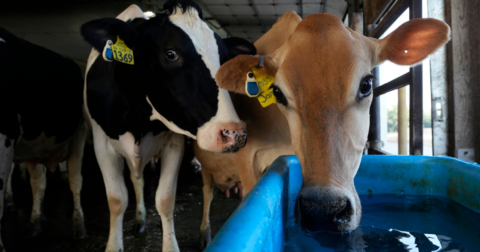
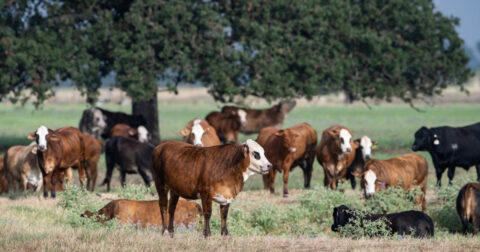
Cows belong to a category of animals called ‘ruminants.’ Under the suborder Ruminantia, this category also includes creatures like goats, sheep, giraffes, deer and buffalo. Ruminants eat grass, have hooves and — here’s the important point for climate emissions — have four compartments in their stomachs in which to digest their food.
Inside these compartments is where the magic happens. The grass goes into the rumen, the first stomach compartment, where it ferments the food to begin breaking it down. After a while, the cow partially regurgitates the food, now called cud, and then chews it even more, which hastens the cellular breakdown. The food then flows into the other three stomach compartments where it is digested through microorganisms.
This is great news for the cow — the process of enteric fermentation enables ruminants to eat all sorts of roughage that humans couldn’t ever (or at least wouldn’t ever want to) digest. But, here’s the kicker, the process also creates a harmful byproduct called methane.
Methane is an exceptionally potent greenhouse gas, having 80 times the warming power in the first twenty years of its release into the atmosphere as compared to carbon dioxide. Methane disperses or breaks down faster than carbon dioxide, but it also does more damage while it’s here.
Cows, because of their distinct biology, produce a lot of this dangerous methane when they digest their food. A single cow can produce up to 500 liters of methane a day. The ranching industry breeds as many as 1.5 billion cows per year, and methane emissions from cattle are a major contributor to global emissions. In fact, methane is the second most abundant greenhouse gas found in the atmosphere, and 40% of all methane comes from agricultural sources, with livestock production directly responsible for 32%.
The good news is that the properties of methane — its relatively short span of existence in the atmosphere as compared to CO2 — also offer up a powerful opportunity for climate action. If we drastically reduce our methane emissions, we will start seeing the benefits in terms of drawing down emissions right away, and that buys us time to bring down more stubborn areas of climate pollution. One way to do that is to cut back on beef.
It’s also important to understand the other part of beef production that drives climate pollution: land use.
A whopping 77% of global farmland goes to raise livestock. Per gram of protein, beef and lamb require more land than any other protein to produce, according to analysis from Our World in Data.
The problem is we don’t have unlimited farmland, but we’re acting like we do. As the Earth’s population goes up, farmers end up expanding their operations in order to produce more food. Between 2000 and 2019, global farmland expanded by 9%, according to reporting in Science magazine. And when that expansion takes place in tropical rainforests and grasslands — which is exactly where it’s happening most often — the climate cost is especially painful.
Let’s dig into why. Wild landscapes like the Chiquitano rainforest and the Cerrado in Brazil are important carbon storage reservoirs, places where the earth sequesters or stores carbon, keeping it out of the atmosphere. In other words, these wild landscapes are kind of like built-in climate solutions — that’s why they’re often called nature-based climate solutions.
So, when we deforest a wild landscape, there are a couple of emissions to consider. First, the land releases the carbon that it was storing but there’s another loss too. Every year after that, that piece of deforested land has now lost its carbon-storing abilities.
Big picture: emissions keep going up but, thanks to that deforestation, we can no longer count on the carbon-storing offset of the land we’ve now turned into a farm or a ranch. Called the carbon opportunity cost by researchers, that loss makes the emissions associated with beef even higher.

On the other hand, the potential to reverse that land loss is also pretty massive. Consider the following, albeit unlikely, scenario: if the whole world switched from animal-based agriculture to plant-based agriculture, this shift would free up more than 3 billion hectares. To put that number into perspective, that’s the size of Brazil, Mexico, Canada and the entire United States, combined.
Though not all of this land could be converted into plant-based agriculture suitable for humans, only a small portion would be needed to grow food for humans. The rest could be rewilded in order to store carbon — not to mention serve as habitat for biodiverse species. According to a 2022 study, if wealthy nations switched from animal-based to plant-based, they’d reduce their emissions by over 60% and sequester almost 100 gigatons of carbon emissions.
Research measuring the efficacy of different climate actions has shown one of the most powerful forms of climate action is reducing meat consumption, especially beef, in favor of a more plant-rich diet. According to analysis from Project Drawdown, this type of dietary shift, along with curbing food waste, could reduce 12.4% of global emissions.
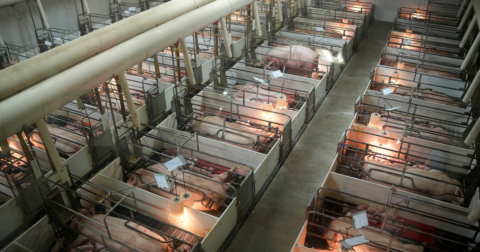
Beyond beef and climate emissions, factory farms are responsible for other impacts too, including increasing the risk and likelihood of pandemics and fueling antibiotic use. In addition, the vast majority of farm animals are raised on factory farms, where animals, especially chickens and pigs, experience poor animal welfare.
This piece has been updated.
Björn Jóhann Ólafsson is a science writer and journalist who cares deeply about understanding the natural world and her inhabitants through stories and data. He reports on the environmental footprint of the meat industry, the alternative protein sector and cultural attitudes around food. His previous bylines include the EU Observer and Elemental. He lives in Spain with his two lovebirds.
News
Climate•4 min read

Solutions
A new report from the World Resources Institute on its Coolfood pledge initiative observes progress and challenges in curbing cafeteria emissions.
Climate•6 min read
Feature
But no matter the way it’s raised, beef comes with a steep climate cost.
Climate•4 min read